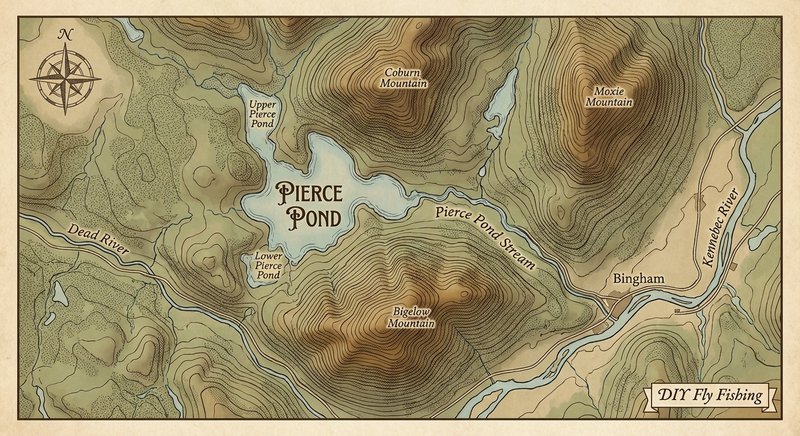
Pierce Pond
Fly fishing in Maine · Intermediate · Best seasons: Summer, Fall
Target Species
Brook Trout
About This Water
Somerset County pond with brook trout. Fly fishing only with excellent hatches.
Fishing Recommendations
Welcome to the Maine North Woods. As your guide, I can tell you that Pierce Pond is whispered about in hushed tones by New England fly anglers. It is one of the most storied "Fly Fishing Only" waters in the United States, representing the pinnacle of the classic Maine wilderness experience.
Here is your comprehensive guide to fishing Pierce Pond.
🎣 Location Overview
Located in Somerset County, west of the Kennebec River and the town of Caratunk, Pierce Pond is a 1,650-acre gem nestled in a rugged, mountainous landscape. It is actually a chain of ponds, but the "Main Pond" is where the legend resides.
What makes Pierce Pond special is its extraordinary water clarity and its status as a "cold water factory." It is deep, oxygenated, and stays cool even when other Maine ponds warm up. The scenery is quintessential Maine: granite boulders, dense spruce and fir forests, and the haunting call of loons. It offers a rare opportunity to catch trophy-sized, wild-strain Brook Trout in a setting that has changed little in a century.
🐟 Target Species & Behavior
While the pond holds Landlocked Salmon and Lake Trout (Togue), the Brook Trout are the stars.
- Behavior: These are "cruising" fish. Because the water is so clear, they are highly visual predators. In the summer, they retreat to the "spring holes" and deeper thermoclines, but they will rise for major hatches. In the fall, they become aggressive and territorial as they prepare to spawn, moving toward the shorelines and the pond's many rocky reefs.
- Diet: The engine of the Pierce Pond ecosystem is the Smelt. The biggest Brookies here act like mini-tuna, chasing schools of smelt in open water. They also feed heavily on Hexagenia limbata (Mayflies), caddis, and terrestrial insects blown from the thick forest canopy.
📅 Best Times to Fish
Summer (July – August)
- The Window: This is all about the "Hex Hatch." Usually peaking in late June through mid-July, this is your best chance at a 3–5 lb Brookie on a dry fly at dusk.
- Time of Day: Early morning (before the sun hits the water) and the "witching hour" (30 minutes before and after sunset). Mid-day fishing in summer usually requires sinking lines in 20–30 feet of water.
Fall (September – September 30th)
- The Window: September is prime time. As water temperatures drop, the fish move into the shallows.
- Time of Day: You can fish all day in the fall. Overcast, drizzly "trout weather" days are the most productive.
- Conditions: Look for "the chop." A slight breeze on the surface breaks up the fish's window, making them less spooky in the crystal-clear water.
🪰 Recommended Flies & Techniques
Dry Flies (The Surface Game)
- Hexagenia Patterns (Size 6-8): During the hatch, use a Floating Hex or a Michigan Gamecock.
- Goddard Caddis (Size 10-14): Great for skittering across the surface to trigger an aggressive strike.
- Terrestrials: Large Black Ants and foam Beetles are deadly along the shoreline in August and September.
Streamers (The Smelt Connection)
In Maine, streamers are king. Trolling or casting these is the most consistent way to find big fish.
- Grey Ghost / Black Ghost: Classic Maine patterns that mimic smelt.
- Joe’s Smelt: A local favorite for Pierce Pond.
- Muddler Minnow: Fished on a sink-tip line to mimic sculpins or bottom-dwelling baitfish.
Techniques
- The "Pierce Pond Twitch": When fishing streamers, use a fast, erratic strip. These fish are used to chasing fast-moving smelt.
- Long Leaders: Because the water is so clear, use 12-foot to 15-foot leaders tapered to 4X or 5X for dry flies. For streamers, 9-foot 3X is usually sufficient.
- Stillwater Nymphing: During the day, hanging a Pheasant Tail or Hare’s Ear nymph 4–6 feet under a small indicator near drop-offs can be surprisingly effective.
💡 Pro Tips & Local Knowledge
- Focus on the Inlets and Outlets: Areas where water moves, such as near the "Dead Diamond" or the thoroughfares between the ponds, hold fish year-round.
- The "Cobb’s" Influence: Cobb’s Pierce Pond Camps has been the steward of this water since 1904. Even if you aren't staying there, their influence on the "fly-only" culture is why the fishing remains world-class.
- Watch the Loons: If you see loons diving repeatedly in one area, they are on a school of smelt. The Brookies are almost certainly underneath them.
- Structure is Key: Look for "boulder gardens"—large submerged rocks. Brook trout love to tuck into the shadows of these rocks and dart out to grab passing prey.
⚠️ Important Information
- Access: This is a remote area. Access is primarily via the Northwest Carry (private logging roads). Be prepared for gravel roads; a high-clearance vehicle and a full-sized spare tire are highly recommended.
- Regulations: Pierce Pond is Fly Fishing Only (FFO). Maine Department of Inland Fisheries & Wildlife (MDIFW) regulations are strict here. Always check the current lawbook for length limits and bag limits, though most anglers here practice 100% Catch and Release to preserve the trophy quality.
- Safety: Cell service is non-existent. Bring a satellite communication device (like a Garmin inReach) and plenty of bug spray—the Maine black flies and mosquitoes are legendary.
- Boats: While there are some shore-casting spots, you really need a canoe or a small motorboat (there are horsepower restrictions) to fish the pond effectively.
Tight lines, and enjoy one of the last great wild places in the East!
Bug Hatches & Matching Flies
| Hatch | Type | Peak months | Time of day | Hook sizes | Matching flies |
|---|---|---|---|---|---|
| Hexagenia (The Hex) Hexagenia limbata | mayfly | June, July | Dusk/Night | #6-10 | Hexagenia Paradun #6-8, Wiggle Hex Nymph #8-10, Hexagenia Spinner #6-8 |
| Hendrickson Ephemerella subvaria | mayfly | May, June | Afternoon | #12-14 | Red Quill #12-14, Hendrickson Emerger #12-14, Pheasant Tail Nymph #12-14 |
| Spotted Sedge Hydropsyche | caddis | June, July, August | Evening | #14-18 | Elk Hair Caddis (Tan) #14-16, LaFontaine's Deep Sparkle Pupa #14-16, Iris Caddis #16 |
| Chironomids (Midges) Chironomidae | midge | May, June, September | All Day | #18-24 | Zebra Midge #18-22, Griffith's Gnat #20-22, Ice Bud Midge #18-20 |
| Pale Evening Dun Ephemerella invaria | mayfly | June, July | Evening | #14-16 | Light Cahill #14-16, Sulfur Parachute #16, Hare's Ear Nymph #14-16 |
| Blue-Winged Olive (BWO) Baetis | mayfly | May, September, October | Afternoon | #18-22 | BWO Parachute #18-22, RS2 #20-22, WD-40 #20-22 |
| March Brown Maccaffertium vicarium | mayfly | June | Afternoon | #10-12 | March Brown American #10-12, Gold Ribbed Hare's Ear #10-12, March Brown Wet Fly #12 |
| Flying Ants Formicidae | terrestrial | August, September | Afternoon | #16-20 | Black Flying Ant #16-18, Cinnamon Ant #18-20, Chernobyl Ant #12-14 |