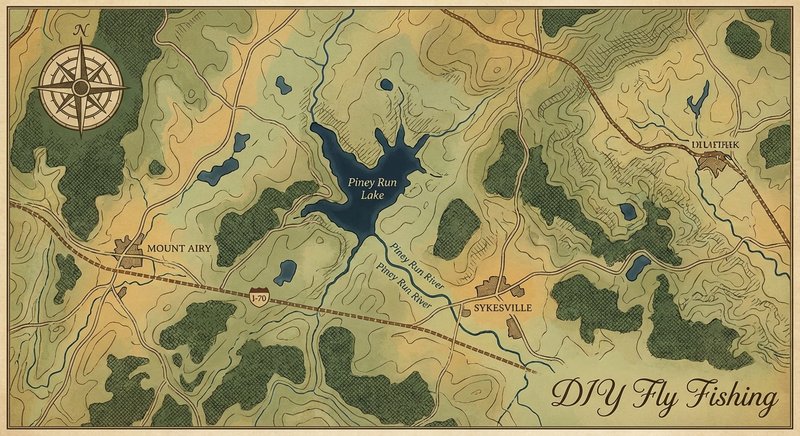
Piney Run Lake
Fly fishing in Maryland · Intermediate · Best seasons: Spring, Summer, Fall
Target Species
Largemouth Bass, Tiger Musky, Crappie
About This Water
Carroll County reservoir with excellent bass fishing. Electric motors only.
Fishing Recommendations
As an expert guide who has spent many seasons navigating the transition from the rolling hills of the Piedmont to the reservoirs of Maryland, I can tell you that Piney Run Lake is a hidden gem for the warm-water fly angler. Located in Carroll County, this 300-acre reservoir is one of the most well-managed fisheries in the state, offering a "big water" feel with the quiet accessibility of a local park.
Here is your comprehensive guide to fly fishing Piney Run Lake.
🎣 Location Overview
Piney Run Lake is the centerpiece of Piney Run Park in Sykesville, Maryland. What makes it special for the fly angler is the "No Internal Combustion" rule. Only electric trolling motors are allowed, which means the water remains quiet, the fish are less pressured by engine noise, and kayak or drift-boat fly fishing is incredibly peaceful.
The lake is characterized by its clear-to-stained water, significant underwater structure (including old roadbeds and submerged timber), and lush aquatic vegetation. With depths reaching up to 50 feet near the dam but featuring expansive 5-to-10-foot flats, it provides a diverse "top-to-bottom" fly fishing experience.
🐟 Target Species & Behavior
Largemouth Bass
Piney Run is famous for its "fat" bass. These fish grow heavy on a diet of bluegill and gizzard shad.
- Behavior: In the spring, they hug the shorelines and fallen logs. During the summer heat, they retreat to the weed edges and submerged "islands" or roadbeds.
- Feeding: They are opportunistic but can be "leader shy" in the clearer sections of the lake.
Tiger Musky
The "Fish of Ten Thousand Casts" lives here. These are sterile hybrids (Northern Pike x Muskellunge) stocked by the DNR.
- Behavior: Ambush predators. They prefer "transition zones"—where a shallow flat suddenly drops into deep water.
- Feeding: They want a large meal. They often follow a fly all the way to the boat without striking, requiring a "Figure-8" maneuver.
Crappie
Piney Run boasts a massive population of "slabs."
- Behavior: They are school-oriented. In the spring, they move into the shallows near the fishing piers and fallen brush. In the summer/fall, they suspend over deep structure.
- Feeding: Small minnows and insects.
📅 Best Times to Fish
- Spring (April – June): This is the prime window. April is peak for Crappie. May is the best month for Largemouth Bass as they move into the shallows to spawn.
- Summer (July – August): Focus on the "Golden Hours." Be on the water at sunrise. By 10:00 AM, the bass move deep. Summer evenings are excellent for topwater poppers along the lily pads.
- Fall (September – November): As water temperatures drop, Tiger Musky become most active. October is the "trophy month" for Musky and big Bass feeding up for winter.
- Optimal Conditions: Overcast, slightly breezy days are best. The "chop" on the water helps hide your fly line shadow, which is crucial in this lake's clarity.
🪰 Recommended Flies & Techniques
For Largemouth Bass
- Patterns: BoogleBugs (size 4) in yellow or green for topwater; Gamechangers (white/shad) for subsurface; Murdich Minnows.
- Technique: Use a 7-weight rod with a weight-forward floating line. Cast into the "pockets" of the lily pads. Give the popper a long pause—often the strike comes when the fly is sitting perfectly still.
For Tiger Musky
- Patterns: Double Bunnies or Buford-style streamers (8–10 inches long) in orange/black or "perch" patterns.
- Technique: You need a 9 or 10-weight rod and wire tippet. Use a sinking-tip line to get the fly down 5–10 feet. Strip fast and aggressively, and always finish with a Figure-8 at the side of the boat.
For Crappie
- Patterns: Woolly Buggers (size 8-10) in white or chartreuse; Micro-Clouser Minnows.
- Technique: Use a 3 or 4-weight rod. A slow, rhythmic strip-strip-pause near submerged brush piles is lethal.
💡 Pro Tips & Local Knowledge
- The "Dead Forest": There are areas of the lake with standing submerged timber. If you can navigate your kayak into these "stump fields," you’ll find the biggest bass. Use a weedless fly pattern here, or you'll spend all day snagged.
- The Dam Breast: The deepest water is near the dam. In the heat of July, try a heavy sinking line and a white streamer to mimic shad. Large predators often hang out here to stay cool.
- Rent a Boat: If you don't have a boat, the park office rents rowboats. This is much more effective than fishing from the bank, as the best structure is out of casting reach from the shore.
- Stealth Matters: Because of the electric-only rule, the lake is quiet. Don't bang your oars or drop heavy gear in the boat. The big Piney Run bass are wary.
⚠️ Important Information
- Access: Entry is via Piney Run Park (Martz Rd, Sykesville). There is a daily park entrance fee for vehicles (higher for non-residents of Carroll County).
- Seasonality: The park is generally open from March 1st through November 30th. It is closed during the winter months.
- Permits: You must have a valid Maryland Non-Tidal Fishing License.
- Regulations:
- Tiger Musky: Maryland has specific size limits (usually 36 inches minimum), but most local fly anglers practice 100% Catch and Release for Muskies to maintain the trophy fishery.
- Electric Only: Do not bring a gas motor; you aren't even allowed to have one on the transom of your boat (even if it's tilted up).
Guide’s Final Word: Piney Run is a "quality over quantity" lake. You might not catch 50 fish a day, but the ones you do catch will be healthy, hard-fighting, and beautiful. Bring your 7-weight, some olive poppers, and keep your eyes peeled for the shadow of a Tiger Musky!
Bug Hatches & Matching Flies
| Hatch | Type | Peak months | Time of day | Hook sizes | Matching flies |
|---|---|---|---|---|---|
| Chironomids (Midges) Chironomidae | midge | March, April, October | All Day | #18-24 | Zebra Midge #18-22, Griffith's Gnat #20-24, Chan's Chironomid #16-18 |
| Speckled Spinner / Speckled Dun Callibaetis | mayfly | May, June, September | Morning | #14-16 | Callibaetis Nymph #14-16, Parachute Adams #14-16, Callibaetis Spinner #16 |
| Damselfly Enallagma / Ischnura | terrestrial | June, July | Late Morning/Afternoon | #10-14 | Marabou Damselfly Nymph #10-12, Adult Damsel #12, Blue Foam Damsel #12 |
| Dragonfly Anisoptera | terrestrial | June, July, August | Afternoon | #4-10 | Dragonfly Nymph #6-8, Adult Dragon #6-10, Woolly Bugger (Olive) #4-8 |
| Black Carpenter Ant Camponotus pennsylvanicus | terrestrial | July, August, September | Afternoon/Evening | #12-18 | Black Foam Ant #14-18, Chernobyl Ant #10-12, Fur Ant #16-18 |
| Japanese Beetle Popillia japonica | terrestrial | July, August | Afternoon | #12-14 | Foam Beetle (Green/Copper) #12-14, Coffee's Sparkle Beetle #14 |
| Blue-Winged Olive Baetis | mayfly | April, October | Afternoon (Overcast) | #18-22 | BWO Sparkle Dun #20-22, RS2 #18-22, Pheasant Tail #18-20 |
| Grasshopper Acrididae | terrestrial | August, September | Midday | #8-12 | Dave's Hopper #10-12, Hopper Juan #8-12, Letort Hopper #12 |