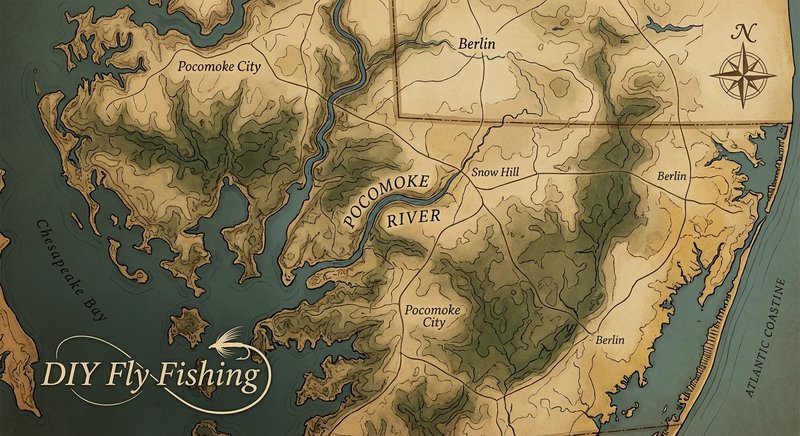
Pocomoke River
Fly fishing in Maryland · Intermediate · Best seasons: Spring, Summer, Fall
Target Species
Largemouth Bass, Chain Pickerel, Crappie
About This Water
Cypress swamp river on Eastern Shore. Unique fishing environment with bass and pickerel.
Fishing Recommendations
The Pocomoke River on Maryland's Eastern Shore is one of the most unique and hauntingly beautiful fly fishing destinations in the Mid-Atlantic. Known as a "blackwater" river, its dark, tannin-stained waters wind through the northernmost stands of Bald Cypress trees in the United States.
As your guide, I can tell you that fishing the Pocomoke feels like stepping back in time. It is primordial, quiet, and offers some of the best cypress-swamp fly fishing outside of the Deep South.
🎣 Location Overview
The Pocomoke is characterized by its tea-colored water, caused by the tannic acid leaching from the surrounding cypress swamps. Despite the dark color, the water is clean and supports a thriving ecosystem.
- The Character: It is a narrow, slow-moving river with extreme depth in some sections (reaching up to 45 feet) despite its narrow width.
- The Environment: You’ll be casting amongst ancient cypress "knees," fallen timber, and massive lily pad fields (spatterdock).
- The Draw: For the fly angler, it offers a technical challenge—navigating tight quarters and heavy structure—with the reward of aggressive strikes from fish that use the dark water to hide.
🐟 Target Species & Behavior
Largemouth Bass
The Pocomoke bass are "structure-oriented" to the extreme. Because the river is tidal, they move with the water levels.
- Behavior: On high tides, they push deep into the cypress roots and flooded timber where they are hard to reach. On falling tides, they move to the edges of the wood and lily pads to ambush bait being flushed out.
- Diet: Golden shiners, crayfish, frogs, and juvenile panfish.
Chain Pickerel
Known locally as "Federals" or "Pike," these are the wolves of the swamp.
- Behavior: They love the vegetation. Look for them in the spatterdock fields or hovering near submerged logs. They are highly aggressive and will often follow a fly right to the boat.
- Diet: Anything that moves. They are particularly fond of flashy, silver-colored baitfish.
Crappie
The Pocomoke holds "slabs"—massive crappie that thrive in the deep, woody cover.
- Behavior: They school up around bridge pilings, fallen "lay-downs," and docks. They prefer vertical structure.
- Diet: Small minnows and grass shrimp.
📅 Best Times to Fish
Optimal Seasons
- Spring (April – May): Prime time. Pre-spawn bass are aggressive, and crappie are in the shallows. Pickerel are recovering from their winter spawn and are ravenous.
- Summer (June – August): Early morning and late evening are mandatory. The mid-day heat sends fish deep. This is the best time for topwater "frog" action.
- Fall (September – November): My favorite time. As the water cools, the bass feed heavily for winter. The colors of the cypress trees turning bronze are spectacular.
The Tidal Factor
The Pocomoke is tidal. This is more important than the time of day.
- Best Window: The last two hours of the falling tide and the first hour of the rising tide. This pulls the fish out of the inaccessible swamp and onto the "edges" where you can reach them with a fly.
🪰 Recommended Flies & Techniques
Top Fly Patterns
- For Bass:
- BoogleBugs or Poppers (Size 4): In black, chartreuse, or white.
- Dahlberg Divers: Excellent for "swimming" over cypress knees.
- Gamechangers: In "Eastern Shore" colors (Gold/Orange or Black/Blue).
- For Pickerel:
- Enrico Puglisi (EP) Minnows: Silver/White with lots of flash.
- Clouser Minnows: Chartreuse/White with lead eyes to get deep.
- For Crappie:
- Woolly Buggers (Size 8-10): In white, pink, or chartreuse.
- Micro-Jig Flies: Under a small strike indicator.
Techniques & Presentation
- Pound the Wood: You must get your fly within inches of the cypress knees. If you aren't hitting the wood, you aren't in the strike zone.
- The "Twitch and Sit": When using topwater, cast to a log, let the rings disappear, and give it one small twitch. Bass often hit on the dead pause.
- The Strip-Set: Because of the woody cover, you need to use a heavy tippet (12lb–20lb) and a hard strip-set to keep the fish from immediately wrapping you around a root.
💡 Pro Tips & Local Knowledge
- Color Matters: In the dark "Coke-colored" water, visibility is low. Use high-contrast colors. Black and Blue or Solid Chartreuse are the "pro secrets" for the Pocomoke.
- The "Shad Landing" Stretch: Focus your efforts between Snow Hill and Shad Landing (Pocomoke River State Park). This stretch has the best density of cypress and structure.
- Don't Forget the Wire: Pickerel have razor-sharp teeth. If you are targeting them, use a 6-inch piece of 15lb multi-strand wire or a very heavy fluorocarbon bite tippet (30lb+).
- Stealth: The river is quiet. Using a push-pole or a quiet electric motor is better than a loud outboard. Kayaks are arguably the best way to fish this water.
⚠️ Important Information
Access Information
- Byrd Park (Snow Hill): Excellent public ramp and floating docks for easy launching.
- Pocomoke River State Park (Shad Landing): Great facility with rentals, ramps, and camping.
- Milburn Landing: Located on the opposite side of the river, offering a more remote feel.
Regulations & Permits
- A Maryland Non-Tidal (Freshwater) Fishing License is required for the upper reaches.
- Note the "Tidal/Non-Tidal" line. Below the bridge in Snow Hill is generally considered tidal, but a freshwater license covers you for the primary target species throughout this stretch.
- Catch and Release: While there are keeper limits, most fly anglers practice catch and release to preserve the trophy bass and pickerel populations in this fragile ecosystem.
Special Considerations
- Safety: The water is dark and masks submerged logs. If you are motoring, go slow.
- Wildlife: Keep an eye out for Bald Eagles and River Otters, which are common here.
- Insects: In Summer, the biting flies and mosquitoes can be intense in the swamp. Bring heavy-duty repellent or wear long sleeves.
Bug Hatches & Matching Flies
| Hatch | Type | Peak months | Time of day | Hook sizes | Matching flies |
|---|---|---|---|---|---|
| Giant Mayfly (Hex) Hexagenia limbata | mayfly | June, July | Dusk/Evening | #6-10 | Hexagenia Dry #6-8, Burrowing Mayfly Nymph #8-10 |
| White Miller Nectopsyche | caddis | July, August | Evening | #12-16 | White Miller Caddis #14-16, White Elk Hair Caddis #12-14 |
| Blue-Winged Olive Baetis | mayfly | March, April, October, November | Late Morning/Afternoon | #18-22 | BWO Sparkle Dun #18-20, Pheasant Tail #18-22 |
| Blue Damselfly Enallagma | terrestrial | June, July, August | All Day | #10-14 | Adult Damsel #10-12, Marabou Damsel Nymph #12-14 |
| Green Darner Dragonfly Anax junius | terrestrial | July, August | Afternoon | #4-8 | Dragonfly Nymph #6-8, Deer Hair Dragonfly #6 |
| Carpenter Ant Camponotus | terrestrial | May, June | Afternoon | #12-16 | Black Foam Ant #12-14, Cinnamon Ant #16 |
| Japanese Beetle Popillia japonica | terrestrial | July, August | All Day | #10-14 | Foam Beetle #12-14, Coffee's Sparkle Beetle #12 |
| Blood Midge Chironomus plumosus | midge | April, May, September | Anytime/Evening | #16-22 | San Juan Worm (Small) #16-18, Zebra Midge #18-20 |