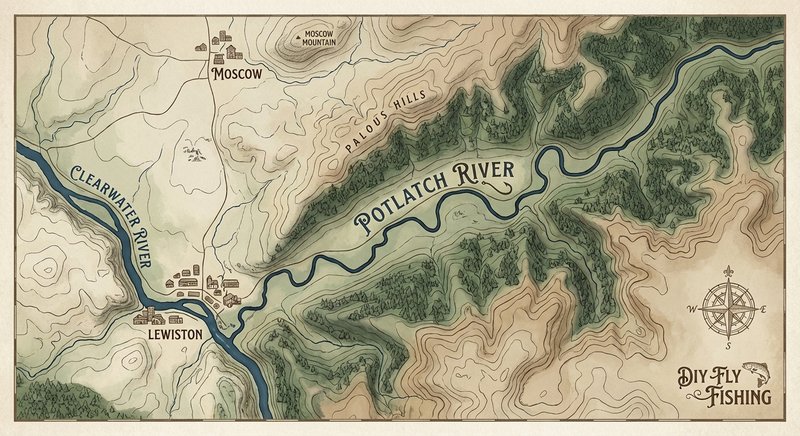
Potlatch River
Fly fishing in Idaho · Intermediate · Best seasons: Fall, Winter
Target Species
Steelhead
About This Water
North-central Idaho stream with steelhead runs. Less crowded than major rivers.
Fishing Recommendations
As an expert fly fishing guide who has spent years navigating the basalt canyons and timbered draws of the Inland Northwest, I can tell you that the Potlatch River is a hidden gem for the angler who values solitude and "small water" steelheading.
While the Clearwater River gets all the glory, the Potlatch is where local sticks go when they want to escape the jet boats and test their skills in an intimate, rugged environment.
🎣 Location Overview
The Potlatch River is a major tributary of the lower Clearwater River. Unlike the mainstem Clearwater, which is a massive, daunting piece of water, the Potlatch is a mid-sized to small stream characterized by dramatic basalt cliffs, riffle-pool sequences, and heavy pocket water.
What makes it special is the A-Run Steelhead that migrate here. These fish are typically smaller and more athletic than the "B-Run" giants of the mainstem, but they are incredibly aggressive. Fishing here feels more like trout fishing for 5- to 10-pound chrome bright ghosts. It is wild, scenic, and requires a high level of technical wading.
🐟 Target Species & Behavior
The primary draw is the Wild Clearwater A-Run Steelhead.
- Behavior: These fish are opportunistic. Because the Potlatch is smaller and shallower than the Clearwater, the fish are often more "spooky." They use the heavy basalt boulders as "buckets" to rest in.
- Holding Water: Look for "walking pace" water. In the Potlatch, steelhead will hold in surprisingly shallow water (2–4 feet) if there is overhead cover or broken surface tension. They love the tails of pools and the soft edges of fast chutes.
- Feeding: While they aren't actively feeding on a caloric cycle, they retain a strong predatory instinct. They will react to the "swing" of a fly or a well-drifted nymph out of sheer aggression or memory.
📅 Best Times to Fish
The Potlatch is a rain-and-snowmelt-dependent system, meaning timing is everything.
- Fall (Late October – November): This is the prime window for active, aggressive fish. The water temperatures are cooling, and the first pushes of fish move in after the autumn rains.
- Winter (January – March): This is "hardcore" season. Fish are in the system, but they are lethargic. You need a break in the weather—a multi-day warming trend—to get them to move.
- Prime Conditions: You want the river to be "dropping and clearing." If the river is rising due to heavy rain, it turns into "chocolate milk" due to the surrounding agricultural runoff. Look for a CFS (Cubic Feet per Second) that is stable or slightly declining.
🪰 Recommended Flies & Techniques
Techniques
- Indicator Nymphing: This is the most productive method on the Potlatch. Because the river is rocky and pocket-heavy, keeping a fly in the "zone" is easiest with an indicator.
- The Swing (Trout Spey): A 3-weight or 4-weight Spey rod (11–12 feet) is perfect here. The river is too small for big 8-weight Spey rods. A light Skagit head with a 5-foot sink tip is the ticket.
Fly Patterns
- Nymphs:
- Lifter/Glo-Bug: Size 10-12 in peach or Oregon cheese.
- Copper John: Size 12-14 (Red or Blue).
- Pats Rubber Legs: Size 8-10 (Black/Brown) – a local staple.
- Streamers/Swing Flies:
- Hobos Spey: Purple/Black or Pink/Orange.
- Intruders: Small versions (2-3 inches max).
- Green Butt Skunk: A classic for a reason.
💡 Pro Tips & Local Knowledge
- The "Basalt Bounce": The bottom of the Potlatch is incredibly slick. Wear studs and use a wading staff. The basalt rocks are irregularly shaped and will trip up even the most experienced waders.
- Stealth Matters: Because the water is often clear and shallow, avoid "lining" the fish. Cast from a distance and stay low. If you can see the fish, they have likely already seen you.
- Focus on the Lower River: The most consistent fishing is found from the confluence with the Clearwater up to the town of Kendrick. The "Canyon Stretch" offers the best holding water.
- Temperature Check: In the winter, bring a thermometer. If the water is below 38°F, you need to put your fly right on their nose. If it hits 42°F, the fish will move several feet to grab a fly.
⚠️ Important Information
- Access: Much of the Potlatch runs through private land. However, there are several public access points along Highway 3 and near the Jules Bridge. Always respect "No Trespassing" signs. The lower canyon has some BLM land access that requires a bit of a hike.
- Regulations: Check the Idaho Fish & Game (IDFG) seasons carefully. Steelhead seasons can change based on return numbers. Generally, the Potlatch is Catch and Release only for all wild fish (look for the intact adipose fin). Most anglers here practice 100% C&R to protect the run.
- Permits: You need an Idaho Fishing License and a Steelhead Permit.
- Cell Service: It is spotty to non-existent in the canyon. Let someone know where you are going.
Guide’s Final Word: The Potlatch isn't about numbers; it's about the intimacy of the pursuit. If you want to swing a fly in a place where the only sound is the water and the occasional canyon wren, this is your river. Tight lines!
Bug Hatches & Matching Flies
| Hatch | Type | Peak months | Time of day | Hook sizes | Matching flies |
|---|---|---|---|---|---|
| Skwala Stonefly Skwala americana | stonefly | March, April | Afternoon | #8-12 | Skwala Stone Dry #10-12, Pat's Rubber Leg #8-12 |
| Blue Winged Olive Baetis | mayfly | April, May, September, October | Late Morning/Afternoon | #16-22 | Parachute Adams #18-22, RS2 #20-22, Pheasant Tail #18-20 |
| March Brown Rhithrogena morrisoni | mayfly | April, May | Afternoon | #12-14 | March Brown Western Red #12-14, Gold Ribbed Hare's Ear #12-14 |
| Mother's Day Caddis Brachycentrus occidentalis | caddis | May | All Day/Evening | #14-16 | Peacock Elk Hair Caddis #14-16, Deep Sparkle Pupa #14-16 |
| Golden Stonefly Hesperoperla pacifica | stonefly | June, July | Morning/Evening | #6-12 | Chubby Chernobyl #8-12, Golden Stone Nymph #8-10 |
| Pale Morning Dun Ephemerella | mayfly | June, July | Late Morning | #14-18 | PMD Sparkle Dun #16-18, Split Case PMD #16-18 |
| Spotted Sedge Hydropsyche | caddis | July, August | Evening | #14-18 | Elk Hair Caddis (Tan) #14-16, LaFontaine's Emergent Pupa #16 |
| Trico Tricorythodes | mayfly | August, September | Early Morning | #20-24 | Trico Spinner #20-24, Zebra Midge #20-22 |
| Terrestrials Orthoptera/Formicidae | terrestrial | July, August, September | All Day | #8-16 | Morrish Hopper #8-12, Black Foam Ant #14-16 |