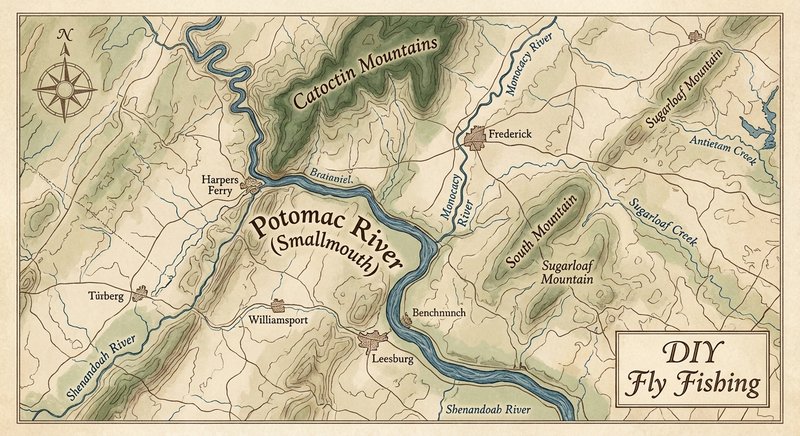
Potomac River (Smallmouth)
Fly fishing in Maryland · Intermediate · Best seasons: Spring, Summer, Fall
Target Species
Smallmouth Bass, Largemouth Bass, Channel Catfish
About This Water
World-class smallmouth bass fishing from DC to western Maryland. Diverse fishing opportunities.
Fishing Recommendations
The Potomac River, particularly the "Upper Potomac" (the non-tidal portion above the Great Falls), is widely considered one of the premier Smallmouth Bass destinations in the Mid-Atlantic. As a guide, I view the Potomac as a classic limestone-influenced river: it’s fertile, diverse, and offers a "big water" experience that can be tackled by both wade anglers and boaters.
🎣 Location Overview
The Upper Potomac flows through the rolling hills of Maryland, West Virginia, and Virginia. What makes it special is its geological diversity. You’ll find everything from deep, slow-moving pools and ledges to fast-moving "clinker" rapids and pocket water.
The water is generally alkaline due to the limestone tributaries that feed it, which leads to high insect productivity and healthy fish growth. Anglers love it because it offers a "Western River" feel in the East—broad vistas, eagle sightings, and aggressive bass that fight hard in the river’s consistent current.
🐟 Target Species & Behavior
Smallmouth Bass (The Main Attraction)
- Behavior: These are "river bronzebacks." They are muscular and use the current to their advantage.
- Holding Water: Look for the "seams" where fast water meets slow water, the eddies behind large boulders, and the deep ledges. In summer, they move into the faster, oxygenated "white water" riffles.
- Diet: Primarily crayfish, hellgrammites (dobsonfly larvae), and baitfish like sculpin and shiners.
Largemouth Bass
- Behavior: Found more frequently in the slower, weedier sections or the backwaters and "sloughs" off the main channel.
- Holding Water: Look for submerged wood, lily pads, and thick grass beds (Hydrilla).
- Diet: Opportunistic—frogs, large minnows, and damsel/dragonflies.
Channel Catfish
- Behavior: Often an accidental (but fun) catch for fly anglers using heavy streamers or weighted nymphs near the bottom.
- Holding Water: Deep holes and the base of heavy rapids where food settles.
📅 Best Times to Fish
- Spring (April – June): This is the time for trophy fish. As the water hits 55°F, Smallmouth become aggressive. Pre-spawn (May) is peak season. Look for fish moving toward shallower flats with gravel bottoms.
- Summer (July – August): The most consistent time for fly fishing. Low, clear water makes for excellent wading and spectacular topwater action. Fish early morning or late evening to avoid the midday heat.
- Fall (September – early November): As the water cools, bass feed heavily for winter. This is "Streamer Season." The fish are focused on baitfish, and the colors on the river are stunning.
Prime Window: A steady or slightly falling river gauge is ideal. Avoid the river for 48 hours after heavy rain, as it turns "chocolate milk" quickly.
🪰 Recommended Flies & Techniques
Top Patterns
- Topwater: Sneaky Pete (chartreuse or white), BoogleBug (Popper), and Dahlberg Divers.
- Subsurface/Crayfish: Clouser Minnow (Olive/White or Chartreuse/White), Near Nuff Crayfish, and the Hellgrammite (Pat’s Rubber Legs in black/brown works wonders here).
- Streamers: Gamechangers (for big fish), Murdoch Minnows, and Wooly Buggers (Size 4-8 in black or olive).
Techniques
- The "Swing and Strip": Cast a Clouser Minnow 45 degrees downstream, let it sink, and strip it back through the current seams.
- Popper Dropper: In summer, tie a 2-foot piece of tippet to the bend of your popper and attach a small weighted hellgrammite pattern. It’s deadly.
- Dead Drifting: During high sun, drift large nymphs or crayfish patterns under an indicator through deep ledges.
💡 Pro Tips & Local Knowledge
- The "Ledge" Logic: Much of the Potomac's bottom consists of tilted shale ledges that run perpendicular to the current. Fish sit right in the "trough" on the upstream side or the slack pocket on the downstream side. Always fish your fly across the ledges, not parallel to them.
- Focus Areas:
- Brunswick to Point of Rocks: Excellent for drift boats and rafts.
- Lander/Catoctin: Great wading access and prolific Smallmouth habitat.
- Dam #4 and Dam #5: The areas below these dams offer high oxygen and hold massive amounts of fish, but be careful of wading near the dams.
- The Stealth Factor: Because the water gets very clear in the summer, long leaders (9-12 feet) and fluorocarbon tippet (2X or 3X) are essential to keep from spooking wary "Smallies."
⚠️ Important Information
- Regulations: A Maryland Non-Tidal Angling License is required. If you are fishing from the Virginia shore, a VA license is usually honored due to a reciprocal agreement, but always check the current MD DNR "Compendium of Service" for specific boundary rules.
- Safety: The Potomac is deceptively powerful. The bottom is incredibly slippery (wear studded wading boots). Always wear a PFD if you are in a boat or wading deep.
- Access: Maryland has excellent public boat ramps (DNR managed) at Point of Rocks, Brunswick, and Whites Ferry. The C&O Canal National Historical Park runs alongside the river, providing hundreds of miles of foot access to the bank.
- Ethical Note: Smallmouth Bass are a precious resource. Practice Catch and Release, especially for fish over 14 inches, to maintain the quality of the fishery.
Bug Hatches & Matching Flies
| Hatch | Type | Peak months | Time of day | Hook sizes | Matching flies |
|---|---|---|---|---|---|
| White Miller Caddis Nectopsyche candida | caddis | June, July, August | Evening/Dusk | #12-16 | White Henryville Special #14-16, White Elk Hair Caddis #12-16, LaFontaine Sparkle Pupa (White) #14-16 |
| White Fly Ephoron leukon | mayfly | August, September | Late Evening/Night | #10-14 | Ephoron Dun #12-14, White Wulff #10-12, White Fly Paradun #12-14 |
| Hellgrammite / Dobsonfly Corydalus cornutus | stonefly | June, July | All Day/Night | #2-8 | Murray's Hellgrammite #4-8, Clouser Hellgrammite #2-6, Bitch Creek Nymph #4-8 |
| Damselfly Zygoptera | terrestrial | June, July, August | Afternoon | #8-12 | Adult Damsel (Blue) #10-12, Marabou Damsel Nymph #10-12, Braided Butt Damsel #10-12 |
| Hexagenia Hexagenia limbata | mayfly | June, July | Dusk | #6-10 | Hexagenia Spinner #6-8, Hexagenia Nymph #8-10, Yellow Humpy #8-10 |
| Annual Cicada Neotibicen canicularis | terrestrial | July, August, September | Afternoon | #2-6 | Rainy's Cicada #4-6, Cat's Mew #2-6, Black/Green Foam Cicada #4-8 |
| Trico Tricorythodes spp. | mayfly | July, August, September | Morning | #18-24 | Trico Spinner #20-24, RS2 (Black) #20-22, Griffith's Gnat #18-22 |
| Japanese Beetle Popillia japonica | terrestrial | June, July, August | All Day | #10-14 | Foam Beetle (Iridescent) #12-14, Coffee's Sparkle Beetle #12-14, McGinty #10-14 |