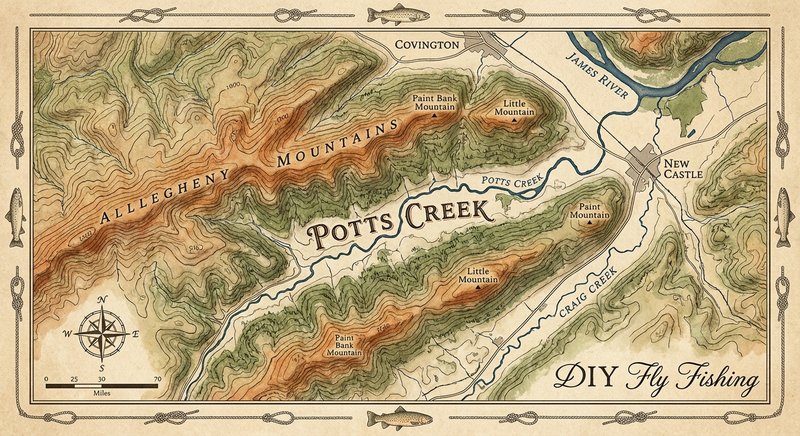
Potts Creek
Fly fishing in Virginia · Intermediate · Best seasons: Spring, Summer, Fall
Target Species
Brown Trout, Rainbow Trout
About This Water
Craig County stream with wild trout. Remote mountain fishing experience.
Fishing Recommendations
Tighten your wading boots and grab your 4-weight; we’re heading to the Allegheny Mountains. Potts Creek is one of Virginia’s hidden gems, offering a classic Appalachian freestone experience with a touch of limestone influence that keeps the water productive and the trout healthy.
🎣 Location Overview
Potts Creek flows through Craig and Alleghany Counties before joining the Jackson River near Covington. It is a quintessential mountain stream characterized by crystalline water, rugged pocket water, and deep, ledge-lined pools.
What makes Potts Creek special is its transition. The upper reaches feel like a tight, technical mountain brook, while the middle and lower sections widen into a classic trout stream with long glides and significant riffles. While much of the creek is "Put-and-Take" or "delayed harvest" in certain stretches, the cold-water springs feeding the creek allow for excellent holdover potential. In the more secluded stretches, you’ll find wild fish that are as beautiful as the surrounding George Washington National Forest.
🐟 Target Species & Behavior
- Rainbow Trout: These are the primary residents in the stocked sections. They tend to hold in the faster "bubble curtain" water at the heads of pools. They are opportunistic feeders but can become wary once the water clears and levels drop in late spring.
- Brown Trout: The "kings" of Potts Creek. While some are stocked, there are legendary holdover browns that tuck into the deep undercut banks and beneath the large boulders. They are nocturnal and predatory; if you want a big brown, you have to hunt the shadows and the wood cover.
- Behavior: In the spring, fish are active in the riffles. As the summer heat hits, they retreat to the oxygenated "white water" or the deepest, coolest holes near spring seeps.
📅 Best Times to Fish
- Spring (March – June): The Gold Standard. This is when the major hatches occur (Quill Gordons, Hendricksons, and March Browns). Water levels are usually ideal, and the trout are feeding aggressively after winter.
- Summer (July – Early September): This is "Stealth Season." Focus on the early mornings and late evenings. The water can get low and clear, making the fish extremely spooky. Terrestrials (beetles/ants) are the name of the game now.
- Fall (Late September – November): A favorite for local guides. The Brown Trout begin to move for the spawn, becoming more aggressive. The fall colors in the Alleghany Mountains provide a world-class backdrop.
- Optimal Window: The two hours before sunset are magic on Potts Creek, especially during a caddis emergence.
🪰 Recommended Flies & Techniques
Top Fly Patterns
- Dry Flies:
- Adams Parachute (Size 14-18) – The ultimate searcher.
- Elk Hair Caddis (Tan or Olive, Size 14-16) – Essential for evening rises.
- Stimulators (Orange or Yellow) – Great for high water or as a hopper-dropper lead.
- Nymphs:
- Pheasant Tail (Size 16-20) – Mimics almost everything in this creek.
- Prince Nymph (Size 12-14) – Use the beaded version to get deep in the plunge pools.
- Pats Rubber Legs – For high-water spring days.
- Streamers:
- Woolly Bugger (Black or Olive) – Swing these through deep holes for holdover browns.
Techniques
- The "Dry-Dropper": Because the water varies from shallow riffles to deep pockets, a buoyant dry fly with a 2-foot dropper to a small nymph is the most efficient way to cover water.
- Tight-Line Nymphing: In the bouldery sections of the National Forest, skip the indicator. Use a long leader and feel for the tick of the bottom to avoid snagging the frequent underwater ledges.
- Stealth Approach: This isn't the wide-open West. Stay low, wear drab colors, and try not to splash. If you see the fish before you cast, you've already won half the battle.
💡 Pro Tips & Local Knowledge
- Focus on the "Pockets": Many anglers rush to the big, obvious pools. Experienced Potts Creek fishers know that the best fish often sit in "pocket water"—small soft spots behind rocks that are only 2 feet wide.
- The Wood Factor: Potts Creek collects a lot of downed timber. Big browns love wood. If you find a log jam with a deep scour hole underneath, spend 20 minutes picking it apart with a weighted nymph or a small streamer.
- Check the Gauges: Potts Creek can rise and discolor quickly after a heavy rain in the mountains. If it’s "blown out," head further upstream where the water clears faster.
- Private vs. Public: Be very mindful of "Purple Paint" and posted signs. There are excellent public access points in the George Washington National Forest sections, but much of the lower creek is private. Always respect the landowners to keep future access open.
⚠️ Important Information
- Access: Much of the best fishing is along Route 18 (Potts Creek Rd). Look for the George Washington National Forest signs for public pull-offs.
- Regulations: Potts Creek contains sections of "Designated Stocked Trout Waters." You will need a Virginia State Fishing License AND a Trout License (between Oct 1 and June 15).
- Safety: The rocks in Potts Creek are notoriously "greasy." Felt-soled boots or studs are highly recommended to avoid a dunking.
- Cell Service: Expect it to be non-existent. Download your maps for offline use before you leave Covington or New Castle.
Guide’s Final Word: Potts Creek isn't about catching 50 fish a day; it's about the quality of the environment and the technical challenge of the mountain freestone. Treat it with respect, pack out your trash, and it will reward you with some of the prettiest trout in the Commonwealth.
Bug Hatches & Matching Flies
| Hatch | Type | Peak months | Time of day | Hook sizes | Matching flies |
|---|---|---|---|---|---|
| Blue Winged Olive Baetis | mayfly | March, April, October, November | Mid-day | #18-22 | RS2 #20-22, Parachute BWO #18-20, WD-40 #18-22 |
| Quill Gordon Epeorus pleuralis | mayfly | March, April | Afternoon | #12-14 | Quill Gordon Dry #12-14, Hare's Ear Nymph #12-14 |
| Hendrickson Ephemerella subvaria | mayfly | April | Afternoon | #12-14 | Hendrickson Dry #12-14, Red Quill #14, Pheasant Tail Nymph #12-14 |
| Grannom Caddis Brachycentrus | caddis | April, May | All day | #14-16 | Elk Hair Caddis (Olive) #14-16, Peacock Caddis #16, Deep Sparkle Pupa #14-16 |
| Sulphur Ephemerella invaria / dorothea | mayfly | May, June | Evening | #14-18 | Sulphur Parachute #14-18, Sulphur Emerger #16-18, Split Case Sulphur #16 |
| Yellow Sally Isoperla | stonefly | June, July | Late Afternoon | #14-16 | Yellow Stimulator #14-16, Little Yellow Sloan #14-16 |
| Cinnamon Caddis Hydropsyche | caddis | June, July, August, September | Evening | #14-18 | Elk Hair Caddis (Tan) #14-18, Holy Grail #16, Hydropsyche Larva #14-16 |
| Terrestrials (Ants/Beetles) Formicidae / Coleoptera | terrestrial | July, August, September | All day | #12-18 | Black Foam Ant #16-18, Crowe Beetle #14-16, Chernobyl Ant #10-12 |
| Common Midge Chironomidae | midge | January, February, March, December | Morning/Mid-day | #20-26 | Zebra Midge #20-24, Griffith's Gnat #20-22, Top Secret Midge #22-24 |