Poultney River
Fly fishing in Vermont · Beginner · Best seasons: Spring, Summer, Fall
Target Species
Brown Trout, Brook Trout
About This Water
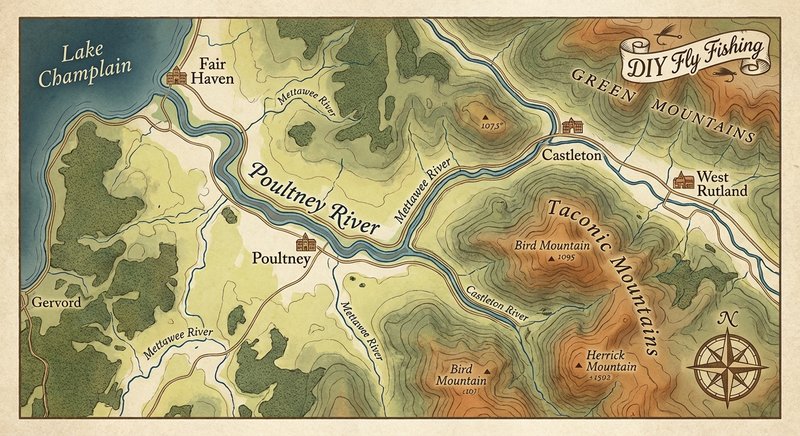
Western Vermont stream forming part of the NY border. Brown trout in pastoral Champlain Valley setting.
Fishing Recommendations
The Poultney River is one of Vermont’s best-kept secrets, carving its way through the slate valley of the southwest part of the state. It is a river of dual personalities: a mountain freestone stream in its headwaters and a meandering, fertile valley river as it forms the border between Vermont and New York. For the trout angler, it offers a classic New England experience with less pressure than the nearby Battenkill.
🎣 Location Overview
The Poultney River is unique due to its geological setting. Flowing through the "Slate Belt," the riverbed is often composed of flat slate shelves, deep shale pools, and classic pocket water.
What makes it special is the diversity of the water. You can fish tight, technical pocket water in the morning and find yourself casting to rising fish in long, glass-smooth glides by evening. The water is generally fertile, leading to excellent insect biomass and healthy, hard-fighting fish. While much of the river is classic "trout water," its lower reaches (below the falls in Whitehall/Fair Haven) transition into a warm-water fishery, making the upper and middle sections the primary focus for trout enthusiasts.
🐟 Target Species & Behavior
The Poultney is primarily a Brown Trout and Brook Trout fishery, with some rainbow trout present due to state stocking programs.
- Brown Trout: These are the kings of the deeper pools and undercut banks. They are notoriously "moody" on the Poultney. During the day, they hold deep under the slate ledges or near heavy woody debris. They become highly active during low-light periods or after a light rain when the water has a slight "tea" stain.
- Brook Trout: Found more predominantly in the upper reaches and the colder tributaries. They are opportunistic feeders, often holding in the faster "bubble foam" at the heads of pools or behind mid-stream boulders.
- Behavioral Note: Because the river can get warm in mid-summer, trout will congregate near "cold water refugia"—small tributary mouths or deep, spring-fed pockets.
📅 Best Times to Fish
The Poultney is a seasonal river that rewards those who time their trips with the hatch cycles.
- Spring (Late April – June): This is the prime window. As the runoff subsides, the Hendricksons (late April/May) and March Browns (June) bring the larger browns to the surface.
- Summer (July – August): Fishing becomes a "low and slow" game. Focus on early mornings (sunrise to 10:00 AM) and late evenings. Terrestrials (ants, beetles, hoppers) are the main course during this time. Note: Check water temperatures; if it’s over 68°F, give the trout a break.
- Fall (September – October): A magical time on the Poultney. Brown trout become aggressive and territorial as they prepare for the spawn. Streamer fishing is highly productive, and the fall foliage provides a stunning backdrop.
🪰 Recommended Flies & Techniques
Dry Flies
- Hendrickson (Size 12-14): Essential for May.
- Light Cahill (Size 14-16): Great for summer evenings.
- Elk Hair Caddis (Size 14-18): A year-round staple for the swifter runs.
- Parachute Adams (Size 14-20): The go-to when you aren't sure what's hatching.
Nymphs
- Pheasant Tail (Size 14-18): Best for mimicking the river's prolific mayfly population.
- Prince Nymph (Size 12-16): Effective in the faster, deeper slate runs.
- Pat’s Rubber Legs (Size 8-12): Essential for high water or "searching" deep pools.
Streamers
- Woolly Bugger (Black or Olive, Size 6-10): The gold standard here.
- Muddler Minnow: Excellent for mimicking the sculpins and dace that inhabit the slate crevices.
Technique Tip
High-Stick Nymphing: Because the Poultney has many jagged slate ridges, a traditional long-line drift often results in snags. Use a "Euro" or "High-Stick" style to keep your line off the varying currents and tick the bottom of the deep slots.
💡 Pro Tips & Local Knowledge
- The "Slate Slide" Approach: The slate bottom can be incredibly slick. Felt soles or studs are highly recommended. Walk softly; vibrations travel easily through the rock shelves and can spook fish 20 feet away.
- Focus on the Confluences: Where small, cold brooks enter the main stem, you will often find the highest concentration of Brook Trout, especially as the air temperature rises in June.
- Shadow Management: The river valley is relatively narrow in spots. Pay attention to your shadow; on sunny afternoons, the fish in the clear pools are extremely sensitive to overhead movement.
- The "Champlain Influence": In the lower sections near the NY border, don't be surprised if you hook into a Fallfish or a Smallmouth Bass. They share the water with trout in the transitional zones.
⚠️ Important Information
Access
- Much of the river flows through private farmland. Vermont has a tradition of open access to unposted land, but always look for signs.
- Good access points can be found near bridge crossings in the town of Poultney and along Route 30 and Route 140.
Regulations
- Vermont Fishing License: Required for all anglers 15 and older.
- State Borders: The river forms the border between VT and NY in certain sections. Be aware of where you are standing; a Vermont license is generally valid if you are fishing the river itself, but check the most recent VT/NY Reciprocal Agreement in the lawbook to ensure compliance.
- Season Dates: General trout season typically runs from the second Saturday in April to October 31st.
Conservation
The Poultney is a sensitive ecosystem. Practice Catch and Release whenever possible, use barbless hooks, and keep the fish in the water while unhooking them to ensure the future of this beautiful fishery.
Bug Hatches & Matching Flies
| Hatch | Type | Peak months | Time of day | Hook sizes | Matching flies |
|---|---|---|---|---|---|
| Blue Winged Olive Baetis | mayfly | April, May, September, October | Midday/Afternoon | #18-22 | RS2 #18-22, Parachute Adams #18-22, Pheasant Tail Nymph #18-20 |
| Hendrickson Ephemerella subvaria | mayfly | April, May | Afternoon | #12-14 | Red Quill #12-14, Hendrickson Spinner #12-14, Gold Ribbed Hare's Ear #12-14 |
| Grannom Caddis Brachycentrus | caddis | April, May | All Day | #14-16 | Elk Hair Caddis #14-16, LaFontaine's Deep Pupa #14-16, Green Weenie #14-16 |
| March Brown Maccaffertium vicarium | mayfly | May, June | Midday | #10-12 | March Brown Dry #10-12, March Brown Nymph #10-12, Soft Hackle Hare's Ear #12 |
| Slate Drake Isonychia bicolor | mayfly | June, July, September | Late Afternoon/Evening | #10-12 | Iso Parachute #10-12, Zug Bug #10-12, Prince Nymph #10-14 |
| Light Cahill Stenacron candadense | mayfly | June, July | Evening | #12-14 | Light Cahill Dry #12-14, Cream Usual #12-16, Gold Ribbed Hare's Ear (Light) #14 |
| Golden Stonefly Acroneuria | stonefly | June, July | Evening/Night | #8-12 | Kaufmann's Stone #8-12, Golden Stimulator #8-12, Pat's Rubber Leg #8-12 |
| Trico Tricorythodes | mayfly | July, August, September | Early Morning | #22-26 | Trico Spinner #22-26, Trico Dun #22-24, Zebra Midge #22-24 |
| Ants and Beetles Formicidae / Coleoptera | terrestrial | July, August, September | All Day | #12-18 | Cinnamon Ant #14-18, Black Foam Beetle #12-16, Chernobyl Ant #8-12 |