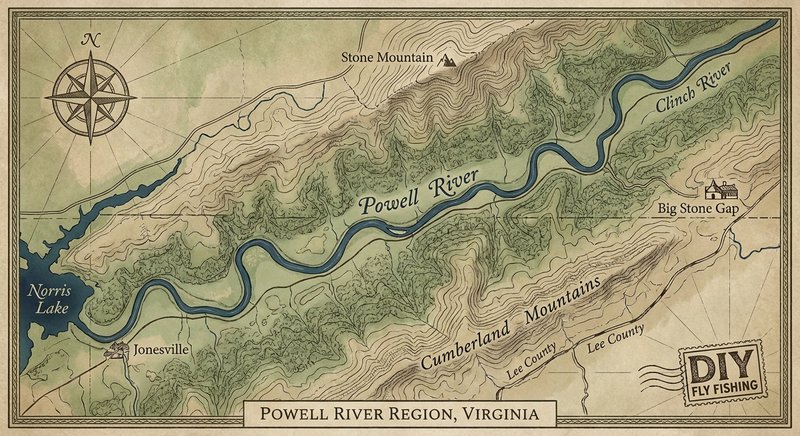
Powell River
Fly fishing in Virginia · Intermediate · Best seasons: Spring, Summer, Fall
Target Species
Smallmouth Bass, Rock Bass
About This Water
Lee County river with smallmouth bass. Remote southwest Virginia fishing.
Fishing Recommendations
The Powell River in Southwest Virginia is a hidden gem for the adventurous fly angler. Flowing through the rugged karst topography of Lee and Wise counties, the Powell is one of the most biologically diverse rivers in the United States. Unlike its more famous neighbor, the New River, the Powell offers a more intimate, remote, and technically challenging experience for Smallmouth and Rock Bass.
🎣 Location Overview
The Powell River is a classic Appalachian limestone river. It is characterized by its dramatic limestone ledges, deep emerald pools, and swift, shallow shoals. What makes it special is its "wild" feel; much of the river is tucked away from major roads, flanked by steep forested ridges and limestone bluffs.
The water chemistry, influenced by the surrounding limestone, promotes incredible biomass. This leads to healthy, hard-fighting Smallmouth Bass. While you may not find the sheer numbers of fish seen in some managed tailwaters, the quality of the fish and the beauty of the scenery are world-class.
🐟 Target Species & Behavior
Smallmouth Bass ("Bronzeback")
The apex predator of the Powell. These fish are incredibly strong due to living in constant current.
- Behavior: In the spring, they move from deep wintering holes to shallower gravel bars. By summer, they hold in "oxygenated" water—the heads of riffles and along the edges of deep current seams.
- Feeding: Their diet is dominated by crayfish and hellgrammites. They also forage on stonerollers, shiners, and occasional terrestrial insects.
Rock Bass ("Redeye")
Often overlooked but a blast on light fly gear.
- Behavior: They are ambush predators. Look for them in "slack" water, particularly around sunken timber, root balls, and in the shadows of large limestone boulders.
- Feeding: They are less migratory than Smallmouth and will strike aggressively at smaller streamers and nymphs.
📅 Best Times to Fish
- Spring (Late April – June): This is prime time. As water temperatures hit the 55–60°F mark, Smallmouth become highly active. The post-spawn period (June) offers some of the most aggressive feeding of the year.
- Summer (July – August): Best for topwater action. Focus on the early morning (sunrise to 10:00 AM) and the "golden hour" before sunset. During mid-day, fish move deep or tight into the swiftest current.
- Fall (September – October): As temperatures drop, bass gorge themselves for winter. This is the best time to find "trophy" fish using large streamer patterns. The fall foliage in the Powell River Valley is a spectacular bonus.
🪰 Recommended Flies & Techniques
Topwater (The "Heartbeat" of Summer)
- Flies: BoogleBugs (Size 4-6) in Chartreuse or Black, Sneaky Petes, and Murdich Minnows (fished on a floating line).
- Technique: Cast tight to the bank or over submerged ledges. Let the rings dissipate before the first twitch. Use a "pop-pop-pause" rhythm.
Streamers (The Meat and Potatoes)
- Flies: Clouser Minnows (Chartreuse/White or Olive/White), Game Changers, and Woolly Buggers (Black or Olive, Size 4).
- Technique: Use a sink-tip line in the deeper pools. Swing the streamer through the current or use erratic strips to mimic a wounded baitfish.
Nymphing/Crayfish (The High-Confidence Choice)
- Flies: Near-Nuff Crayfish, Pat’s Rubber Legs (Black or Brown), and Murray’s Hellgrammite.
- Technique: Dead-drift these under an indicator through deep runs, or "bounce" them along the bottom of limestone ledges. Smallmouth in the Powell stay glued to the bottom when the sun is high.
💡 Pro Tips & Local Knowledge
- Work the Ledges: The Powell is famous for its vertical limestone shelves. Smallmouth love to tuck under these ledges. Don't just fish the top of the ledge; make sure your fly drops down the "face" of the rock.
- Stealth Matters: Because the water can get very clear in late summer, long casts and a stealthy approach are vital. If you can see the fish, they have likely already seen you.
- The "Hellgrammite Move": The Powell has a massive population of Dobsonfly larvae (hellgrammites). If the fishing is slow, switch to a heavy, black, leggy nymph and crawl it slowly across the bottom of a rocky run.
- Floating is Best: While there is some wade fishing at bridge crossings, the best way to see the Powell is via kayak or canoe. This allows you to reach the "interior" stretches that rarely see a fly.
⚠️ Important Information
- Access: Key access points include the Stickleyville (RT 645) bridge, Dryden, and Rose Hill. Many areas are bordered by private property; always respect "Posted" signs and stay within the high-water mark.
- Regulations: A valid Virginia Freshwater Fishing License is required. Be sure to check the Virginia DWR website for the most current creel limits and size restrictions for the Powell River.
- Mussel Conservation: The Powell is home to several endangered freshwater mussel species. Avoid wading on soft gravel/silt beds where mussels congregate, and try to stick to larger rocks or bedrock.
- Safety: The Powell can rise rapidly after heavy rains in the mountains. Always check the USGS gauge at Jonesville, VA before heading out. A flow between 200–500 cfs is generally ideal for floating and fishing.
Bug Hatches & Matching Flies
| Hatch | Type | Peak months | Time of day | Hook sizes | Matching flies |
|---|---|---|---|---|---|
| White Fly Ephoron leukon | mayfly | August, September | Evening/Dusk | #12-14 | White Wulff #12-14, Ephoron Spinner #14, White Sparkle Dun #12-14 |
| Blue-Winged Olive Baetis species | mayfly | March, April, October, November | Late Morning/Afternoon | #18-22 | RS2 #18-22, BWO Parachute #18-20, Pheasant Tail #18-20 |
| Light Cahill Stenonema ithaca | mayfly | May, June | Evening | #12-16 | Light Cahill Dry #14-16, Gold Ribbed Hare's Ear #12-14, Cahill Emerger #14-16 |
| Tan Caddis Hydropsyche | caddis | May, June, July | All Day/Evening | #14-18 | Elk Hair Caddis #14-16, Holy Grail Caddis #14-16, Pupa-can #16 |
| Golden Stonefly Acroneuria abbreviata | stonefly | May, June | Morning/Evening | #6-10 | Pat's Rubber Leg #8-10, Golden Stimulator #8-12, Kaufmann's Stone #6-10 |
| Hellgrammite Corydalus cornutus | terrestrial | June, July, August | All Day | #2-6 | Murray's Hellgrammite #4-6, Clouser Minnow (Olive/Black) #2-6, Bitch Creek Nymph #4-8 |
| Trico Tricorythodes | mayfly | July, August, September | Early Morning | #20-24 | Trico Spinner #22-24, Griffith's Gnat #20-22, Zebra Midge #20-22 |
| Common Terrestrials Various | terrestrial | July, August, September | Afternoon | #8-14 | Chernobyl Ant #8-12, Black Foam Beetle #12-14, Dave's Hopper #10-12 |