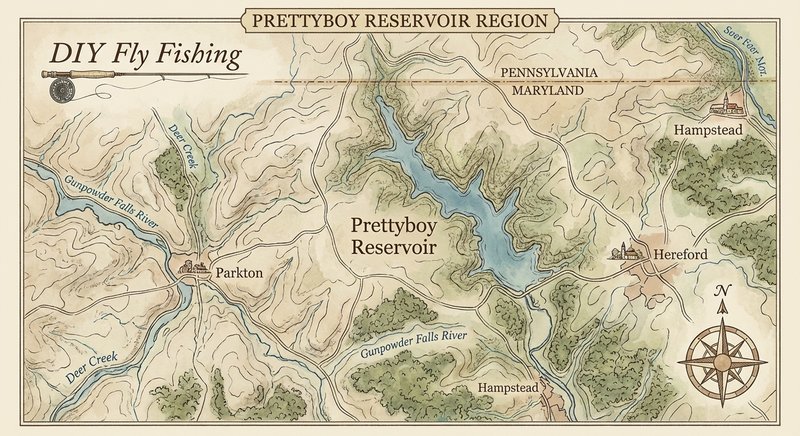
Prettyboy Reservoir
Fly fishing in Maryland · Beginner · Best seasons: Spring, Summer, Fall
Target Species
Largemouth Bass, Crappie, Bluegill
About This Water
Baltimore County reservoir with bass and panfish. Source of Gunpowder Falls.
Fishing Recommendations
Welcome to Prettyboy Reservoir, one of the most scenic and pristine fly fishing destinations in the Mid-Atlantic. Located in northern Baltimore County, Maryland, Prettyboy is the "quieter" sibling to Loch Raven, offering deep, clear water, steep rocky shorelines, and a distinct "wilderness" feel that is rare so close to a major metropolitan area.
As an expert guide, here is your comprehensive breakdown for targeting Largemouth Bass and panfish on the fly at Prettyboy.
🎣 Location Overview
Prettyboy Reservoir is a 1,500-acre impoundment of the Gunpowder Falls. Unlike many Maryland lakes, Prettyboy is characterized by its extreme water clarity and dramatic topography. The banks are often steep, lined with massive boulders and fallen timber (blowdowns).
Anglers love it because it feels like fishing a mountain lake in the Adirondacks. Because gas motors are strictly prohibited (electric only), the water remains calm, allowing for exceptional sight-fishing opportunities. The reservoir acts as a massive heat sink, staying cooler than smaller ponds in the summer, which keeps the fish active longer into the season.
🐟 Target Species & Behavior
Largemouth Bass
The Largemouths here are "structure-oriented." Because the water is so clear, they are often spookier than bass in turbid water.
- Behavior: They hold tight to submerged wood, rock ledges, and the shadows of overhanging trees.
- Feeding: Their diet consists of bluegill, crawfish, and small perch. They are highly opportunistic but require a stealthy presentation.
Crappie & Bluegill
Prettyboy holds a massive population of "slab" Crappie and aggressive Bluegill.
- Behavior: Bluegill dominate the shallow shorelines and lily pad edges. Crappie are more nomadic, often suspending around deep submerged brush piles or "the bridges" in 10–20 feet of water.
- Feeding: They focus on aquatic insects, damselfly larvae, and tiny minnows.
📅 Best Times to Fish
- Spring (April – Early June): This is the prime window. As the water warms to the 55–65°F range, bass move into the shallow coves for the pre-spawn and spawn. Crappie congregate in massive schools near fallen trees.
- Summer (Late June – August): Focus on the "Golden Hour." Because the water is clear, midday sun pushes fish deep. The first 90 minutes of daylight and the last hour before sunset offer incredible topwater action.
- Fall (September – October): As temperatures drop, bass move back to the shallows to gorge on baitfish before winter. Look for fish on the "secondary points" leading into the creek arms.
🪰 Recommended Flies & Techniques
For Largemouth Bass
- Topwater: BoogleBugs or foam poppers in frog or white/silver. In clear water, a "passive" pop (gentle twitches) often works better than loud splashing.
- Sub-surface: Clouser Minnows (Chartreuse/White or Olive/White) are the gold standard here. They mimic the local baitfish and get down to the rock shelves quickly.
- The "Slow Crawl": Use a Rubber-Legged Dragon or a weighted Woolly Bugger (Black or Olive) to mimic crawfish along the rocky bottoms.
For Crappie & Bluegill
- The "Dropper" Rig: A size #10 foam spider or Beetle on top with a size #14 Bead-head Pheasant Tail or Hare’s Ear nymph suspended 18 inches below it.
- Small Streamers: Size #8–10 Micro-Buggers or white Zuludredgers are deadly for Crappie when stripped slowly near submerged timber.
Presentation Tips
- Long Leaders: Because of the clarity, use 9-foot leaders. For bass, 10lb or 12lb fluorocarbon is recommended to prevent break-offs on submerged wood.
- Stealth: Position your boat or kayak a full cast's length away from the structure you are targeting. If you can see the fish, they can definitely see you.
💡 Pro Tips & Local Knowledge
- Follow the "Blowdowns": If a massive oak tree has fallen into the water, spend 20 minutes picking it apart. Start at the outer branches (deeper water) and work your way toward the trunk.
- The Bridge Pillars: The bridges crossing the reservoir provide vertical structure. Bass and Crappie will move up and down these pillars throughout the day to find their preferred temperature and light level.
- Feeder Creeks: After a rain, focus on the areas where small creeks enter the reservoir. These "inflow" points bring in nutrients and oxygen, often stacking up hungry fish.
- The "Electric Only" Advantage: Since you aren't fighting gas-boat wakes, use a kayak or a small boat with a high-quality electric motor. It allows you to get into the narrow, shallow "fingers" of the reservoir where the biggest bass often hide.
⚠️ Important Information
- Permits: You must have a Baltimore City Watershed Boat Permit to put any craft on the water. These are not sold at the dock; you must apply for them in advance.
- Regulations: No wading and no swimming are permitted. Fishing is allowed from the shore or from an authorized boat. Maryland State fishing licenses are required for those 16 and older.
- Invasive Species: Be diligent about cleaning your gear. Zebra mussels are a concern in Maryland waters; ensure your boat and boots are dry before moving between watersheds.
- Access Points: Major access points include the parking areas near the Prettyboy Dam and the Tracey’s Store area. Be prepared for some hiking if you are fishing from the shore, as the trails can be steep.
Guide’s Final Word: Prettyboy is a "thinking angler's" reservoir. It rewards patience, long casts, and a quiet approach. If you can master the clear-water stealth required here, you can catch fish anywhere in the country. Tight lines!
Bug Hatches & Matching Flies
| Hatch | Type | Peak months | Time of day | Hook sizes | Matching flies |
|---|---|---|---|---|---|
| Blue Winged Olive Baetis tricaudatus | mayfly | March, April, October, November | Afternoon | #18-22 | RS2 #18-22, BWO Sparkle Dun #18-20, Pheasant Tail #18-20 |
| Sulphur Ephemerella invaria/dorothea | mayfly | May, June | Late Afternoon/Evening | #14-18 | Sulphur Parachute #14-18, Hare's Ear Nymph #14-16, Sulphur CDC Emerger #16-18 |
| Trico Tricorythodes | mayfly | July, August, September | Morning | #22-26 | Trico Spinner #22-24, Trico Parachute #22-26 |
| Tan Caddis Hydropsyche | caddis | April, May, June | Evening | #14-18 | Elk Hair Caddis #14-16, LaFontaine's Deep Sparkle Pupa #14-18 |
| Little Black Stonefly Taeniopteryx | stonefly | February, March | Afternoon | #14-18 | Early Black Stone #16-18, Prince Nymph #14-16 |
| Midges Chironomidae | midge | December, January, February | Anytime | #20-28 | Zebra Midge #20-24, Griffith's Gnat #20-24, Mercury Midge #20-22 |
| Terrestrials (Ants/Beetles) Formicidae/Coleoptera | terrestrial | July, August, September | Mid-day | #12-20 | Cinnamon Ant #16-20, Black Foam Beetle #14-18 |
| Light Cahill Stenacron interpunctatum | mayfly | June, July | Evening | #12-14 | Light Cahill #12-14, Gold Ribbed Hare's Ear #12-14 |