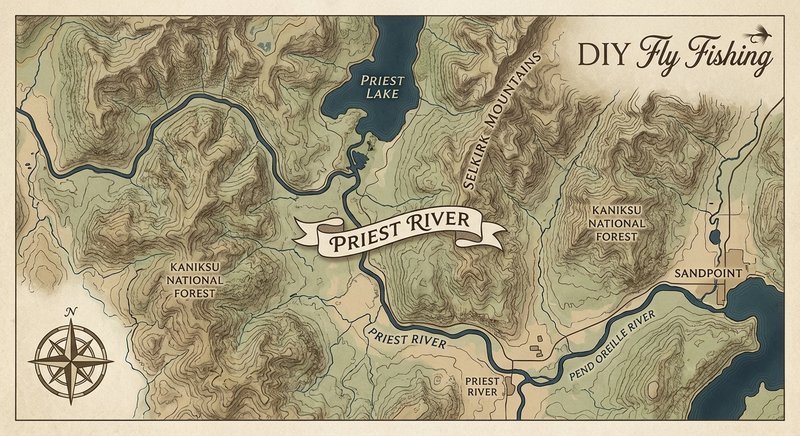
Priest River
Fly fishing in Idaho · Intermediate · Best seasons: Summer, Fall
Target Species
Cutthroat Trout, Bull Trout
About This Water
Northern Idaho Panhandle stream with cutthroat and bull trout. Scenic fishing near Priest Lake.
Fishing Recommendations
As an expert guide who has spent many seasons navigating the cold, pristine waters of the Idaho Panhandle, the Priest River holds a special place in my heart. While it often takes a backseat to the more famous St. Joe or Coeur d’Alene rivers, the Priest offers a rugged, "old Idaho" feel with spectacular scenery and native fish that are as beautiful as they are scrappy.
Here is your comprehensive guide to fly fishing the Priest River.
🎣 Location Overview
The Priest River flows out of the southern end of Priest Lake and winds approximately 45 miles south to its confluence with the Pend Oreille River. It is a classic freestone river characterized by crystal-clear water, dense pine forests, and a mix of boulder-strewn pocket water, long glassy runs, and deep, mysterious pools.
What makes the Priest special is its solitude. It is far less pressured than other regional rivers. The upper reaches (above the Dickensheet bridge) feel like a high-mountain stream, while the lower sections broaden out. It is a river for the angler who values the experience of the wilderness as much as the number of fish in the net.
🐟 Target Species & Behavior
Westslope Cutthroat Trout
The crown jewel of the Priest. These are native fish, known for their brilliant orange throat slashes and opportunistic feeding habits.
- Behavior: They are famously "looking up." They hold in the "seams" (where fast and slow water meet), in the tailouts of pools, and right against the bank under overhanging brush.
- Feeding: In summer, they are suckers for terrestrials. In fall, they focus on smaller mayflies and mahogany duns.
Bull Trout
The "ghosts" of the river. Bull Trout are apex predators and are a federally protected species.
- Behavior: They are usually found in the deepest, coldest holes or tucked under massive log jams. They move into the river system from the lake or downstream to spawn in the fall.
- Feeding: They are piscivorous (fish-eaters). They target mountain whitefish and smaller trout.
- Note: Targeting Bull Trout specifically is often restricted; check current IDFG regs. They must be released immediately without being removed from the water.
📅 Best Times to Fish
Summer (July – August)
This is the prime window for dry fly enthusiasts.
- Conditions: Once the spring runoff subsides (usually by late June), the river becomes wadeable and the fish become very active.
- Time of Day: Early morning and "the magic hour" before sunset. During the heat of the day, fish deep in the oxygenated "white water" at the head of pools.
Fall (September – October)
My personal favorite time to be on the water.
- Conditions: The water cools, and the big fish get aggressive before winter. The larch trees turn gold, making for a stunning backdrop.
- Prime Window: Look for the October Caddis hatch. These are massive orange insects that bring the largest Cutthroats to the surface.
- Time of Day: Mid-day becomes the most productive as the sun warms the water.
🪰 Recommended Flies & Techniques
Dry Flies
- Chubby Chernobyl (Size 8-12): In gold, purple, or olive. This is the ultimate "scout" fly.
- Stimulators (Size 10-14): Orange or Yellow. Great for imitating adult stones or caddis.
- Purple Haze (Size 14-18): A North Idaho staple; it simply out-fishes a standard Parachute Adams here.
- October Caddis (Size 8-10): Specifically for late September and October.
Nymphs
- Pat’s Rubber Legs (Size 8-12): In coffee/black. Fish this deep under a bobber or as a dropper.
- Perdigons (Size 14-16): Use these to get down fast in the faster chutes.
Streamers
- Galloup’s Sex Dungeon (White or Olive): For targeting large, aggressive fish in deep holes.
- Sculpzilla: Works wonders in the rocky runs.
Technique Tip: The "Hopper-Dropper"
The Priest is perfect for a "Hopper-Dropper" rig. Use a buoyant Chubby Chernobyl on top and hang a weighted Pheasant Tail or Hares Ear 2–3 feet below it. This covers both bases in the varied depths of the river.
💡 Pro Tips & Local Knowledge
- Focus on the Wood: The Priest River has a lot of "sweepers" (fallen trees). Large Cutthroats and Bull Trout love the safety of overhead cover. Cast your fly as tight to the wood as you dare.
- The Dickensheet Stretch: The area near the Dickensheet Campground is a great starting point for wading. As you move downstream, access becomes more difficult, making a small raft or drift boat helpful.
- Watch the Temperature: In late August, the lower Priest can get warm. If the water hits 68°F, stop fishing to protect the trout. Head further upstream where the water stays cooler.
- Stealth Matters: Because the water is so clear, long leaders (9–12 feet) and delicate presentations are necessary, especially in the slower glides.
⚠️ Important Information
- Access: Much of the river is surrounded by Idaho State Lands or Kaniksu National Forest, but there are pockets of private land. Use an app like OnX to ensure you are staying on public access points.
- Regulations: Check the Idaho Fish & Game (IDFG) booklet. The Priest often has specific rules regarding bait, barbless hooks, and harvest.
- Bull Trout: Must be released.
- Cutthroat: Generally catch-and-release in many stretches.
- Bear Safety: This is Grizzly and Black Bear country. Always carry bear spray on your person (not in your pack) and make noise while walking through thick brush to the river.
- Wading: The rocks can be incredibly slick. Felt-soled boots or studs are highly recommended.
Guide’s Final Word: The Priest River isn't about high fish counts; it's about the quality of the surroundings and the purity of the strain of fish. Treat these native trout with respect, keep them in the water, and they’ll be there for the next generation. Tight lines!
Bug Hatches & Matching Flies
| Hatch | Type | Peak months | Time of day | Hook sizes | Matching flies |
|---|---|---|---|---|---|
| Blue Winged Olive (BWO) Baetis | mayfly | March, April, October, November | Late Morning to Mid-Afternoon | #16-22 | Parachute Adams #16-20, RS2 #18-22, BWO Sparkle Dun #18-20 |
| Skwala Stonefly Skwala americana | stonefly | March, April | Midday | #8-12 | Skwala Stone #10-12, Pat's Rubber Leg #8-12, Bullet Skwala #12 |
| March Brown Rhithrogena morrisoni | mayfly | April, May | Afternoon | #12-14 | March Brown Western Red #12-14, Pheasant Tail #12-14, Hare's Ear Soft Hackle #14 |
| Pale Morning Dun (PMD) Ephemerella excrucians | mayfly | June, July | Morning to Early Afternoon | #16-18 | PMD Sparkle Dun #16-18, Split Case PMD #16-18, Film Critic PMD #16 |
| Golden Stonefly Hesperoperla pacifica | stonefly | June, July | Morning/Evening | #8-12 | Chubby Chernobyl (Gold) #8-12, Golden 20-Incher #8-12, Norm Wood Special #10 |
| Green Drake Drunella doddsi | mayfly | June, July | Afternoon | #10-12 | Green Drake Hairwing #10-12, Quigley Cripple Drake #12, Mercer's Poxyback Drake #10-12 |
| Spotted Sedge Hydropsyche | caddis | June, July, August | Evening | #14-16 | Elk Hair Caddis (Tan) #14-16, Holy Grail Caddis #14-16, LaFontaine's Deep Sparkle Pupa #16 |
| October Caddis Dicosmoecus atripes | caddis | September, October | Afternoon/Evening | #8-10 | Stimulator (Orange) #8-10, October Caddis Pupa #8-10, Morrish October Caddis #10 |
| Grasshoppers Orthoptera | terrestrial | July, August, September | Late Morning to Evening | #8-14 | Morrish Hopper #10-12, Dave's Hopper #8-14, Parachute Hopper #12 |