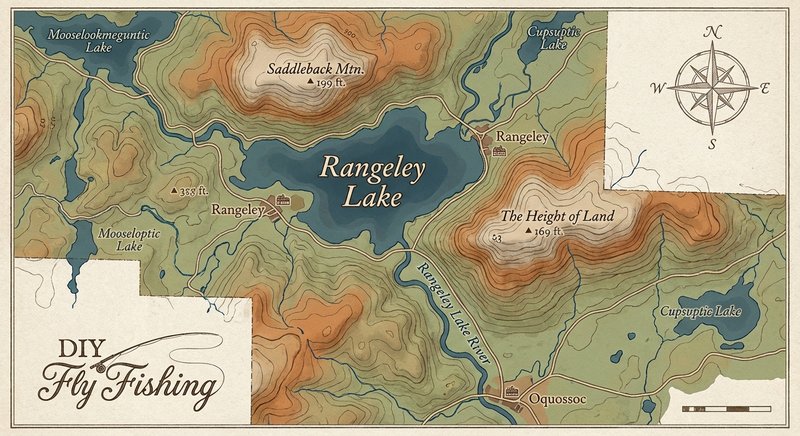
Rangeley Lake
Fly fishing in Maine · Intermediate · Best seasons: Spring, Summer, Fall
Target Species
Brook Trout, Landlocked Salmon, Lake Trout
About This Water
Historic Maine lake famous for native brook trout. Landlocked salmon and lake trout also present.
Fishing Recommendations
Welcome to the legendary waters of the Rangeley Lakes region. As your guide, I can tell you that Rangeley Lake is the crown jewel of Western Maine. This is the birthplace of the famous "Rangeley Style" streamers and is steeped in over 150 years of fly fishing history. It is one of the few places in the lower 48 where you have a legitimate chance at a wild, trophy-sized Brook Trout.
🎣 Location Overview
Rangeley Lake is a massive, deep-water lake (approx. 6,000 acres) nestled at an elevation of 1,518 feet in the mountains of Western Maine. What makes it special is its oligotrophic nature—it is cold, deep, and highly oxygenated, which is the perfect recipe for salmonids.
The water is crystal clear, and the shoreline is a mix of rocky points, submerged boulders, and drop-offs. It is fed by the Kennebago River and drained by the Rangeley River. Unlike many lakes that warm up significantly, Rangeley remains a cold-water sanctuary, allowing fish to grow to massive proportions on a steady diet of Rainbow Smelt.
🐟 Target Species & Behavior
Brook Trout (Squaretails)
These are the heritage species of the lake. Rangeley Brookies are famous for their size (3–5 lbs is not uncommon).
- Behavior: They are structure-oriented. In the spring, they hug the rocky shorelines and cruise the mouths of the Kennebago and Rangeley Rivers. As the water warms, they retreat to "spring holes" or the deep thermocline.
- Feeding: Primarily piscivorous (fish eaters). They gorge on Rainbow Smelt.
Landlocked Salmon
Introduced in the late 1800s, these are the "acrobats" of the lake.
- Behavior: Salmon are pelagic; they follow the schools of smelt. They love "moving" water and are often found where the wind pushes bait against a point or near the river inlets/outlets.
- Feeding: Almost exclusively focused on smelt. They are aggressive hitters and will often leap several times once hooked.
Lake Trout (Togue)
- Behavior: These are the residents of the abyss. They prefer the deepest, coldest parts of the lake.
- Feeding: They are opportunistic predators. While harder to target on a fly during the summer, they move into the shallows during "ice-out" and late fall.
📅 Best Times to Fish
Spring (Ice-Out to Mid-June)
- The Window: This is the Prime Season. As soon as the ice breaks (usually late April/early May), the smelt begin their spawning run into the tributaries.
- Conditions: The fish are in the top 10 feet of the water column. This is the best time for traditional fly casting.
Summer (July to August)
- The Window: The "Dog Days." Fish move deep (30–60 feet).
- Conditions: Best fished at dawn and dusk. Focus on the mouths of cold-water tributaries or use heavy sinking lines (Type 5 or 7) to reach the thermocline.
Fall (September to October)
- The Window: Mid-September through the closing of the season.
- Conditions: As water temperatures drop, fish move back to the shallows and congregate near the river mouths (Kennebago and Rangeley Rivers) in preparation for their own spawning runs. The Brook Trout are in their magnificent "spawning colors."
🪰 Recommended Flies & Techniques
Top Fly Patterns
- Streamers (The Rangeley Classics):
- Grey Ghost: The most famous pattern by Carrie Stevens. Imitates a smelt.
- Black Ghost: High contrast for overcast days.
- Governor Aiken: A local favorite for Brook Trout.
- Muddler Minnow: Great for "waking" on the surface or stripping deep.
- Dry Flies (June/July):
- Hexagenia Limbata: The giant yellow mayfly hatch in late June is legendary.
- Elk Hair Caddis (Size 12-16): For evening rises.
- Nymphs:
- Pheasant Tail & Prince Nymphs (Size 12-14): Effective near river mouths.
Techniques
- Trolling the Fly: The traditional Maine method. Use a sinking tip or full sinking line, let out 50–70 feet of line, and move your boat at a slow "rowing" pace. The "pulse" of the oars gives the streamer a lifelike action.
- Casting to Structure: Target rocky points and submerged "boilers" (large rocks). Use a strip-strip-pause retrieve.
- The "Wind-Blowing-In" Rule: Always fish the shore where the wind is blowing at you. The wind pushes the smelt toward that shore, and the predators follow.
💡 Pro Tips & Local Knowledge
- The Kennebago Mouth: This is the most famous spot on the lake. In the spring and fall, the concentration of fish here is immense.
- Stealth is Key: Because the water is so clear, use long leaders (9–12 feet) and fluorocarbon tippet (3X or 4X) when the sun is high.
- The "Smelt Flash": If you see silver flashes near the surface, those are smelt being harassed. Cast immediately into the fray.
- Oar Power vs. Motor: If possible, use a small motor to get to your spot, but use oars or a trolling motor once you are fishing. Big Brookies in Rangeley are notoriously spooked by engine vibration.
⚠️ Important Information
Access
- Public Boat Launch: Located at Rangeley Lake State Park (south shore) and in the town of Rangeley (Lakeside Park).
- Wading: Wading is limited on the lake itself due to the steep drop-offs; a boat, canoe, or float tube is highly recommended.
Regulations & Permits
- License: A valid Maine Fishing License is required (available online at the MDIFW website).
- Special Rules: Rangeley Lake has specific length and bag limits to protect the trophy Brook Trout. Check the current "Open Water & Ice Fishing Laws" (North Zone) before heading out.
- Barbless Hooks: While not always required by law on the lake, they are highly recommended for the easy release of the wild Brook Trout.
Safety
- Rangeley Lake is large and can kick up "whitecaps" very quickly when the wind shifts. Always check the weather forecast and wear a PFD.
Guide's Final Word: Respect the fish. These Brook Trout are a national treasure. Take a quick photo, keep them in the water, and let them go so they can haunt the dreams of the next angler.
Bug Hatches & Matching Flies
| Hatch | Type | Peak months | Time of day | Hook sizes | Matching flies |
|---|---|---|---|---|---|
| Hexagenia (The Hex) Hexagenia limbata | mayfly | June, July | Evening/Night | #6-10 | Hexagenia Dry #6-8, Hex Emerger #8, Hex Nymph #6-10 |
| Hendrickson Ephemerella subvariabilis | mayfly | May, June | Afternoon | #12-14 | Red Quill #12-14, Hendrickson Nymph #12-14, Hendrickson Sparkle Dun #14 |
| Eastern Green Drake Ephemera guttulata | mayfly | June | Evening | #8-12 | Green Drake Paradox #8-10, Coffin Fly (Spinner) #8-10, Green Drake Nymph #8-12 |
| Blue Winged Olive (BWO) Baetis spp. | mayfly | May, September, October | Afternoon | #18-22 | BWO Parachute #18-22, RS2 #20-22, Pheasant Tail Nymph #18-20 |
| Cinnamon Caddis Hydropsyche | caddis | June, July, August | Evening | #14-18 | Elk Hair Caddis (Cinnamon) #14-16, LaFontaine's Deep Pupa #14-16, Iris Caddis #16 |
| Midges Chironomidae | midge | May, June, July, August, September | All Day | #18-24 | Zebra Midge #18-22, Griffith's Gnat #20-24, Chironocone #18-20 |
| Flying Ants Formicidae | terrestrial | August, September | Afternoon | #14-18 | Black Foam Ant #14-18, Flying Ant (Cinnamon) #16 |
| Alder Fly Sialis spp. | caddis | June, July | Morning/Afternoon | #10-14 | Alder Fly Dry #12, Black Gnat #14 |
| White Miller Ephoron leukon | mayfly | August | Evening | #12-14 | White Wulff #10-12, Ephoron Dun #14 |