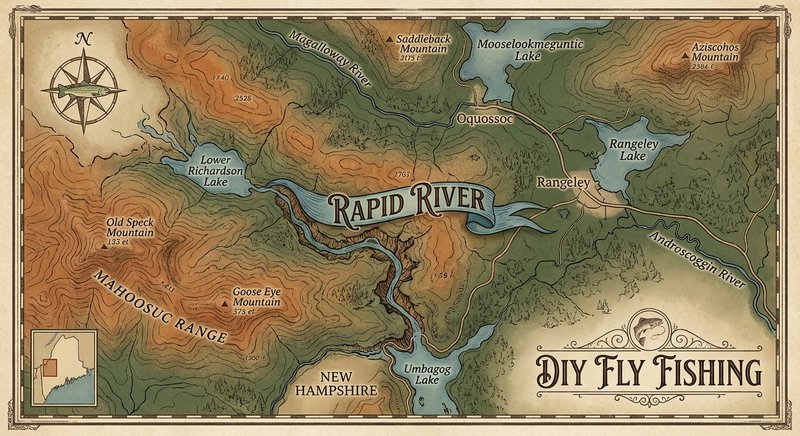
Rapid River
Fly fishing in Maine · Intermediate · Best seasons: Spring, Summer, Fall
Target Species
Brook Trout, Landlocked Salmon
About This Water
Trophy brook trout and landlocked salmon water in western Maine. Fly fishing only with catch-and-release.
Fishing Recommendations
The Rapid River in Western Maine is widely considered the crown jewel of Eastern fly fishing. It is a place of pilgrimage for those seeking the largest wild Brook Trout in the lower 48 states. This is a high-gradient, powerful river that demands respect and rewards technical proficiency.
🎣 Location Overview
Located in the remote Rangeley Lakes region, the Rapid River flows roughly six miles from Middle Dam on Lower Richardson Lake down to Umbagog Lake. As the name implies, it is a "rapid" river, dropping 155 feet over its short course.
What makes it special is the bottom-release dam, which provides cold, oxygen-rich water throughout the summer, and the fact that its Brook Trout are 100% wild and indigenous. The river is rugged, boulder-strewn, and surrounded by the dense Maine woods immortalized by Louise Dickinson Rich in her memoir, We Took to the Woods.
🐟 Target Species & Behavior
- Brook Trout: These are the stars of the show. Unlike the small mountain brookies found elsewhere, the Rapid’s trout average 12–18 inches, with 3–5 pound fish (20+ inches) caught every season. They are exceptionally strong and utilize the heavy current to their advantage.
- Landlocked Salmon: These are acrobatic, aggressive, and move into the river from Umbagog Lake or are resident in the deeper pools. They often hold in the faster "white water" at the heads of pools.
Behavior: During the spring, they focus on smelt. In the summer, they move into the "pocket water" behind large boulders. In the fall, they become territorial and aggressive as they prepare for the spawn, donning brilliant orange and red bellies.
📅 Best Times to Fish
- Spring (Late May – June): This is the Smelt Run. Large Brook Trout congregate near Middle Dam and Pond-in-the-River to gorge on baitfish. This is your best chance at a trophy fish on a streamer.
- Summer (July – August): While other Maine rivers get too warm, the Rapid stays cool. This is prime Caddis and Stonefly season. Expect heavy hatches in the evenings.
- Fall (September): The river becomes "Fly Fishing Only" with stricter catch-and-release rules (though most of it is C&R year-round). The fish are in their most beautiful spawning colors, and the Salmon run is at its peak. September 15th through the 30th is the most coveted window.
🪰 Recommended Flies & Techniques
Top Fly Patterns
- Streamers: Gray Ghost, Black Ghost, Herb Johnson’s Smelt, and the Muddler Minnow. Size 4-8.
- Dries: Goddard Caddis (a local favorite), Elk Hair Caddis (size 12-16), Stimulators (size 8-12), and the Hornberg (fished as a dry or a wet).
- Nymphs: Pat’s Rubber Legs (Black/Brown), Prince Nymphs, and Pheasant Tails. The fish here love big "ugly" nymphs that mimic the giant Golden Stoneflies found in the rapids.
Effective Techniques
- The "Rapid Swing": Cast a streamer quartering downstream, let it sink, and swing it through the heavy current. Give it short, erratic strips.
- High-Sticking/Euro Nymphing: Because the water is so fast, traditional indicator nymphing can be difficult. High-sticking heavy nymphs in the pockets behind boulders is deadly.
- Skating Dries: For the caddis hatches, don't be afraid to twitch or skate your dry fly across the surface. This often triggers a violent strike from a large Brookie.
💡 Pro Tips & Local Knowledge
- Focus on the Pockets: Don't just look for big pools like "Cold Spring." Some of the largest fish live in tiny pockets of calm water behind boulders in the middle of Class III rapids.
- Wading Safety: A wading staff is non-negotiable. The rocks are incredibly slippery (often called "bowling balls covered in grease"), and the current is relentless.
- Pond-in-the-River: This is a widening of the river halfway down. The "Inlet" and "Outlet" of this pond are legendary holding spots. If the main river is too crowded, the flats of the pond can offer great sight-fishing for cruising trout.
- The "Long Rod": A 9-foot or 10-foot 5-weight or 6-weight rod is ideal. You need the length to reach over complex currents and the backbone to turn a 3-pound trout in heavy water.
⚠️ Important Information
- Access: Access is difficult. Most anglers drive to Black Brook Cove Campground and pay a gate fee to use the private logging roads. From the parking areas, expect a 1 to 2-mile hike to reach the best water.
- Regulations: The Rapid is strictly Fly Fishing Only. Motorized vehicles are prohibited beyond certain points. Always check the current Maine MDIFW Open Water Regulations as they are strictly enforced.
- Cell Service: Virtually non-existent. Bring a map, a first aid kit, and let someone know when you plan to return.
- Bugs: In June and July, the black flies and mosquitoes are world-class. Bring high-quality repellent and a head net.
The Rapid River is a "bucket list" destination. It is not an easy river to fish, but for the angler who handles the rugged terrain and the heavy water, it offers the chance to connect with a wild Brook Trout of a lifetime.
Bug Hatches & Matching Flies
| Hatch | Type | Peak months | Time of day | Hook sizes | Matching flies |
|---|---|---|---|---|---|
| Hendrickson Ephemerella subvaria | mayfly | May, June | Afternoon | #12-14 | Red Quill #12-14, Hendrickson Emerger #14, Pheasant Tail #12-16 |
| Eastern Green Drake Ephemera guttulata | mayfly | June | Evening/Dusk | #8-12 | Green Drake Paradox #8-10, Coffin Fly #8-10, Green Drake Nymph #8-10 |
| Grannom Caddis Brachycentrus | caddis | May, June | All day | #14-16 | Elk Hair Caddis (Olive) #14-16, LaFontaine's Deep Sparkle Pupa #14-16, Holy Grail #14-16 |
| Golden Stonefly Acronuria abnormis | stonefly | June, July | Morning/Evening | #6-10 | Golden Stone #8-10, Kaufmanns Stone #6-10, Pat's Rubber Leg #8-12 |
| Alder Fly Sialis hastata | other | June, July | Afternoon | #10-12 | Alder Fly #10-12, Black Gnat #12, Z-Lon Midge #12 |
| Blue-Winged Olive Baetis | mayfly | May, September, October | Afternoon | #18-22 | BWO Sparkle Dun #18-20, RS2 #20-22, WD-40 #18-22 |
| Slate Drake Isonychia bicolor | mayfly | July, August, September | Late Afternoon | #10-12 | Isonychia Parachute #10-12, Zug Bug #10-12, Prince Nymph #10-14 |
| Flying Ants Formicidae | terrestrial | August, September | Mid-day | #16-22 | Black Flying Ant #16-18, Cinnamon Ant #16-20, Fur Ant #18-22 |