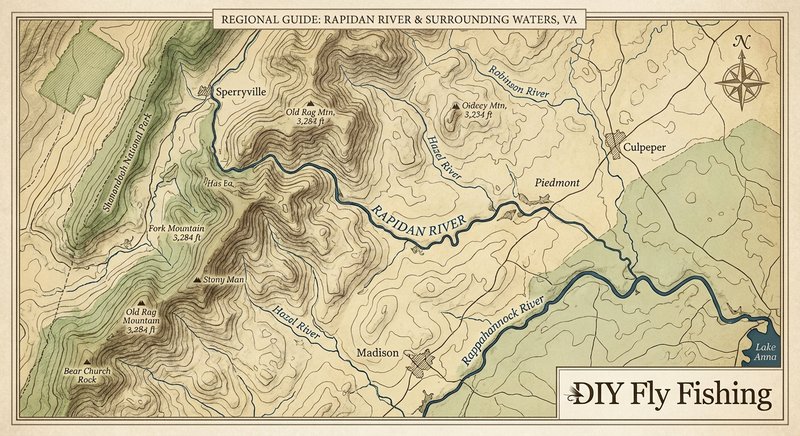
Rapidan River
Fly fishing in Virginia · Intermediate · Best seasons: Spring, Summer, Fall
Target Species
Brook Trout, Brown Trout
About This Water
Blue Ridge mountain stream with wild brook and brown trout. Shenandoah National Park waters.
Fishing Recommendations
The Rapidan River is widely considered the crown jewel of Virginia trout fishing. Flowing off the eastern slope of the Blue Ridge Mountains within Shenandoah National Park, it is a quintessential freestone mountain stream characterized by crystalline water, ancient boulders, and deep plunge pools. It holds a sacred place in fly fishing history as the favorite retreat of President Herbert Hoover and was the first stream in Virginia to be designated as "Catch and Release."
🎣 Location Overview
The Rapidan is the ultimate destination for the "blue-lining" enthusiast. Its upper reaches are rugged and pristine, offering a classic high-gradient mountain experience. The river is special because it remains one of the best strongholds for genetically pure, wild Southern Appalachian Brook Trout.
The water is chemically "soft" and nutrient-poor, meaning the fish are opportunistic and the water is incredibly clear. Anglers love it for the solitude, the stunning scenery of the Shenandoah, and the technical challenge of sneaking up on wary fish in thin water.
🐟 Target Species & Behavior
- Wild Brook Trout: The star of the show. In the upper sections (within the Park), these are 100% wild, native fish. They are vibrant, aggressive, and highly opportunistic. They typically range from 6 to 10 inches, with a 12-incher being a true trophy.
- Wild Brown Trout: As you move downstream toward the lower boundary of the Park and into the Rapidan Wildlife Management Area (WMA), you will encounter wild Brown Trout. These fish are much more elusive, nocturnal, and temperamental than the Brookies.
- Behavior: These fish are extremely "spooky." Due to the clarity of the water and the presence of predators (herons, kingfishers, and bears), they will bolt for cover if they see a shadow or a clumsy step. They hold in the "bubble line" at the head of pools, behind large mid-stream boulders, and in the deep tail-outs during low light.
📅 Best Times to Fish
- Spring (Late March – May): Prime Time. This is the window for the legendary Quill Gordon and March Brown hatches. Water levels are usually optimal, and the fish are hungry after a long winter.
- Summer (June – August): Excellent dry fly fishing, but water levels can get low and temperatures can rise. Focus on the higher elevations and shaded canyons. Terrestrials (ants/beetles) are the name of the game here.
- Fall (September – November): A magical time. The Brook Trout take on their brilliant spawning colors (deep oranges and reds). The October Caddis hatch provides some of the best dry fly action of the year.
- Best Time of Day: In Spring/Fall, 10:00 AM to 4:00 PM is best as the water warms. In the heat of Summer, focus on the "Grey Light" hours of early morning and late evening.
🪰 Recommended Flies & Techniques
Top Fly Patterns
- Dry Flies:
- Mr. Rapidan (Size 14-16): Created by local legend Harry Murray specifically for this river. It mimics everything and is highly visible.
- Royal Wulff or Stimulator (Size 14-16): Great attractor patterns for fast water.
- Parachute Adams: The gold standard for matching small Mayflies.
- Elk Hair Caddis: Essential for the heavy caddis presence on the river.
- Terrestrials: Black Foam Ants and Cinnamon Beetles (Size 16-18) are deadly in mid-summer.
- Nymphs: Pheasant Tail, Hare's Ear, and Prince Nymphs (Size 16-20). Often used as a "dropper" under a bushy dry fly.
Techniques & Presentation
- Stealth is Mandatory: Wear drab clothing (camo or olive). Do not wear white or bright colors. Kneel when approaching a pool.
- The "Dry-Dropper": This is the most effective rig. Use a buoyant dry fly (like a Mr. Rapidan) and hang a small weighted nymph 12–18 inches below it.
- Upstream Casting: Always fish facing upstream. This keeps you behind the fish's field of vision. Short, accurate casts (15–25 feet) are much better than long, messy ones.
💡 Pro Tips & Local Knowledge
- The "Hoover" Stretch: Fishing near Camp Hoover (the former Presidential retreat) offers some of the most scenic and productive water, but it requires a hike.
- The Two-Stage Approach: Many anglers fish the first pool they see. To find the bigger fish, hike at least 20–30 minutes upstream from the parking areas before you even string your rod.
- Read the Bubbles: In the plunge pools, the fish will almost always be sitting right where the white bubbles begin to dissipate into clear water.
- The "Murray" Influence: If you are in the area, visit Murray’s Fly Shop in Edinburg. Harry Murray literally wrote the book on the Rapidan; his patterns and advice are the local gospel.
⚠️ Important Information
- Regulations: The Rapidan River and its tributaries within Shenandoah National Park are Catch and Release ONLY. You must use single-hook, artificial lures only. No bait, and no treble hooks.
- Access:
- From the Bottom: Access through the Rapidan Wildlife Management Area (Criglersville side). This requires a vehicle with decent clearance, as the road (Route 649) can be rough.
- From the Top: Access via Skyline Drive. Park at Milam Gap (Mile 52.4) and hike down the Mill Prong trail to reach the upper Rapidan.
- Permits: You need a valid Virginia Freshwater Fishing License. If fishing within the National Park, ensure you have your park entrance pass.
- Wildlife: This is active Black Bear country. Keep your snacks sealed and be aware of your surroundings. Also, watch for Copperheads on the rocky banks during the summer.
Bug Hatches & Matching Flies
| Hatch | Type | Peak months | Time of day | Hook sizes | Matching flies |
|---|---|---|---|---|---|
| Quill Gordon Epeorus pluralis | mayfly | March, April | Midday | #12-14 | Quill Gordon Dry #12-14, Quill Gordon Nymph #12-14 |
| Blue Quill Paraleptophlebia adoptiva | mayfly | March, April | Midday to Afternoon | #16-18 | Blue Quill Dry #16-18, Pheasant Tail Nymph #16-18 |
| Hendrickson Ephemerella subvaria | mayfly | April | Afternoon | #12-14 | Red Quill #12-14, Hendrickson Emerger #12-14 |
| March Brown Maccaffertium vicarium | mayfly | May | Afternoon | #10-12 | March Brown Dry #10-12, Hare's Ear Nymph #10-14 |
| Sulfur Ephemerella dorothea | mayfly | May, June | Evening | #14-18 | Sulfur Parachute #14-18, Sulfur Sparkle Dun #14-18 |
| Little Yellow Stonefly (Yellow Sally) Isoperla spp. | stonefly | May, June, July | Late Afternoon/Evening | #14-16 | Yellow Sally Dry #14-16, Yellow Sally Nymph #14-16 |
| Blue Winged Olive (BWO) Baetis spp. | mayfly | March, April, September, October | Midday/Cloudy days | #18-22 | BWO Sparkle Dun #18-22, RS2 #20-22 |
| Cinnamon Caddis Hydropsyche spp. | caddis | May, June, July, August | Evening | #14-16 | Elk Hair Caddis (Tan) #14-16, LaFontaine's Deep Sparkle Pupa #14-16 |
| Terrestrials (Ants and Beetles) Formicidae / Coleoptera | terrestrial | June, July, August, September | All day | #14-20 | Black Foam Ant #16-20, Cricket or Beetle #12-16 |