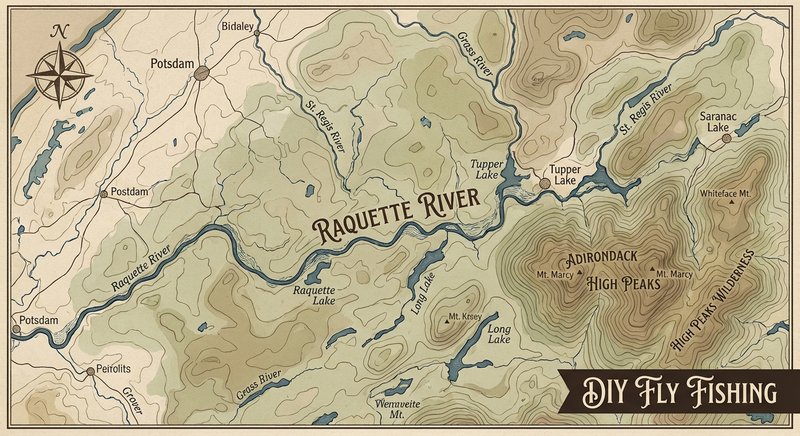
Raquette River
Fly fishing in New York · Beginner · Best seasons: Summer, Fall
Target Species
Smallmouth Bass, Brook Trout, Brown Trout
About This Water
Adirondack river with smallmouth bass and trout. Multiple stretches with varied fishing.
Fishing Recommendations
The Raquette River is the second-longest river in New York State, flowing over 146 miles from the Adirondack High Peaks to the St. Lawrence River. For a fly angler, it is a "tale of two rivers." The upper sections are quintessential Adirondack wilderness—tea-colored water, boulders, and brook trout—while the middle and lower sections transform into a premier warm-water fishery characterized by massive granite shelves and aggressive smallmouth bass.
Here is your comprehensive guide to fly fishing the Raquette River.
🎣 Location Overview
The Raquette is unique because of its diverse topography. It drops significantly in elevation as it moves north, creating a mix of slow-moving "flow" sections (like the Oxbow near Tupper Lake) and high-gradient, oxygenated rapids.
What makes it special is the solitude. Unlike the crowded Ausable or Delaware, you can often spend a whole day on the Raquette without seeing another angler. The water is stained with tannins (looking like dark tea), which provides excellent cover for fish but requires anglers to use fly patterns with high contrast.
🐟 Target Species & Behavior
Smallmouth Bass (The Main Attraction)
The Raquette is arguably one of the best smallmouth rivers in the Northeast.
- Behavior: These fish are incredibly athletic due to the river's current. They hold in the "seams" where fast water meets slow water and behind large boulders.
- Feeding: They focus on crayfish and baitfish (shiners and dace). In late summer, they become very opportunistic with terrestrial insects.
Brook Trout & Brown Trout
Found primarily in the upper reaches (above Tupper Lake) and in the cold-water tributaries.
- Behavior: They seek "thermal refuge" during the summer, meaning they stay near cold-water springs or deep, shaded oxygenated pockets.
- Feeding: They rely on classic Adirondack hatches (Mayflies, Caddis) but are notorious for hitting large streamers during the fall transition.
📅 Best Times to Fish
Summer (June – August)
- Smallmouth: This is the prime window. The water is warm, and the bass are metabolism-driven.
- Trout: Focus on the early morning or late evening when water temperatures are lowest.
- Prime Window: "The Golden Hour"—the 90 minutes before sunset—is when the massive Hexagenia (Green Drake) hatches can occur in the slower stretches, bringing even the biggest bass and trout to the surface.
Fall (September – October)
- The Transition: As water temperatures drop, Smallmouth begin to feed aggressively to bulk up for winter.
- Brown Trout: This is when the big migratory Browns move. They become territorial and aggressive.
- Conditions: Overcast, drizzly days in October are often the best days of the year for trophy-sized fish on the Raquette.
🪰 Recommended Flies & Techniques
For Smallmouth Bass
- Topwater: Dahlberg Divers or clacker-style poppers in black or olive. There is nothing like a Raquette Smallie smashing a popper in a current seam.
- Sub-surface: Game Changers or Woolly Buggers (Size 4-8) in Black, Olive, or "Copper/Brown" to mimic crayfish.
- Technique: "Swing and Strip." Cast across the current, let the fly swing into the soft water, and use erratic strips to mimic a wounded baitfish.
For Trout
- Dry Flies: Stimulators (Orange/Yellow), Adirondack Adams, and Royal Wulffs.
- Nymphing: Pheasant Tails and Prince Nymphs (Size 14-18). Because of the dark water, use beads (gold or copper) to add flash.
- Streamers: Black Ghost or Muddler Minnows.
💡 Pro Tips & Local Knowledge
- Follow the "Flows": The sections between the dams (like the stretch between Piercefield and Colton) are local favorites. The Colton "Stone Valley" section is rugged and beautiful but requires nimble wading.
- Tannin Tactics: Because the water is dark, don't be afraid to use fluorescent hot-spots on your nymphs or extra-flashy flashabou on your streamers. The fish need to see the silhouette through the "tea."
- The "Crayfish Kick": When fishing for Smallmouth, let your fly bounce off the bottom of granite ledges. Bass often sit right under the lip of the rock waiting for a crayfish to get swept over the edge.
- Canoe/Kayak is King: While there is wade access, the best way to fish the Raquette is by floating it. This allows you to reach the mid-river boulders that shore-bound anglers can't touch.
⚠️ Important Information
Access
- Upper River: Access via Axton Landing or the Crusher boat launch near Tupper Lake.
- Middle/Lower: Look for NYSDEC "Public Fishing Rights" (PFR) signs along Route 56 between Sevey’s Corner and Potsdam.
Regulations & Permits
- License: A valid New York State fishing license is required (available online or at local outfitters).
- Trout Specs: Many sections have specific "Catch and Release" or "Artificial Lures Only" regulations, especially in the fall. Always check the NYSDEC Freshwater Fishing Regulations for the specific county (Franklin or St. Lawrence) you are in.
Special Considerations
- Wading Safety: The Raquette is notorious for "slippery snot" rocks. Felt-soled boots or studs are highly recommended.
- Black Flies: If fishing in June or July, bring heavy-duty bug repellent or a head net. The Adirondack black fly is no joke.
- Cell Service: It is extremely spotty. Download your maps for offline use before heading out.
Tight lines, and enjoy one of the last true wilderness rivers in the East!
Bug Hatches & Matching Flies
| Hatch | Type | Peak months | Time of day | Hook sizes | Matching flies |
|---|---|---|---|---|---|
| Hendrickson Ephemerella subvaria | mayfly | May | Afternoon | #12-14 | Red Quill #12-14, Hendrickson Emerger #14, Pheasant Tail #12-14 |
| March Brown Maccaffertium vicarium | mayfly | May, June | Afternoon | #10-12 | March Brown Dry #10-12, Gold Ribbed Hare's Ear #10-12 |
| Grannom Caddis Brachycentrus | caddis | April, May | Morning/Afternoon | #14-16 | Elk Hair Caddis (Dark) #14-16, LaFontaine's Deep Sparkle Pupa #14-16 |
| Sulphur Ephemerella invaria/dorothea | mayfly | June, July | Evening | #14-18 | Sulphur Parachute #16-18, CDC Sulphur Emerger #16-18 |
| Isonychia (Slate Drake) Isonychia bicolor | mayfly | June, July, August, September | Late Afternoon/Evening | #10-12 | Iso Parachute #10-12, Zug Bug #10-12, Prince Nymph #10-12 |
| Giant Stonefly Pteronarcys dorsata | stonefly | May, June | Morning/Evening | #4-8 | Pat's Rubber Legs #4-8, Stimulator (Orange/Black) #6-10 |
| White Fly Ephoron leukon | mayfly | August | Late Evening/Night | #12-14 | White Wulff #12-14, White Miller #12-14 |
| Blue Winged Olive Baetis | mayfly | April, May, September, October | Afternoon | #18-22 | BWO Sparkle Dun #18-22, RS2 (Olive) #20-22 |
| Terrestrials Formicidae / Coleoptera | terrestrial | July, August, September | All Day | #12-18 | Black Foam Ant #14-18, Beefus Beetle #12-16 |