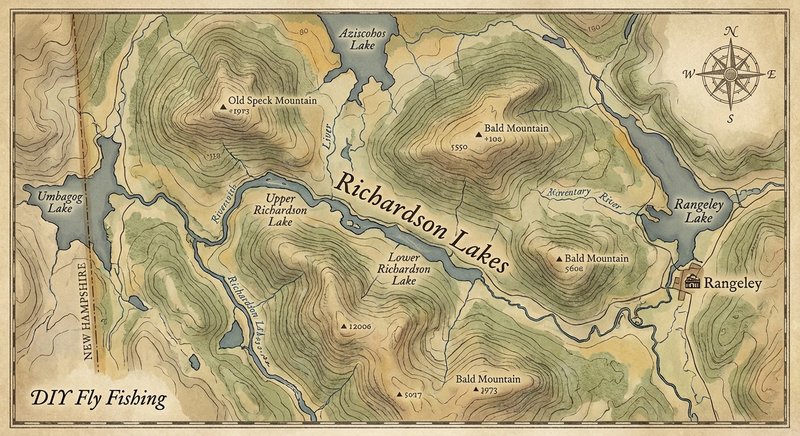
Richardson Lakes
Fly fishing in Maine · Intermediate · Best seasons: Spring, Summer, Fall
Target Species
Brook Trout, Landlocked Salmon
About This Water
Western Maine lakes with trophy brook trout and landlocked salmon. Remote wilderness.
Fishing Recommendations
Welcome to the legendary waters of the Rangeley Lakes region. As a guide in these parts, I can tell you that Upper and Lower Richardson Lakes represent the pinnacle of traditional Maine fly fishing. This is the land of Carrie Stevens, the Grey Ghost, and some of the largest wild Brook Trout in the lower 48.
Here is your comprehensive guide to fishing the Richardson Lakes.
🎣 Location Overview
The Richardson Lakes (Upper and Lower) are part of a chain of lakes in Western Maine’s Oxford County. What makes this area special is its connectivity and heritage. Upper Richardson is fed by the famous Upper Dam (flowing from Mooselookmeguntic Lake), and Lower Richardson empties into the Rapid River, arguably the finest wild Brook Trout river in the Eastern United States.
The water is classic "Northwoods"—crystal clear, cold, and surrounded by dense forests of spruce, fir, and birch. Anglers love it because it offers a "step back in time" experience. You aren't just fishing for stocked fish here; you are chasing the descendants of the same wild strains that drew presidents and legends like Herb Welch and Carrie Stevens a century ago.
🐟 Target Species & Behavior
Brook Trout (Squaretails)
- Behavior: These are wild, native fish. In the spring, they hug the shorelines and inlets looking for smelt. As the water warms in summer, they drop into the deep "cool holes" of the lake or stack up at the mouth of cold-water tributaries.
- Feeding: Their primary protein source is the Rainbow Smelt. However, they are opportunistic and will gorge on Hexagenia mayflies in early July.
Landlocked Salmon
- Behavior: Faster and more aggressive than the trout, salmon are nomadic. They follow the smelt schools relentlessly. They are known for their acrobatic leaps once hooked.
- Feeding: 90% of their diet in these lakes is smelt. If you find the bait, you find the salmon.
📅 Best Times to Fish
Spring (Ice-Out to Mid-June)
- The Prime Window: This is the best time for trophy fish. As the ice melts, smelt move into the shallows and stream mouths to spawn. The trout and salmon follow them.
- Conditions: Cold, often rainy, but the fish are in 5–10 feet of water and highly aggressive.
Summer (July to August)
- The Hex Hatch: Late June through mid-July features the Hexagenia limbata (Giant Yellow Mayfly) hatch. This is the only time the biggest fish in the lake consistently rise to the surface.
- Daytime: Fishing slows down in the main lakes during the heat of the day; focus on the "Upper Dam" pool or the "Narrows" where there is current and oxygen.
Fall (September)
- The Spawn Run: Salmon and trout begin staging near the mouth of the Rapid River and Upper Dam. The Brook Trout take on vivid orange spawning colors.
- Note: Fishing can be spectacular, but be mindful of the cooling water and changing regulations as the season closes (Sept 30th for most moving water).
🪰 Recommended Flies & Techniques
Streamer Fishing (The Maine Tradition)
This is the most effective way to fish the Richardsons.
- Patterns: Grey Ghost, Black Ghost, Herb Johnson’s Smelt, Governor Aiken, and the Mickey Finn.
- Technique: Use a 6-weight rod with a 10–15 foot sink-tip line. Cast toward the rocky shorelines or "the drop-off" and strip back with erratic pulses to mimic a wounded smelt.
Dry Fly Fishing
- Patterns: Hexagenia (Size 6-8), Elk Hair Caddis (Size 12-14), Royal Wulff, and Blue-Winged Olives for rainy days.
- Technique: During the Hex hatch at dusk, look for "sip" rises. Cast ahead of the cruising fish and let it sit.
Nymphing
- Patterns: Golden Stoneflies, Pheasant Tails, and Prince Nymphs.
- Technique: Most effective in the moving water of Upper Dam or the Narrows. Use a high-indicator rig or "Euro-style" in the heavy pockets.
💡 Pro Tips & Local Knowledge
- The "Upper Dam" Pool: This is hallowed ground. It’s the short stretch of water connecting Mooselookmeguntic to Upper Richardson. It holds massive fish. Use a "smelt-style" streamer on a sinking line and swing it through the current like you’re fishing for steelhead.
- The Narrows: The passage between Upper and Lower Richardson often has a slight current. This is a natural bottleneck for smelt and a prime spot to troll or cast streamers.
- Watch the Wind: The Richardsons are oriented in a way that northwesterly winds can whip up dangerous "whitecaps" quickly. Always check the weather; if the wind picks up, get to the leeward shore immediately.
- The "Drop-Off": Use a fish finder or topographic map. The Brookies love to sit right where the shallow shelf drops from 10 feet into 30+ feet of water.
⚠️ Important Information
- Access: Much of the land around the Richardsons is privately managed timberland or part of the Rangeley Lakes Heritage Trust. Access is often via long, gravel logging roads (South Arm Road). Ensure your spare tire is inflated.
- Regulations: Maine fishing laws are specific.
- F.F.O.: Many areas (like the Rapid River and parts of Upper Dam) are Fly Fishing Only.
- Barbless Hooks: Highly recommended (and required in some sections) to protect the wild fish population.
- Always check the Maine IF&W Rulebook for "S-Codes" (Special Regulations).
- Permits: You need a valid Maine Fishing License, which can be purchased online.
- Cell Service: Expect zero bars once you leave the main paved roads. Download your maps for offline use.
Guide’s Final Word: Treat these fish with respect. Use a rubber net, keep them in the water, and if you're lucky enough to land a 4-pound "Squaretail," take a quick photo and let her go. That fish is a treasure of the Northwoods.
Bug Hatches & Matching Flies
| Hatch | Type | Peak months | Time of day | Hook sizes | Matching flies |
|---|---|---|---|---|---|
| Hexagenia (The Hex) Hexagenia limbata | mayfly | June, July | Dusk/Evening | #6-10 | Hexagenia Spinner #6-8, Hexagenia Nymph #6-10, Wiggle Hex #8 |
| Hendrickson Ephemerella subvaria | mayfly | May, June | Afternoon | #12-14 | Red Quill #12-14, Hendrickson Emerger #12-14, Pheasant Tail #12-14 |
| Blue-Winged Olive (BWO) Baetis / Drunella | mayfly | May, September, October | Midday | #18-22 | RS2 #18-22, BWO Sparkle Dun #18-20, Parachute Adams #18-22 |
| Grannom Caddis Brachycentrus | caddis | May | Morning/Afternoon | #14-16 | Elk Hair Caddis (Olive) #14-16, Grannom Pupa #14-16, Holy Grail #14-16 |
| Brown Drake Ephemera simulans | mayfly | June | Evening | #10-12 | Brown Drake Cripple #10-12, Brown Drake Spinner #10-12 |
| Cinnamon Caddis Hydropsyche | caddis | June, July, August | Evening | #14-18 | LaFontaine's Deep Pupa #14-16, Tan Elk Hair Caddis #14-18 |
| Flying Ant Formicidae | terrestrial | August, September | Afternoon | #16-20 | Black Foam Ant #16-20, Cinnamon Flying Ant #16-18 |
| March Brown Maccaffertium vicarium | mayfly | June | Afternoon | #10-12 | March Brown Dun #10-12, Gold Ribbed Hare's Ear #10-14 |