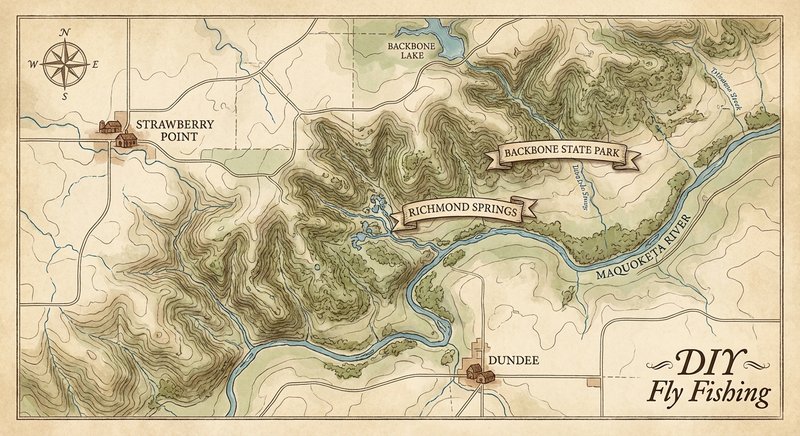
Richmond Springs
Fly fishing in Iowa · beginner · Best seasons: spring, summer, fall
Target Species
Rainbow Trout, Brown Trout
About This Water
Delaware County spring-fed stream. Stocked trout with consistent cool water.
Fishing Recommendations
As an expert guide who has spent years navigating the hidden gems of the Driftless Area and the limestone spring creeks of the Midwest, it is a pleasure to break down Richmond Springs.
Located within Backbone State Park (Iowa’s oldest state park), Richmond Springs is the headwater of the Maquoketa River. This is a quintessential limestone spring creek—crystal clear, cold, and challenging. It offers a unique "mountain-style" aesthetic right in the heart of the Hawkeye State.
🎣 Location Overview
Richmond Springs is a geological marvel. The spring itself gushes from the base of a massive limestone bluff at a rate of nearly 2,000 gallons per minute, maintaining a consistent 48–52°F temperature year-round.
What makes this water special is its clarity and stability. While other Iowa rivers might blow out after a heavy rain, Richmond Springs clears relatively quickly. The upper stretch is characterized by shallow riffles, deep limestone-walled pools, and heavy aquatic vegetation (watercress and elodea). Anglers love it because it offers a "technical" experience—you can often see the fish you are casting to, but they can see you just as easily.
🐟 Target Species & Behavior
The Iowa DNR manages this water heavily, providing a mix of opportunities:
- Rainbow Trout: These are primarily stocked "catchable" fish. They tend to congregate in the deeper pools near the spring head and the bridge crossings. They are generally opportunistic but become "educated" within 48 hours of a stocking truck's visit.
- Brown Trout: This is where the real challenge lies. There are holdover and wild Brown Trout in this system. They are incredibly wary and favor the undercut banks, submerged logs, and the darker shadows beneath the limestone cliffs.
- Behavior: Due to the high water clarity, these fish are "spooky." In the morning, they may move into the shallow riffles to feed, but as the sun rises, they retreat to the protection of the weed beds and rock shelves.
📅 Best Times to Fish
- Spring (April - June): This is prime time. The aquatic insect life begins to stir. Overcast days in May can produce spectacular Blue-Winged Olive (BWO) hatches.
- Summer (July - August): While other Iowa streams get too warm for trout, Richmond Springs remains a "cold-water refuge." This is Terrestrial Season. Look for fish tight against the banks waiting for grasshoppers or ants to fall.
- Fall (September - November): The Brown Trout become aggressive and territorial as they prepare for the spawn. This is your best chance at a "trophy" fish using streamers.
- Optimal Windows: The "Golden Hours" (first two hours of light and last two hours of light) are critical here. Because the water is so clear, mid-day sun usually sends the fish into hiding unless there is significant cloud cover.
🪰 Recommended Flies & Techniques
Nymphing (The Bread & Butter)
The biomass in Richmond Springs is dominated by Scuds and Sowbugs.
- Top Patterns: Pink or Orange Scuds (size 14–18), Ray Charles (grey/tan), and Zebra Midges (black or red, size 18–22).
- Technique: Use a "Tippet Ring" and a very long leader (9ft to 12ft) to avoid spooking fish. Sight-nymphing is highly effective here—watch the white of the fish’s mouth to time your hook set.
Dry Flies
- Top Patterns: Adams (Parachute style), Elk Hair Caddis (size 16–18), and Griffith’s Gnat for midge clusters.
- Terrestrials: Fat Albert or Dave’s Hopper (size 10–14) and Black Foam Ants (size 18).
- Technique: A delicate presentation is mandatory. Use a 6X or 7X fluorocarbon tippet.
Streamers
- Top Patterns: Woolly Buggers (Olive or Black, size 10–12) and small pine squirrel leeches.
- Technique: "Dead-drift" the streamer through deep holes, then give it a few erratic twitches at the end of the swing.
💡 Pro Tips & Local Knowledge
- The "Stealth" Approach: Many anglers make the mistake of standing right on the bank. At Richmond Springs, you should stay 5-10 feet back from the water’s edge or crouch down. If you can see the trout, they have likely already seen you.
- Fish the "Greenery": The thick beds of elodea (aquatic weeds) act as oxygen factories and food larders. Look for small "lanes" or openings in the weeds. Dropping a weighted scud into these lanes is a high-percentage move.
- The "Backbone" Hike: Don't just fish the pool at the spring head where the crowds are. Hike downstream into the wooded sections of the park. The water becomes more diverse with better structure, and the fishing pressure drops significantly.
- Check the Stocking Calendar: The Iowa DNR website posts a trout stocking calendar. If you want a high catch rate, go the day of a stocking. If you want a more "wild" experience, go several days after.
⚠️ Important Information
- Permits: You must have a valid Iowa Fishing License AND a paid Trout Fee.
- Regulations: While Richmond Springs is generally "all tackle," always check the posted signs at the park entrance for any recent changes to length limits or lure restrictions.
- Gear Recommendation: A 3-weight or 4-weight fly rod (7'6" to 8'6") is perfect for this water. Anything heavier is overkill and will likely result in "slapping" the water too hard.
- Wading: Be careful wading; the limestone can be slick, and the silt in certain areas is deeper than it looks. Felt soles or studs are recommended.
Guide’s Final Word: Richmond Springs is a gem of the Midwest. Treat it with respect, practice Catch & Release whenever possible to preserve the holdover population, and keep your shadow off the water!
Bug Hatches & Matching Flies
| Hatch | Type | Peak months | Time of day | Hook sizes | Matching flies |
|---|---|---|---|---|---|
| Blue-Winged Olive Baetis | mayfly | March, April, September, October | Afternoon | #18-22 | RS2 #18-22, Parachute BWO #18-20, WD-40 #20-22 |
| Midges Chironomidae | midge | January, February, March, December | Late Morning/Early Afternoon | #20-24 | Zebra Midge #20-24, Griffith's Gnat #20-22, Top Secret Midge #22-24 |
| Grannom Caddis Brachycentrus | caddis | April, May | Morning/Evening | #14-16 | Peacock Caddis #14-16, Deep Sparkle Pupa #14-16, Elk Hair Caddis #14-16 |
| Sulfurs Ephemerella invaria | mayfly | May, June | Evening | #16-18 | Sparkle Dun #16-18, Sulfur Parachute #16-18, Pheasant Tail #16-18 |
| Trico Tricorythodes | mayfly | July, August, September | Early Morning | #22-26 | Trico Spinner #22-26, Sunken Trico Spinner #22-24 |
| Spotted Sedge Hydropsyche | caddis | June, July, August | Evening | #14-18 | Tan Elk Hair Caddis #14-18, LaFontaine's Emergent Sparkle Pupa #16 |
| Light Cahill Stenacron interpunctatum | mayfly | June, July | Late Evening | #12-14 | Light Cahill Dry #12-14, Gold Ribbed Hare's Ear #12-14 |
| Terrestrials Formicidae/Coleoptera | terrestrial | July, August, September | All Day | #12-18 | Chernobyl Ant #12-14, Black Foam Beetle #14-16, Cinnamon Ant #16-18 |