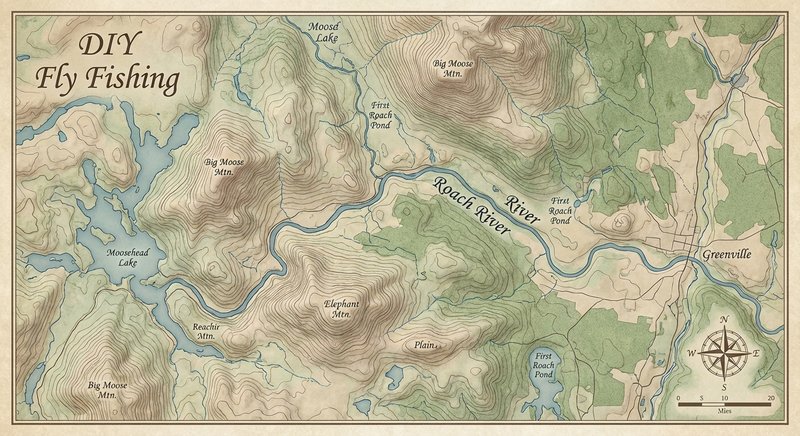
Roach River
Fly fishing in Maine · Intermediate · Best seasons: Spring, Summer, Fall
Target Species
Brook Trout, Landlocked Salmon
About This Water
Moosehead Lake tributary with excellent brook trout and salmon. Scenic wilderness setting.
Fishing Recommendations
As an expert guide who has spent many seasons navigating the North Maine Woods, the Roach River holds a special place in my heart. It is, quite simply, one of the finest stretches of fly-fishing water in the Eastern United States.
Here is your comprehensive guide to fishing this Maine gem.
🎣 Location Overview
The Roach River is a 6.3-mile stretch of pristine water flowing from First Roach Pond in Kokadjo down to Spencer Bay on Moosehead Lake. What makes it special is its designation: it is managed as Fly Fishing Only (FFO) and is strictly Catch and Release.
The river is a classic "pool-and-drop" fishery. You’ll find everything from plunging runs and deep, dark pools to wide, gravelly riffles. It feels wild—surrounded by dense pine forests where you’re more likely to see a moose than another angler. Because the water flow is regulated by a dam at Kokadjo, it often maintains fishable flows even when other Maine freestone rivers are bone-dry in mid-summer.
🐟 Target Species & Behavior
The Roach is famous for its "runs." While there are resident fish, the river acts as a primary spawning thoroughfare for the giants of Moosehead Lake.
- Landlocked Salmon: These are the "silver bullets." In the spring, they follow smelt runs; in the fall, they move up to spawn. They are known for aerial acrobatics and aggressive takes. They hold in the faster "bubble line" at the head of pools or in the heavy chop.
- Brook Trout: These are wild, native Maine Brookies. In the spring and summer, they are vibrant and hungry. By September, they take on their breathtaking spawning colors—deep orange bellies and haloed spots. They tend to hold in the softer seams, behind boulders, and in the undercut banks.
📅 Best Times to Fish
- Spring (Late May – June): This is the prime window for aquatic insect hatches and the post-smelt run. The fish are hungry after a long winter.
- Summer (July – August): The river stays cooler than most due to the bottom-release dam. This is the time for technical dry-fly fishing and "terrestrials" (ants and beetles).
- Fall (September 1st – September 30th): The "Grand Finale." This is when the massive Salmon and Brookies migrate up from Moosehead Lake. The fish are large, aggressive, and concentrated. Note: The river closes to fishing on October 1st.
Best Time of Day: During summer, early morning and "liquid gold" (the last hour of light) are essential. On overcast fall days, the fish may move and strike all day long.
🪰 Recommended Flies & Techniques
Nymphing (The High-Confidence Method)
Most fish in the Roach are caught sub-surface.
- Patterns: Pheasant Tail (#14-18), Prince Nymph (#12-14), and the Copper John.
- Pro Secret: The Stonefly nymph in golden or black (#8-12) is a staple here year-round.
- Technique: Use a strike indicator, but in the crystal clear water, try "Euro-style" or high-stick nymphing to avoid spooking fish with a heavy fly line.
Dry Flies (The Purest Joy)
- Patterns: Elk Hair Caddis (#14-16), Adams (#14-18), and the Blue Winged Olive (BWO) on cloudy days.
- Terrestrials: In August, a #14 black foam ant can be deadly.
- Technique: Long leaders (9-12 feet) ending in 5X or 6X tippet are necessary for the flat water in the larger pools.
Streamers (For the Big Pull)
- Patterns: The Grey Ghost (a Maine classic), Black Ghost, or a Muddler Minnow. For modern tastes, a small olive Wooly Bugger.
- Technique: "Swing" the fly across the current at the head of the pools. For Salmon, a fast, erratic strip often triggers a territorial strike.
💡 Pro Tips & Local Knowledge
- The "Kokadjo Stretch": Most people fish right near the bridge in Kokadjo. To find the trophies, be prepared to hike. Use the logging road turnouts to access the middle sections of the river. The further you walk from the road, the better the fishing gets.
- Watch Your Shadow: The water is exceptionally clear. If you stand on a high bank, your shadow will clear a pool faster than a hungry otter. Stay low and wade quietly.
- The "Egg" Factor: In September, as fish begin to spawn, an egg pattern (Glo-Bug) trailed behind a nymph can be the most effective rig on the river.
- Check the Flow: Before driving up, check the USGS gauge for the Roach River. Ideal flows are between 100 and 250 CFS. If it's over 400, wading becomes dangerous and the fish hunkered down.
⚠️ Important Information
- Access: Access is via the Lily Bay Road from Greenville heading toward Kokadjo. The roads are often unpaved logging roads; watch out for logging trucks—they have the right of way!
- Regulations:
- Fly Fishing Only (FFO).
- Catch and Release ONLY.
- Check the current Maine Open Water Fishing Laws (North Zone) for any emergency changes.
- Gear: A 9-foot, 5-weight rod is the perfect "all-around" tool for the Roach. A 4-weight is fun for summer dries, while a 6-weight is better for hucking heavy streamers in the fall.
- Safety: This is bear and moose country. Carry a map (the DeLorme Maine Atlas & Gazetteer is the gold standard) and tell someone where you are going, as cell service is non-existent.
Final Guide Tip: Stop at the Kokadjo First Roach Pond Store for a "Moose Burger" and the latest river report. The folks there know exactly what's hatching that morning. Tight lines!
Bug Hatches & Matching Flies
| Hatch | Type | Peak months | Time of day | Hook sizes | Matching flies |
|---|---|---|---|---|---|
| Hendrickson Ephemerella subvaria | mayfly | May, June | Afternoon | #12-14 | Red Quill #12-14, Hendrickson Nymph #12-14, Hendrickson Emerger #14 |
| Blue Winged Olive Baetis / Drunella | mayfly | May, September, October | Midday | #18-22 | RS2 #18-22, BWO Sparkle Dun #18-20, Pheasant Tail #16-20 |
| Grannom Caddis Brachycentrus | caddis | May | Morning/Evening | #14-16 | Grannom Pupa #14-16, Elk Hair Caddis (Black/Dark Olive) #14-16 |
| Golden Stonefly Acroneria / Hesperoperla | stonefly | June, July | Evening | #8-12 | Kaufmanns Stone #8-12, Golden Stimulator #10-12 |
| Slate Drake Isonychia bicolor | mayfly | July, August, September | Late Afternoon/Evening | #10-12 | Isonychia Nymph #10-12, Parachute Adams #10-12, Zug Bug #10-14 |
| Tan Caddis Hydropsyche | caddis | June, July, August | Evening | #14-18 | Tan Elk Hair Caddis #14-18, LaFontaine's Deep Sparkle Pupa #14-16, X-Caddis #16 |
| Giant Black Stonefly Pteronarcys dorsata | stonefly | May, June | All Day/Night | #4-8 | Pat's Rubber Legs (Black) #4-8, Black Stimulator #6-8 |
| Terrestrials (Ants and Beetles) Formicidae / Coleoptera | terrestrial | July, August, September | All Day | #12-18 | Black Foam Ant #14-18, Flying Ant #16, Chernobyl Ant #10-12 |