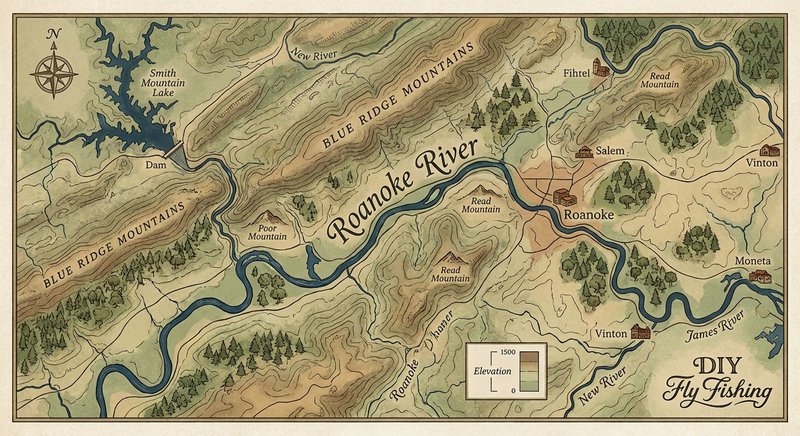
Roanoke River
Fly fishing in Virginia · Intermediate · Best seasons: Spring, Summer, Fall
Target Species
Smallmouth Bass, Striped Bass, Channel Catfish
About This Water
Central Virginia river with diverse species. Smallmouth bass in upper reaches.
Fishing Recommendations
The Roanoke River in Virginia is a diverse and dynamic fishery that offers a unique "split personality" depending on which section you fish. From the high-gradient, rocky waters near Salem and Roanoke to the powerful tailwaters below the massive impoundments of Smith Mountain and Leesville Lakes, this river is a playground for fly anglers seeking hard-fighting warm-water species.
🎣 Location Overview
The Roanoke River (known in its upper reaches as the Staunton River) is a centerpiece of Southwest Virginia. What makes it special is the accessibility provided by the Roanoke River Blueway, a system of water trails and access points that allow for both wading and floating through urban and wild landscapes.
The water characteristics vary significantly:
- Upper River (Salem/Roanoke City): Characterized by classic riffle-run-pool sequences, limestone ledges, and clear water. This is prime wading territory.
- Lower River (Below the Dams): This is a larger, more powerful river. It is influenced by power generation (pulses of cold/fast water), creating a "tailwater" environment that supports massive populations of baitfish and migratory predators.
🐟 Target Species & Behavior
Smallmouth Bass
The "Bronze Back" is the king of the upper Roanoke. They are highly opportunistic.
- Behavior: They hold in "seams" where fast water meets slow water, behind mid-stream boulders, and along the deep limestone ledges.
- Feeding: They focus on crayfish and hellgrammites (larval dobsonflies), moving to the surface for damsel flies and cicadas in mid-summer.
Striped Bass (Landlocked and Migratory)
The Roanoke is famous for its Stripers. While the famous "run" happens further south in Weldon, NC, the Virginia sections below Smith Mountain Lake hold massive resident and lake-run fish.
- Behavior: These are "wolf pack" hunters. They follow schools of Gizzard Shad. Look for them in deep holes during the day and moving into shallow flats or tailraces to hunt at dawn and dusk.
- Feeding: Almost exclusively piscivorous (fish-eaters).
Channel Catfish
Often ignored by fly anglers, the Roanoke holds a healthy population of "cats" that are surprisingly aggressive.
- Behavior: They aren't just bottom feeders; they are active predators in the Roanoke. They often hold in the deep, dark slots at the tail-end of runs.
- Feeding: They respond to scent and vibration. On a fly rod, they are most often caught on large, dark streamers stripped slowly near the bottom.
📅 Best Times to Fish
- Spring (April – June): The "Prime Time." This is when the Striped Bass move upriver to spawn. The Smallmouth also become highly aggressive pre-spawn.
- Condition: Watch for spring rains; the river can blow out (become muddy) quickly.
- Summer (July – August): Best for Smallmouth topwater action.
- Time of Day: Low light is key. Be on the water at 5:30 AM or fish the "magic hour" before sunset to avoid the Virginia heat.
- Fall (September – November): As water temperatures drop, Smallmouth and Stripers go on a feeding binge to prepare for winter.
- Condition: The clearest water of the year. Use longer leaders and more stealthy presentations.
🪰 Recommended Flies & Techniques
For Smallmouth Bass
- Topwater: BoogleBugs (Poppers) in "Electric Yellow" or "Frog." Use a rhythmic pop-pop-pause retrieve.
- Sub-surface: Clouser Minnows (Chartreuse/White) and Game Changers. For crayfish imitations, the Near Nuff Crayfish is a local favorite.
- Technique: "Dead-drifting" a hellgrammite pattern (large black rubber-leg nymph) under an indicator through deep runs is a "guide secret" for trophy Smallies.
For Striped Bass
- Patterns: Cowen’s Baitfish, Left’s Deceiver (6-8 inches long), and heavy Clouser Minnows with extra-large dumbbell eyes.
- Technique: Use a sink-tip line (250-350 grain). You must get the fly down to the fish in the heavy current. Use a "strip-strip-pause" retrieve to mimic a wounded shad.
For Channel Catfish
- Patterns: Large, black Woolly Buggers or Bunny Leaches.
- Technique: Fish the deepest pools. Let the fly sink to the absolute bottom and "crawl" it back with tiny strips.
💡 Pro Tips & Local Knowledge
- The "Salem Stretch": The section through the City of Salem offers some of the best Smallmouth wading. Access via Green Hill Park or Rotary Park. The limestone influence here keeps the fish healthy and the water fertile.
- Watch the Gauges: Before heading out, check the USGS Gauge for Roanoke River at Roanoke. If it’s over 3.0 feet, wading becomes dangerous. Ideally, look for 2.0 to 2.5 feet for safe wading.
- The Shad Factor: Below the dams, if you see "flickering" on the surface, those are shad. If the shad are there, the Stripers are right underneath them. Match the size of your fly to the size of the shad you see.
- Stealth Matters: In the summer, the river runs very clear. Wear earthy tones (camo or tan) and avoid splashing. Roanoke Smallmouth are pressured and can be "spooky."
⚠️ Important Information
- Access: Use the Roanoke River Blueway website to find public put-in and take-out points. Many areas are bordered by private property; stay in the riverbed.
- Regulations: A valid Virginia Freshwater Fishing License is required. Note that there are specific creel limits and size minimums for Smallmouth and Striped Bass that change seasonally—always check the Virginia DWR website for the latest updates.
- Safety: The rocks in the Roanoke are notoriously slippery (covered in "didmo" or fine silt). Studded wading boots and a wading staff are highly recommended.
- Dam Releases: If fishing below Smith Mountain Lake or Leesville Lake, be extremely cautious of rising water levels due to power generation. The water can rise several feet in minutes.
Bug Hatches & Matching Flies
| Hatch | Type | Peak months | Time of day | Hook sizes | Matching flies |
|---|---|---|---|---|---|
| Blue Winged Olive Baetis spp. | mayfly | March, April, October, November | Late Morning/Afternoon | #18-22 | RS2 #18-22, BWO Sparkle Dun #18-20, Pheasant Tail #18-20 |
| Quill Gordon Epeorus pluralis | mayfly | March, April | Mid-day | #12-14 | Quill Gordon Dry #12-14, Hare's Ear #12-14 |
| Tan Caddis Hydropsyche | caddis | April, May, June | Evening | #14-18 | Elk Hair Caddis #14-16, LaFontaine's Deep Sparkle Pupa #14-18, Holy Grail Caddis #16 |
| Sulfur Mayfly Ephemerella invaria | mayfly | May, June | Late Afternoon/Evening | #14-18 | Parachute Sulfur #14-18, Sulfur Emerger #16, Split Case Sulfur #16 |
| March Brown Maccaffertium vicarium | mayfly | April, May | Afternoon | #10-14 | March Brown Dry #10-12, Gold Ribbed Hare's Ear #10-14 |
| Trico Tricorythodes | mayfly | July, August, September | Early Morning | #20-24 | Trico Spinner #22-24, Zebra Midge #20-22 |
| Common Midge Chironomidae | midge | January, February, December | Morning/Afternoon | #18-24 | Griffith's Gnat #18-22, Black Zebra Midge #18-24, Top Secret Midge #20-22 |
| Golden Stonefly Acronuria spp. | stonefly | May, June, July | Evening/Night | #6-10 | Pat's Rubber Legs #6-10, Stimulator (Yellow) #8-12 |
| Terrestrials (Ants/Beetles) Formicidae/Coleoptera | terrestrial | July, August, September | All Day | #12-18 | Chernobyl Ant #10-14, Black Foam Beetle #14-16, Cinnamon Ant #16-18 |