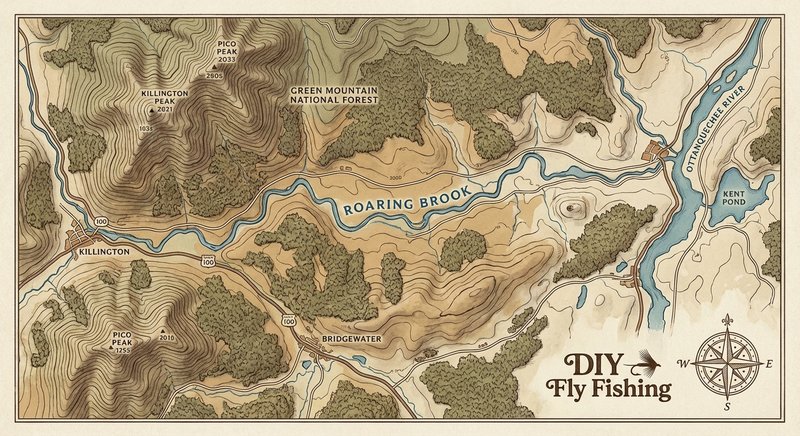
Roaring Brook
Fly fishing in Vermont · Advanced · Best seasons: Summer, Fall
Target Species
Brook Trout
About This Water
Green Mountain National Forest stream with native brook trout. Small water requiring stealth and short casts.
Fishing Recommendations
Roaring Brook in Vermont—specifically the stretch flowing through the Killington and Sherburne valley—is a quintessential high-gradient mountain stream. It is the definition of "blue-lining" in New England. If you enjoy technical casting in tight quarters, boulder hopping, and catching some of the most vibrantly colored wild Brook Trout in the Northeast, this is your water.
Here is a comprehensive guide to fishing Roaring Brook.
🎣 Location Overview
Roaring Brook is a high-elevation tributary that eventually feeds the Ottauquechee River. It is characterized by its steep gradient, crystal-clear oxygenated water, and a "staircase" structure of plunge pools and pocket water.
What makes this area special is its resilience. Even when larger rivers like the White or the Connecticut get too warm in the heat of July, Roaring Brook remains a cold-water refuge. The stream is heavily forested, providing a dense canopy that keeps the water temperatures stable and offers a bounty of terrestrial insects for the fish. Anglers love it because it feels prehistoric; you are often fishing in a mossy, boulder-strewn canyon where you won't see another soul.
🐟 Target Species & Behavior
The primary resident is the Wild Brook Trout. These are not stocked fish; they are native jewels of the Green Mountains.
- Size: Expect fish in the 4- to 8-inch range. A 10-inch Brookie in this water is a trophy.
- Behavior: Due to the short growing season and nutrient-poor mountain water, these fish are highly opportunistic. They don't have the luxury of being picky. However, they are incredibly "spooky." In water this clear, a shadow or a heavy footstep will send them darting under a rock for an hour.
- Holding Spots: Look for "the bucket"—the soft water at the base of a waterfall or behind a large refrigerator-sized boulder. They also sit right on the "lip" of a pool where the water begins to accelerate downward.
📅 Best Times to Fish
Summer (Late June – August)
This is the prime window for dry fly action. As the spring runoff subsides, the pools become defined and the fish look upward.
- Time of Day: Mid-morning (once the sun hits the water and wakes up the bugs) through late afternoon.
Fall (September – October)
This is arguably the most beautiful time. The Brook Trout enter their spawning colors—deep orange bellies and halos of red and blue.
- Conditions: Target the stream after a light rain. The slight rise in water triggers an aggressive feeding response before the winter dormancy.
- Note: Be mindful of spawning beds (redds) in late October and avoid walking on shallow gravel.
🪰 Recommended Flies & Techniques
Top Fly Patterns
Because the water is fast and turbulent, you need flies that float high and are easy for the angler to see.
- Dry Flies:
- Royal Wulff (Size 14-16): An absolute classic mountain fly.
- Elk Hair Caddis (Size 14-18): Tan or olive.
- Stimulators (Size 12-14): Great for mimicking large stoneflies or grasshoppers.
- Black Gnat / Ants (Size 16-20): Essential for late summer.
- Nymphs:
- Bead-Head Pheasant Tail (Size 16-18): Needs weight to get down in the fast plunge pools.
- Prince Nymph (Size 14-16): The "flash" works well in dark, deep pockets.
Effective Techniques
- Dry-Dropper: This is the most effective way to fish Roaring Brook. Use a buoyant Stimulator as your "indicator" and hang a small Pheasant Tail nymph 12–18 inches below it.
- Dapping: In many spots, the brush is too thick to cast. Poke your rod tip through the branches and simply drop the fly onto the surface.
- Short Line Nymphing: You rarely have more than 10 feet of fly line out. It’s mostly leader work.
💡 Pro Tips & Local Knowledge
- The "Bow and Arrow" Cast: Master this before you go. You will often find yourself in tunnels of rhododendron and alder where a traditional backcast is impossible.
- Work Upstream: Always fish moving upstream. Brook Trout face into the current; if you approach from behind them, you are much less likely to be spotted.
- Stealth is King: Wear drab colors (greens and browns) to blend in with the canopy. Avoid "shiny" gear that might reflect sunlight.
- The "Two-Cast" Rule: In these small pockets, if you don't get a strike in the first two or three clean drifts, move on to the next pocket. These fish decide instantly if they want to eat.
⚠️ Important Information
- Access: Much of the upper Roaring Brook is accessible via the Green Mountain National Forest or near the base of the Killington Resort area. Always respect "Posted" signs on private land sections near the lower valley.
- Regulations: Vermont state law generally allows trout fishing from the second Saturday in April to October 31st. Check the Vermont Fish & Wildlife Department website for the most current "Test Waters" or special regulation designations.
- Gear Recommendation: A 2-weight or 3-weight rod (7' to 7'6" in length) is perfect. Anything longer will get caught in the trees.
- Safety: The rocks in Roaring Brook are notoriously slick. Felt-soled boots or studs are highly recommended, and a wading staff isn't a bad idea for the steeper sections.
Guide’s Final Word: Roaring Brook isn't about the size of the fish; it's about the purity of the experience. Bring a camera—the colors on a wild Vermont Brookie are nature’s finest artwork.
Bug Hatches & Matching Flies
| Hatch | Type | Peak months | Time of day | Hook sizes | Matching flies |
|---|---|---|---|---|---|
| Blue Winged Olive Baetis species | mayfly | April, May, September, October | Midday | #18-22 | RS2 #20-22, Parachute BWO #18-20, BWO CDC Emerger #18-22 |
| Hendrickson Ephemerella subvaria | mayfly | May | Afternoon | #12-14 | Red Quill #12-14, Hendrickson Wet Fly #12-14, Pheasant Tail #12-14 |
| Grannom Caddis Brachycentrus | caddis | May | Morning/Afternoon | #14-16 | Elk Hair Caddis (Olive) #14-16, LaFontaine's Deep Sparkle Pupa #14-16, Peeking Caddis #14-16 |
| March Brown Maccaffertium vicarium | mayfly | June | Midday/Afternoon | #10-12 | March Brown Parachute #10-12, Gold Ribbed Hare's Ear #10-12, March Brown Spider #12 |
| Giant Golden Stonefly Acroneuria | stonefly | June, July | Evening/Night | #6-10 | Pat's Rubber Leg #6-10, Golden Stimulator #8-12, Kaufmann's Stone #8-10 |
| Light Cahill Stenacron / Stenonema | mayfly | June, July | Evening | #14-16 | Light Cahill #14-16, Cream Usual #14-18, Light Cahill Wet Fly #14-16 |
| Cinnamon Caddis Hydropsyche | caddis | June, July, August | Evening | #16-18 | Tan Elk Hair Caddis #16-18, Hydropsyche Larva #16-18, Iris Caddis #16-18 |
| Little Black Stonefly Capniidae | stonefly | March, April | Midday | #18-20 | Zebra Midge #18-20, Early Girl Stonefly #18, Black Stonefly Nymph #18-20 |
| Terrestrials (Ants/Beetles) Formicidae / Coleoptera | terrestrial | July, August, September | All Day | #14-20 | Black Foam Ant #16-20, Cinnamon Ant #16-18, Crowe Beetle #14-16 |