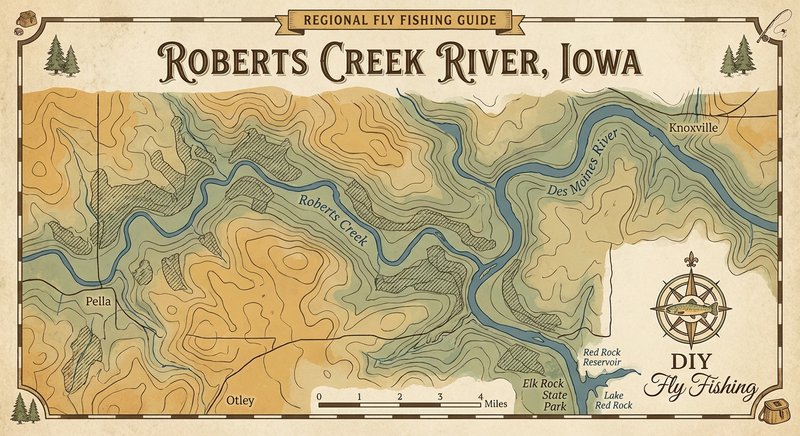
Roberts Creek
Fly fishing in Iowa · intermediate · Best seasons: spring, summer, fall
Target Species
Brown Trout
About This Water
Clayton County stream with wild trout. Driftless limestone spring creek.
Fishing Recommendations
Roberts Creek, located in the heart of Clayton County in Northeast Iowa, is a quintessential "Driftless Area" spring creek. While Iowa might not be the first state that comes to mind for trout, those in the know recognize Roberts Creek as a hidden gem that offers some of the most technical and rewarding brown trout fishing in the Midwest.
Here is your comprehensive guide to fly fishing Roberts Creek.
🎣 Location Overview
Roberts Creek is a tributary of the Turkey River, characterized by its winding path through limestone bluffs, rolling pastures, and timbered valleys. What makes it special is its classic Driftless character: cold, nutrient-rich spring water that stays cool enough to support trout year-round, even during the humid Iowa summers.
The creek varies from tight, brushy headwaters to wider, meandering stretches with deep "lunker holes." Anglers love it because it offers a mix of wild and stocked Brown Trout. Unlike some of the more "manicured" streams in the region, Roberts retains a rugged, natural feel with plenty of undercut banks and downed timber that provide perfect ambush points for big browns.
🐟 Target Species & Behavior
The primary prize here is the Brown Trout.
- Behavior: These fish are notoriously "spooky." The water is often crystal clear, and the fish are highly attuned to overhead movement.
- Holding Patterns: Look for them tight against undercut banks, beneath overhanging "lunker structures" (DNR-installed bank reinforcements), and in the shadows of deadfall. In the faster riffles, they will hold in the "cushion" just in front of or behind large rocks.
- Feeding: They are opportunistic but can become selective during specific hatches. Their diet consists heavily of scuds, sowbugs, and midges, but the larger specimens are highly piscivorous, feeding on chubs, dace, and even smaller trout.
📅 Best Times to Fish
Optimal Seasons
- Spring (March – May): This is prime time. The water begins to warm, and the first major hatches of Blue Winged Olives (BWO) and Grannom Caddis occur.
- Summer (June – August): Excellent for terrestrial fishing. Even on hot days, the spring-fed nature of the creek keeps fish active, though early morning and late evening are best.
- Fall (September – October): The most scenic time. Brown trout become aggressive and territorial as they prepare for the spawn. Streamer fishing is peak during this window.
Best Times of Day
- Low Light Windows: Brown trout are photosensitive. The first two hours of daylight and the "magic hour" before sunset are when the largest fish move out of cover to feed.
- Overcast Days: A cloudy, drizzly day is a gift on Roberts Creek. It cuts the glare and makes the fish feel secure enough to feed in open water.
🪰 Recommended Flies & Techniques
Top Fly Patterns
- Nymphs:
- The Pink Squirrel (Size 14-18): An absolute Driftless staple.
- Scuds & Sowbugs (Size 16-20): Gray or olive. These are the "bread and butter" of the creek.
- Frenchie or Pheasant Tail: Classic triggers for active fish.
- Dry Flies:
- Elk Hair Caddis (Size 14-18): Great for skating across riffles.
- Blue Winged Olive (BWO) (Size 18-22): Essential for spring and fall.
- Hippie Stomper or Foam Beetles: Deadly in mid-summer.
- Streamers:
- Black or Olive Woolly Bugger (Size 8-12): Effective in deep pools or during high water.
Techniques & Presentation
- The Stealth Approach: Approach the bank from downstream and stay low. If you can see the fish, they have likely already seen you. Wear earthy tones (camo or olive) to blend in with the vegetation.
- Nymphing: Use a "Leisenring Lift" at the end of your drift. Many strikes occur just as the nymph begins to rise toward the surface.
- Dry-Dropper: This is the most effective way to cover Roberts Creek. Use a buoyant terrestrial (like a Chernobyl Ant) and hang a small midge or scud 18–24 inches below it.
💡 Pro Tips & Local Knowledge
- The "Lunker Structure" Secret: The Iowa DNR has done extensive work installing wooden structures under the banks to prevent erosion. These are magnet locations for the biggest Browns. Always drift your fly as tight to these structures as possible.
- Focus on the Wildlife Area: The Roberts Creek Wildlife Area (north of Elkader) offers some of the best public access. This stretch features excellent habitat diversity.
- Tippet Management: While you want a light tippet (5x or 6x) for dry flies in clear water, don't be afraid to go to 4x when fishing streamers near logs. You’ll need the strength to pull a 16-inch Brown away from the root balls.
- Wading: Be careful. The bottom can be a mix of slick limestone and "muck" holes. Felt soles or studs are recommended, but move slowly to avoid sending vibrations through the water.
⚠️ Important Information
- Access: Much of Roberts Creek runs through private land. Always look for "Public Hunting/Fishing" signs or use the Iowa DNR "Trout Fishing" map. Iowa law dictates that the streambed is private property; you must stay within the designated public areas or ask permission.
- Regulations:
- A valid Iowa Fishing License AND a Trout Fee are required.
- Check current Iowa DNR regulations for specific length limits or lure restrictions (some sections may be "Catch and Release" or "Artificial Lure Only" depending on the year's management plan).
- Bio-Security: To prevent the spread of invasive species like New Zealand Mudsnails or Didymo, please clean and dry your waders thoroughly before moving to another watershed.
Guide’s Final Word: Roberts Creek isn't about high fish counts; it’s about the quality of the hunt. Slow down, observe the water, and enjoy the quiet beauty of the Clayton County bluffs. Tight lines!
Bug Hatches & Matching Flies
| Hatch | Type | Peak months | Time of day | Hook sizes | Matching flies |
|---|---|---|---|---|---|
| Blue Winged Olive Baetis | mayfly | March, April, September, October | Late Morning/Afternoon | #18-22 | BWO Sparkle Dun #18-22, Pheasant Tail #18-20, RS2 #20-22 |
| Grannom Caddis Brachycentrus | caddis | April, May | Afternoon/Evening | #14-16 | Elk Hair Caddis (Olive) #14-16, LaFontaine's Deep Sparkle Pupa #14-16, Peacock Caddis #16 |
| Sulphur Ephemerella invaria | mayfly | May, June | Evening | #14-18 | Sulphur Parachute #16-18, Sulphur Spinner #14-16, Hare's Ear #14-18 |
| Trico Tricorythodes | mayfly | July, August, September | Early Morning | #20-24 | Trico Spinner #20-24, Trico Parachute #22, Zebra Midge #20-22 |
| Light Cahill Stenonema/Stenacron | mayfly | June, July | Evening | #12-16 | Light Cahill #12-16, Gold Ribbed Hare's Ear #14-16 |
| Cinnamon Caddis Hydropsyche | caddis | June, July, August | Evening | #14-18 | Cinnamon Caddis #16-18, Iris Emerger #16, Prince Nymph #14-18 |
| Terrestrials Orthoptera/Formicidae | terrestrial | July, August, September | Late Morning/Afternoon | #8-18 | Dave's Hopper #8-12, Black Foam Ant #16-18, Chernobyl Ant #10-14 |
| Midges Chironomidae | midge | January, February, March, December | Mid-day | #18-24 | Griffith's Gnat #18-22, Zebra Midge #18-24, Palomino Midge #20-22 |