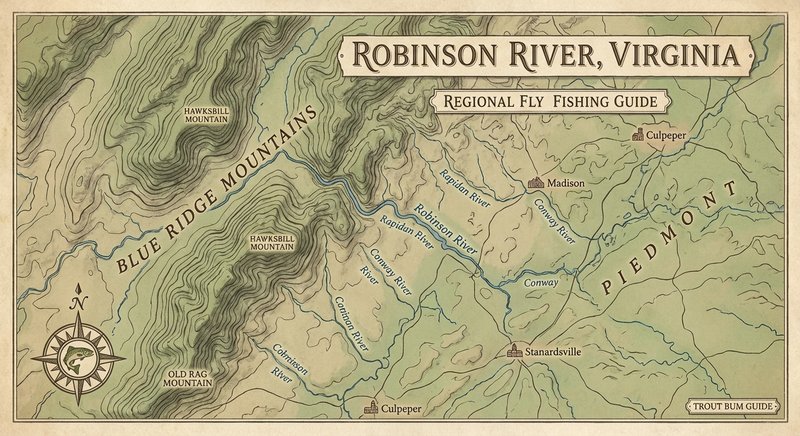
Robinson River
Fly fishing in Virginia · Intermediate · Best seasons: Spring, Summer, Fall
Target Species
Brook Trout, Brown Trout
About This Water
Madison County stream with wild trout. Blue Ridge mountain fishing.
Fishing Recommendations
As an expert guide who has spent countless hours navigating the freestone streams of the Blue Ridge, I can tell you that the Robinson River is one of Virginia's true gems. It offers a "tale of two rivers" experience: high-gradient, technical pocket water for wild brookies in its upper reaches, and more traditional pool-and-run water for browns as it moves toward the valley floor.
Here is your comprehensive guide to fly fishing the Robinson River.
🎣 Location Overview
The Robinson River rises high on the eastern slopes of the Blue Ridge Mountains within Shenandoah National Park (SNP). It is famous for carving the spectacular White Oak Canyon, home to a series of massive waterfalls.
What makes the Robinson special is its raw beauty and its resilience. The upper section is a classic Appalachian freestone stream—clear, cold, and tumbling over granite boulders. As it exits the park, it transitions into private meadow stretches. Anglers love it because it offers a physical challenge in the canyon and a rewarding "blue line" experience for those willing to hike. It feels much more remote than its proximity to Washington D.C. would suggest.
🐟 Target Species & Behavior
Native Brook Trout
- Location: Primarily found within the Shenandoah National Park boundaries and the highest reaches of the White Oak Canyon trail.
- Behavior: These are wild, opportunistic feeders. Because the water is nutrient-poor, they aren't usually "picky," but they are incredibly spooky. If they see your shadow or your fly line, they will dart under a rock and stay there for an hour.
- Holding Water: Look for "the bucket"—the soft water right next to a fast current, or the plunge pools at the base of falls.
Brown Trout
- Location: Found in the lower reaches, particularly around the "White Oak Canyon" lower parking area and downstream through private lands (where accessible).
- Behavior: Much more calculated than brookies. They prefer the deeper, undercut banks and the "tail-outs" of long pools during the evening.
- Feeding: They are more piscivorous (fish-eating) once they reach 12+ inches.
📅 Best Times to Fish
Spring (Late March – Early June) - Prime Time
This is the pinnacle. Water levels are usually perfect from snowmelt and spring rain. The insects are active, and the fish are hungry after a dormant winter.
- Window: 10:00 AM – 4:00 PM (Wait for the water to warm slightly).
Summer (June – August)
Fishing remains good in the high-altitude shaded canyons of SNP where the water stays cool. However, the lower Robinson can get too warm for trout health.
- Window: Dawn and Dusk. Terrestrial fishing (ants/beetles) is spectacular now.
Fall (Late September – November)
The Robinson is stunning when the leaves change. Brook trout develop vibrant orange bellies for spawning.
- Window: Mid-day. Focus on October Caddis hatches.
- Note: Be careful not to step on "redds" (spawning beds) in November.
🪰 Recommended Flies & Techniques
Dry Flies (The Gold Standard)
The Robinson is a dry-fly fisher's dream.
- Royal Wulff or 40-Mile Foam: Great for high visibility in broken water (Size 14-16).
- Mr. Rapidan: A local Virginia favorite developed by Harry Murray. It mimics almost anything and floats like a cork (Size 14-16).
- Elk Hair Caddis: Essential for the heavy caddis hatches in May (Tan or Olive, Size 16).
- Terrestrials: Black Foam Ants and Cricket patterns in mid-summer.
Nymphs & Streamers
- Pheasant Tail Nymph: The best all-around subsurface fly (Size 16-18).
- Copper John: Use as a "dropper" 18 inches below a dry fly to find fish in deeper plunge pools.
- Black Ghost or Woolly Bugger: For the lower sections when targeting larger Brown trout (Size 8-12).
Presentation Tip
The "High-Stick" Drift: Because the current is complex with many "seams," keep as much fly line off the water as possible. Use a short leader (7.5 ft) to prevent tangles in the overhanging mountain laurel.
💡 Pro Tips & Local Knowledge
- Stealth is Everything: Wear drab colors (greens/browns). Before you cast, crouch down. If you can see the fish, they have likely already seen you and won't eat.
- Fish Upstream: Always move upstream as you fish. Trout face into the current; if you approach from behind them, you have a much better chance of staying undetected.
- The "One Cast" Rule: In the small pools of the Robinson, your first cast is your best chance. Subsequent casts in the same spot usually just alert the fish to your presence.
- The Hike-In Factor: Most people fish within a half-mile of the parking lot. If you hike two miles up the White Oak Canyon trail, the fishing pressure drops significantly and the size of the brookies often increases.
⚠️ Important Information
Access Points
- Upper Access: Berry Hollow (near Syria, VA). This is the "back door" to the Robinson and involves less uphill climbing than the lower lot.
- Lower Access: White Oak Canyon Parking Area (Boundary Way). This requires a fee or a National Park Pass.
Regulations
- Inside SNP: You must use single-hook, artificial lures only. No bait is allowed. Many sections are "Catch and Release Only"—check the park's current map at the trailhead.
- Licenses: A valid Virginia State Fishing License is required. If you are fishing inside the National Park, you do not need a separate trout stamp, but you do need the basic license.
Safety
- Cell Service: Virtually non-existent in the canyon. Tell someone where you are going.
- Wildlife: This is black bear and timber rattlesnake country. Keep your eyes open and make noise while walking through thick brush.
- Rocks: The granite in the Robinson is notoriously slippery. Felt-soled boots or studs are highly recommended.
Bug Hatches & Matching Flies
| Hatch | Type | Peak months | Time of day | Hook sizes | Matching flies |
|---|---|---|---|---|---|
| Quill Gordon Epeorus pleuralis | mayfly | March, April | Mid-day | #12-14 | Quill Gordon Dry #12-14, Pheasant Tail #12-14 |
| Blue Winged Olive Baetis | mayfly | March, April, October, November | Afternoon | #18-22 | RS2 #20-22, BWO Sparkle Dun #18-20 |
| Grannom Caddis Brachycentrus | caddis | April | Morning/Afternoon | #14-16 | Elk Hair Caddis (Olive) #14-16, Pupa-X #14-16 |
| Sulfur Ephemerella invaria | mayfly | May, June | Evening | #14-18 | Sulfur Parachute #14-18, Pheasant Tail (Flashback) #16-18 |
| March Brown Maccaffertium vicarium | mayfly | May | Afternoon | #10-12 | March Brown Dry #10-12, Gold Ribbed Hare's Ear #10-12 |
| Light Cahill Stenonema/Stenacron | mayfly | June, July | Evening | #14-16 | Light Cahill Dry #14-16, Cahill Wet Fly #14 |
| Giant Black Stonefly Pteronarcys dorsata | stonefly | May | Morning/Evening | #4-8 | Girdle Bug (Pat's Rubber Legs) #6-8, Stimulator (Orange/Black) #8-10 |
| Terrestrials Formicidae / Coleoptera | terrestrial | July, August, September | All Day | #12-18 | Cinnamon Ant #16-18, Black Foam Beetle #14-16 |