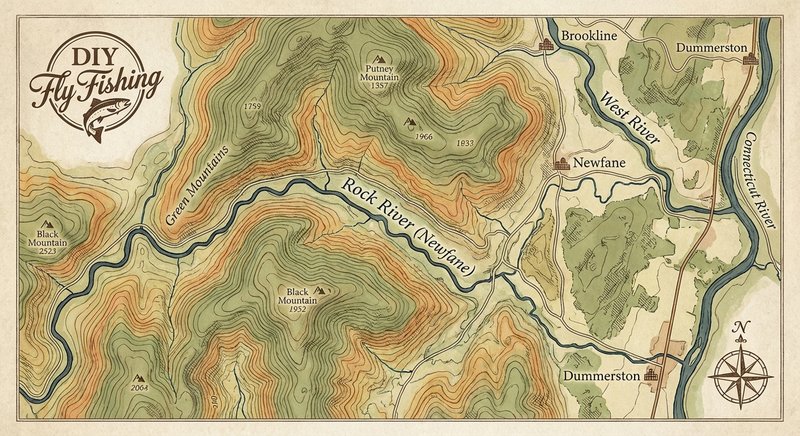
Rock River (Newfane)
Fly fishing in Vermont · Beginner · Best seasons: Spring, Summer, Fall
Target Species
Brown Trout, Brook Trout
About This Water
Southern Vermont stream with brown and brook trout. Scenic fishing near historic villages.
Fishing Recommendations
The Rock River in Newfane, Vermont, is a hidden gem of the Green Mountain State. Often overshadowed by the larger West River—into which it flows—the Rock River is a quintessential New England freestone stream. It offers an intimate, rugged, and rewarding fly fishing experience for those who prefer technical pocket water and pristine scenery.
🎣 Location Overview
The Rock River is characterized by its high gradient, crystal-clear water, and an abundance of granite boulders that create endless "pockets." It begins in the high elevations of the Green Mountain National Forest and winds its way through steep-sided valleys before meeting the West River near Newfane.
What makes this water special is its interstitial nature. It’s not a river where you stand in one spot and cast all day; it is a "hiking" river. Anglers love it because it feels wilder than it is. The canopy is often tight, requiring surgical casting, and the fish are as beautiful as the surrounding maples and birches.
🐟 Target Species & Behavior
The Rock River is a dual-threat fishery:
- Brook Trout (Native/Wild): Found predominantly in the upper reaches and the smaller feeder tributaries. These fish are opportunistic but spook easily. They hold in the small, oxygenated "buckets" behind rocks.
- Brown Trout (Wild & Holdover): As the river widens and deepens toward the confluence with the West River, Brown Trout become the dominant species. They are more calculated, often hiding under undercut banks or in the deep, dark slots at the tail-outs of pools.
- Behavior: Because this is a nutrient-poor freestone stream, the fish are generally "lookers." If a bug passes by without looking suspicious, they will usually strike. However, because the water is exceptionally clear, they have excellent "window" vision—if they see you, the game is over.
📅 Best Times to Fish
- Spring (Late April – June): This is the prime window. Once the snowmelt (runoff) recedes and the water hits 50°F, the insect activity explodes. Late May is often the sweet spot for the Hendrickson hatch.
- Summer (July – August): The river can get low and warm. During this time, focus on the early morning (dawn to 10:00 AM) or late evening. Wet wading is the way to go here. Look for "white water"—the bubbly, oxygenated heads of pools where trout go to stay cool.
- Fall (September – October): A magical time. The Brookies are in their fiery spawning colors and become very aggressive. The Browns begin to move upstream from the West River to spawn in the Rock. Target the deeper pools with streamers.
🪰 Recommended Flies & Techniques
Top Fly Patterns
- Dry Flies:
- Attractors: Royal Wulff (Size 14-16), Stimulators (Orange/Yellow, Size 12-14).
- Match the Hatch: Elk Hair Caddis (Tan/Olive, Size 16), Hendrickson (Size 14), Blue Winged Olive (Size 18-20).
- Nymphs:
- Bead-head Pheasant Tail (Size 14-18), Prince Nymph (Size 12-16), and the Copper John (Red or Silver).
- Streamers:
- Small Woolly Buggers (Black or Olive, Size 8-10) or the Black Ghost.
Effective Techniques
- Dry-Dropper Rig: This is the most effective way to fish the Rock. Use a buoyant Stimulator as your "indicator" and hang a weighted Pheasant Tail about 18–24 inches below it.
- High-Sticking / Tight-Line Nymphing: Because the currents are complex, traditional long-line nymphing results in a lot of drag. Keep your rod tip high and only a few feet of fly line on the water to let the nymph bounce naturally through the pockets.
- Stealth Approach: Fish upstream. Approach a pool from behind, stay low, and make your first cast to the tail-out before working your way to the head.
💡 Pro Tips & Local Knowledge
- The "Swimming Hole" Factor: The lower Rock River is famous for its swimming holes (some of which are historically "clothing optional"). To find the best fishing, look for the stretches between the popular swimming spots. These areas see less human pressure and hold more fish.
- Focus on the Confluence: The area where the Rock River meets the West River can hold surprisingly large Brown Trout that move into the cooler Rock River during the heat of summer.
- Reading the "Bubble Line": On the Rock, if you find the line of bubbles (foam) moving through a pool, that is the "conveyor belt" for food. If your fly isn't in that line, you're likely not catching fish.
- Gear Choice: A 7.5-foot to 8.5-foot 3-weight or 4-weight rod is perfect. A 9-foot rod can be cumbersome in the tighter, brushy sections.
⚠️ Important Information
- Access: Much of the river follows Williamsville Road and Dover Road. There are several pull-offs, but always respect private property markers. Much of the river is "Open to Public" but double-check for "Posted" signs.
- Regulations: Vermont fishing licenses are required. Ensure you check the current Vermont Fish & Wildlife Law Digest, as seasons and creel limits can change. Most anglers on the Rock practice Catch and Release to preserve the wild trout population.
- Safety: The rocks here are notoriously slippery (the river isn't named "Rock" for nothing). Studded wading boots and a wading staff are highly recommended.
- Cell Service: Be prepared for zero cell service once you head upstream into the notch. Download your maps for offline use.
Guide’s Final Word: The Rock River rewards the patient angler who enjoys the hunt as much as the catch. It’s a place to lose yourself in the rhythm of the water and the shadows of the Green Mountains. Tight lines!
Bug Hatches & Matching Flies
| Hatch | Type | Peak months | Time of day | Hook sizes | Matching flies |
|---|---|---|---|---|---|
| Blue Winged Olive Baetis | mayfly | April, May, September, October | Late Morning/Afternoon | #18-22 | BWO Sparkle Dun #18-20, Pheasant Tail Nymph #18-22, RS2 #20 |
| Hendrickson Ephemerella subvaria | mayfly | April, May | Afternoon | #12-14 | Red Quill #12-14, Hendrickson Nymph #12-14, Hare's Ear #12-14 |
| Grannom Caddis Brachycentrus | caddis | April, May | Morning/Afternoon | #14-16 | Elk Hair Caddis (Black/Dark Olive) #14-16, Peacock Caddis Larva #14-16, Holy Grail #14-16 |
| March Brown Maccaffertium vicarium | mayfly | May, June | Afternoon | #10-12 | March Brown American #10-12, Gold Ribbed Hare's Ear #10-12 |
| Sulphur Ephemerella dorothea | mayfly | June, July | Evening | #16-18 | Sulphur Parachute #16-18, Sulphur Spinner #16-18, Pupa-style Sulphur #16-18 |
| Light Cahill Stenonema ithaca | mayfly | June, July | Evening/Dusk | #12-14 | Light Cahill #12-14, Cahill Wet Fly #14 |
| Slate Drake Isonychia bicolor | mayfly | June, August, September | Afternoon/Evening | #10-12 | Isonychia Parachute #10-12, Zug Bug #10-12, Prince Nymph #10-14 |
| Tan Caddis Hydropsyche | caddis | June, July, August | Morning/Evening | #14-18 | Elk Hair Caddis (Tan) #14-18, LaFontaine's Deep Sparkle Pupa #14-16, Goddard Caddis #14 |
| Golden Stonefly Acroneuria | stonefly | June, July | Morning/Evening | #8-12 | Golden Stone Nymph #8-12, Stimulator (Yellow) #8-12 |
| Ants and Beetles Formicidae / Coleoptera | terrestrial | July, August, September | All Day | #12-18 | Black Foam Ant #14-18, Chernobyl Ant #10-12, Cinnamon Ant #16-18 |