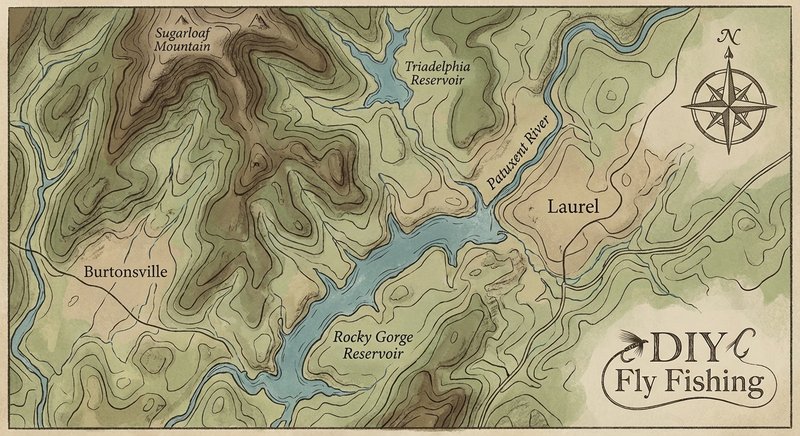
Rocky Gorge Reservoir
Fly fishing in Maryland · Intermediate · Best seasons: Spring, Summer, Fall
Target Species
Largemouth Bass, Crappie, Catfish
About This Water
Howard County reservoir with bass fishing. Scenic Patuxent watershed.
Fishing Recommendations
As an expert guide who has spent years navigating the Mid-Atlantic’s technical reservoirs, I can tell you that Rocky Gorge Reservoir (also known as the T. Howard Duckett Reservoir) is one of Maryland’s premier "hidden gems" for the fly angler. Located on the Patuxent River between Howard, Montgomery, and Prince George’s counties, it offers a more rugged, wilderness feel than its neighbor, Triadelphia.
Here is your comprehensive guide to fly fishing Rocky Gorge.
🎣 Location Overview
Rocky Gorge is a 775-acre ribbon of water characterized by steep, rocky banks, deep drop-offs, and abundant submerged timber. Managed by the Washington Suburban Sanitary Commission (WSSC), it serves as a primary water source, which means the water quality is generally high and the shoreline is strictly protected from development.
What makes it special for fly anglers is the gas motor ban. Only electric motors or human-powered craft (kayaks/canoes) are allowed. This keeps the water quiet, the fish less pressured, and allows for the stealthy approach that fly fishing demands. The "gorge" aspect means you’ll find significant depth very close to the shore, creating excellent "staircase" habitats for predators.
🐟 Target Species & Behavior
Largemouth Bass
The king of the reservoir. Rocky Gorge bass are "structure-oriented." Because the banks drop off quickly, they don’t always roam large flats. Instead, they hug the rock walls and the "chewed up" shorelines where trees have fallen into the water.
- Behavior: They move shallow to spawn in late spring, then retreat to the 10–20 foot range in summer, holding on submerged points and wood.
- Forage: Gizzard shad, bluegill, and a very healthy population of crayfish.
Crappie
Rocky Gorge holds "slabs"—Black Crappie that can exceed 12–14 inches.
- Behavior: In the spring, they school heavily in the back of coves around brush piles. In summer and fall, they move to deeper submerged timber and bridge pilings.
- Forage: Primarily small minnows and young-of-the-year shad.
Catfish (Channel and Flathead)
While not a traditional fly target, the reservoir holds massive catfish.
- Behavior: They cruise the bottom of the old river channel but will move into the shallows of coves at night or after a heavy rain to feed on washed-in terrestrial life.
- Forage: Anything from crayfish to small sunfish.
📅 Best Times to Fish
- Spring (April – June): The Prime Window. Crappie move shallow when water hits 55°F. Largemouth follow shortly after for the pre-spawn. This is the best time for fly anglers to reach fish with a standard floating line.
- Summer (July – August): Low-light is mandatory. Fish the "edges of the day"—the 90 minutes after sunrise and before sunset. During the day, fish move too deep for most fly lines, but the topwater popper bite at dusk can be legendary.
- Fall (September – November): As water temperatures drop, shad migrate toward the creek mouths. The bass follow them. This is "streamer season." Look for surface "busts" where bass are corralling baitfish.
🪰 Recommended Flies & Techniques
For Largemouth Bass
- Topwater: BoogleBugs or foam poppers in white/chartreuse or "frog" patterns.
- Technique: Cast tight to the rocky shoreline. Twitch, pause for 5–10 seconds (let the rings disappear), then twitch again.
- Sub-surface: Game Changers or Clouser Minnows (White/Chartreuse or Grey/White).
- Technique: Use an intermediate sinking line to get the fly down 5–8 feet. Use an erratic "escape" retrieve to mimic a wounded shad.
- Crayfish Patterns: Near Nuff Craws or Clawsome Crayfish in olive or rusty orange.
For Crappie
- Flies: Micro-jig flies, Woolly Buggers (Size 8-10) in pink/white or chartreuse, and the Small Overbite Wiper.
- Technique: Use a 4wt or 5wt rod with a "strike indicator" (bobber) and hang the fly 3–5 feet below it. Give it tiny twitches near fallen trees.
For Catfish
- Flies: Large, heavy Dumbbell-eyed Woolly Buggers or Meat Whistles in black or purple.
- Technique: You must get the fly to the bottom. Use a heavy sink-tip line and "crawl" the fly along the mud flats near the mouth of the Patuxent.
💡 Pro Tips & Local Knowledge
- Focus on the "Points": Rocky Gorge has numerous finger-like points sticking into the main channel. The windward side of these points usually stacks up baitfish. Fish the "drop-off" side of these points.
- The Scott’s Cove Area: This is the most popular launch for a reason. It offers immediate access to good structure. If you want less pressure, paddle across the reservoir from the launch to the southern shore, which sees fewer shore anglers.
- The "Shadow Line": Because of the steep hills surrounding the water, certain banks stay in the shade longer in the morning. Bass will stay active and shallow in these "shadow zones" long after the sun has hit the rest of the lake.
- Color Palette: The water in Rocky Gorge is often "stained" (greenish-brown). Use high-contrast colors. Black/Blue for dark days or murky water; White/Chartreuse for sunny days.
⚠️ Important Information
- WSSC Permit Required: You cannot fish Rocky Gorge without a WSSC Watershed Use Permit. You can purchase a daily or annual permit online via the WSSC Water website.
- Access Points:
- Scott’s Cove (Scaggsville): Best for kayaks and canoes.
- Supplee Lane (Laurel): Good for larger electric-only boats and shore access.
- Seasonal Closures: The reservoir is typically closed to boating from late November through mid-March to protect the water and for safety. Always check the WSSC website for current "ice-out" opening dates.
- Invasive Species: Maryland is strict about Zebra Mussels and Hydrilla. Ensure your kayak or boat is "Clean, Drain, and Dry" before entering the water.
Guide’s Final Word: Rocky Gorge rewards the patient angler. Don't be afraid to fish "tight to the wood." If you aren't occasionally losing a fly to a submerged branch, you aren't fishing where the big ones are hiding!
Bug Hatches & Matching Flies
| Hatch | Type | Peak months | Time of day | Hook sizes | Matching flies |
|---|---|---|---|---|---|
| Chironomids (Midges) Chironomidae | midge | March, April, November | All Day | #18-24 | Zebra Midge #18-22, Griffith's Gnat #20-24, Snowshoe Midge #20-22 |
| Giant Michigan Mayfly Hexagenia limbata | mayfly | June, July | Dusk/Night | #6-10 | Hexagenia Spinner #6-8, Hexagenia Nymph #8-10, Hare's Ear (Gold Ribbed) #10 |
| Blue-Winged Olive Baetis | mayfly | April, October | Afternoon | #18-22 | BWO Parachute #18-22, Pheasant Tail #18-20, RS2 #20-22 |
| Damselfly Enallagma | terrestrial | June, July, August | Morning/Afternoon | #10-14 | Marabou Damselfly Nymph #10-12, Braided Butt Damsel #12-14 |
| Cinnamon Caddis Hydropsyche | caddis | May, June | Evening | #14-16 | Elk Hair Caddis #14-16, LaFontaine's Deep Sparkle Pupa #14-16 |
| White Miller Ephoron leukon | mayfly | August | Evening/Night | #12-14 | White Wulff #12-14, White Miller Female (Egg Sac) #14 |
| Trico Tricorythodes | mayfly | August, September | Early Morning | #22-26 | Trico Spinner #22-26, Sunken Trico #24 |
| Terrestrials (Ants and Beetles) Formicidae / Coleoptera | terrestrial | July, August, September | Afternoon | #12-18 | Chernobyl Ant #10-12, Black Foam Beetle #14-16, Cinnamon Flying Ant #16-18 |