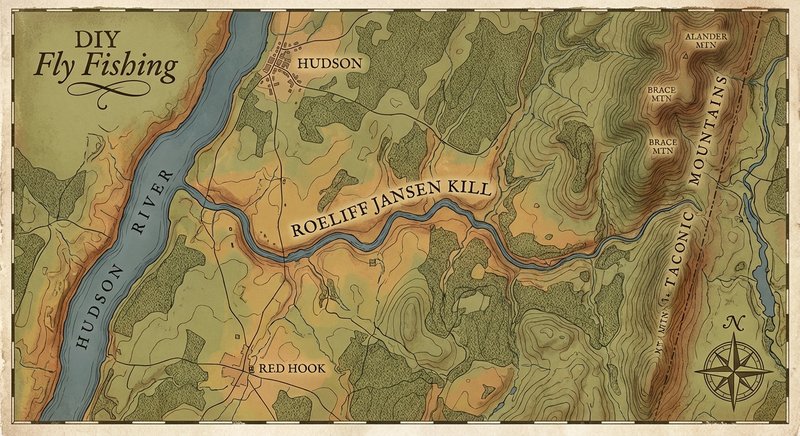
Roeliff Jansen Kill
Fly fishing in New York · Beginner · Best seasons: Spring, Summer, Fall
Target Species
Brown Trout
About This Water
Columbia County stream with wild brown trout. Scenic Hudson Valley fishing.
Fishing Recommendations
The Roeliff Jansen Kill, affectionately known by locals as "The Roe Jan," is one of the Hudson Valley’s most cherished and productive trout streams. Flowing through Columbia and Dutchess Counties, it offers a classic Catskill-style fishing experience without the crushing crowds of the Beaverkill or Delaware.
As your guide, here is the comprehensive breakdown for targeting Brown Trout on this beautiful tributary.
🎣 Location Overview
The Roe Jan is a major tributary to the Hudson River, characterized by its diverse water types. It begins as a small, cool-water stream in the hills and transforms into a substantial river as it winds through agricultural valleys and forested limestone pockets.
What makes it special is its biologic diversity. The river benefits from limestone influences, which lead to high insect productivity and healthy fish growth. Anglers love it because it offers a "big water" feel in certain stretches with deep pools, undercut banks, and classic riffle-run-pool sequences, while maintaining the intimacy of a local stream.
🐟 Target Species & Behavior
The primary draw here is the Brown Trout. The Roe Jan is stocked annually by the NYSDEC, but it also holds a significant population of "holdover" fish and wild Browns in its cooler upper reaches and shaded tributaries.
- Behavior: These Browns are wary. In the spring, they are aggressive and hungry. As summer progresses, they become "pool dwellers," often tucked deep under overhanging trees or tight against limestone ledges to stay cool.
- Feeding: They are opportunistic but can become highly selective during specific hatches (like the Hendrickson or Green Drake). They transition from heavy nymph feeding in early spring to surface-oriented feeding in late May/June, and aggressive predatory behavior (streamers) in the fall.
📅 Best Times to Fish
Spring (April - June)
- Prime Window: Mid-April through Mother’s Day.
- Conditions: This is the peak. Water levels are usually high but clearing. This coincides with the major Mayfly hatches.
- Time of Day: 11:00 AM to 4:00 PM (when the water warms slightly).
Summer (July - August)
- Prime Window: Late evening "spinner falls."
- Conditions: Water temps can rise. Check your thermometer; if the water is over 68°F, stop fishing to protect the trout. Focus on the upper reaches near Silvernails where the water stays cooler.
- Time of Day: First light or the "magic hour" before dark.
Fall (September - October)
- Prime Window: Late September until the season close (or when spawning begins).
- Conditions: Cooling water brings the big Browns out of their lethargy. They become aggressive as they prepare for the spawn.
- Time of Day: Mid-day is excellent as the sun warms the water.
🪰 Recommended Flies & Techniques
Nymphing (The Bread & Butter)
Nymphing is the most consistent way to catch fish on the Roe Jan.
- Patterns: Pheasant Tail (#14-18), Hare’s Ear (#12-16), and Pat’s Rubber Legs (#8-12) for high water.
- Technique: High-sticking through the riffles or using a tactical "Euro" setup in the deeper limestone slots.
Dry Flies (The Glory)
The Roe Jan has excellent hatches.
- Patterns:
- Spring: Hendrickson (Light and Dark), Blue Winged Olives.
- Early Summer: March Brown, Grey Fox, and the famous Green Drake.
- Late Summer: Sulphurs and Terrestrials (Ants/Beetles).
- Presentation: A reach cast is essential here to avoid drag in the complex currents of the pool heads.
Streamers (For the Trophies)
- Patterns: Black or Olive Wooly Buggers (#6-10), Sculpin patterns, and the "Muddler Minnow."
- Technique: Swing streamers through deep undercut banks or "strip-and-pause" through the tail-outs of large pools during overcast days.
💡 Pro Tips & Local Knowledge
- The "Silvernails" Stretch: The area around Silvernails is legendary. It offers great access and some of the most consistent water temperatures on the river.
- Limestone Influence: Look for areas where the river cuts against rock walls. These deep slots hold the largest holdover Browns who use the rock for cover and thermal regulation.
- The Stealth Factor: Because the water can get very clear in the summer, wear earth-toned clothing and stay low. Long leaders (9ft–12ft) with 5x or 6x tippet are often required for surface feeders.
- The "After Rain" Secret: If the river is slightly stained after a light rain, put on a large black stonefly nymph or a gold-ribbed hare's ear. The big Browns lose their caution in slightly murky water.
⚠️ Important Information
- Access: Much of the Roe Jan flows through private land. However, there are numerous Public Fishing Rights (PFR) sections clearly marked with yellow DEC signs. Use the NYSDEC Info Locator map online to find precise parking and access points.
- Regulations: The Roe Jan is subject to New York State inland trout regulations. While much of it allows for harvest, many conservation-minded anglers practice Catch and Release to preserve the wild and holdover populations.
- Permits: A valid New York State Fishing License is required for everyone 16 and older.
- Wading Safety: The bottom can be "greasy" with algae and features round, bowling-ball-sized rocks. Felt soles (where legal) or studded boots and a wading staff are highly recommended.
Bug Hatches & Matching Flies
| Hatch | Type | Peak months | Time of day | Hook sizes | Matching flies |
|---|---|---|---|---|---|
| Blue-Winged Olive Baetis / Acerpenna | mayfly | April, May, September, October | Mid-day/Afternoon | #18-22 | BWO Sparkle Dun #18-22, Pheasant Tail #18-20, RS2 #20-22 |
| Hendrickson Ephemerella subvaria | mayfly | April, May | Afternoon | #12-14 | Hendrickson Dark #12-14, Red Quill #14, Hendrickson wet fly #12-14 |
| Tan Caddis Hydropsyche | caddis | May, June | Evening | #14-18 | Elk Hair Caddis (Tan) #14-16, LaFontaine's Deep Sparkle Pupa #14-18, Holy Grail #16 |
| Sulphur Ephemerella invaria / dorothea | mayfly | May, June | Evening | #14-18 | Sulphur Parachute #14-18, Sulphur Snowshoe Emerger #16-18, Mercer's Pupa #16 |
| March Brown Maccaffertium vicarium | mayfly | May, June | Afternoon | #10-12 | March Brown American #10-12, Gold Ribbed Hare's Ear #10-12, March Brown Wet Fly #12 |
| Light Cahill Stenacron interpunctatum | mayfly | June, July | Evening | #12-14 | Light Cahill #12-14, Cahill Wet Fly #14, Pheasant Tail (Light) #14 |
| Trico Tricorythodes | mayfly | July, August, September | Morning | #22-26 | Trico Spinner #22-24, Trico Parachute #24, Zebra Midge (Black) #22-24 |
| Cinnamon Caddis Ceraclea / Chimarra | caddis | June, July, August | Evening | #16-20 | X-Caddis (Amber) #18-20, Cinnamon Sedge #16-18, Green Weenie #16 |
| Terrestrials Formicidae / Coleoptera | terrestrial | July, August, September | All Day | #12-18 | Black Foam Ant #16-18, Crowe Beetle #14-16, Chernobyl Ant #12-14 |