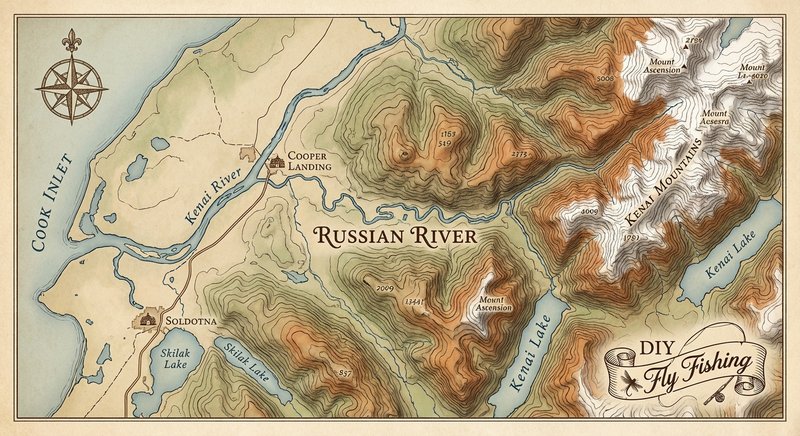
Russian River
Fly fishing in Alaska · Beginner · Best seasons: Summer
Target Species
Sockeye Salmon, Rainbow Trout
About This Water
Accessible from Anchorage with excellent sockeye salmon runs. Combat fishing when salmon are running.
Fishing Recommendations
The Russian River on Alaska’s Kenai Peninsula is arguably the most famous fly fishing destination in the state. Known for its crystal-clear waters and staggering runs of Sockeye salmon, it is a place of high energy, breathtaking scenery, and world-class trout fishing.
As your guide, here is everything you need to know to navigate the "Russian" successfully.
🎣 Location Overview
The Russian River is a clear-water tributary of the turquoise Kenai River. Unlike the glacial silt of the mainstem Kenai, the Russian is gin-clear, allowing for incredible sight-fishing opportunities.
What makes it special is the "Russian River Sockeye"—a run so dense it creates a phenomenon known as "combat fishing" near the confluence, though solitude can be found by hiking upstream. The river is divided into the Lower Russian (from the confluence with the Kenai up to the falls) and the Upper Russian (above the falls). It is a classic freestone-style river with gravel bars, deep pools, and fast riffles set against the backdrop of the Chugach National Forest.
🐟 Target Species & Behavior
Sockeye (Red) Salmon
- Behavior: Sockeye do not strike out of aggression like Silvers or Kings; they are filter feeders. They hug the bank in "travel lanes" to avoid the heavy current.
- Holding: Look for them in shallow water (1–3 feet deep) right along the gravel edges.
- Feeding: They aren't "feeding," but they "mouth" the water as they swim. Fishing for them involves a specific technique called the "floss" or the "Russian River Twitch."
Rainbow Trout
- Behavior: These are some of the fattest, healthiest rainbows in Alaska. They are opportunistic scavengers.
- Holding: They sit behind spawning salmon. In early summer, they are in the riffles eating insects; by mid-to-late summer, they move behind Sockeye pods to feast on dropped eggs and flesh.
- Feeding: Early season is about nymphs and dries; mid-to-late summer is 100% an egg and flesh game.
📅 Best Times to Fish
- June (Mid to Late): The first run of Sockeye arrives. This is peak "combat fishing" time at the confluence. Rainbow trout fishing is excellent as they wake up for the season.
- July: A brief lull in Sockeye between runs, but the Rainbow fishing remains stellar. The second, larger run of Sockeye usually begins in mid-July.
- August: The "Golden Month." Sockeye are spawning, and the Rainbow Trout and Dolly Varden are at their heaviest, gorging on eggs.
- Time of Day: Early morning (3:00 AM – 6:00 AM) is best to beat the crowds and find fish that haven't been pressured. In Alaska's summer, the "night" is just twilight.
🪰 Recommended Flies & Techniques
For Sockeye (The "Floss")
- Fly Patterns: Coho Fly (weighted), Russian River Flies (simple bucktails in red, orange, or green), and sparsely tied streamers on heavy-duty hooks (Size 2–4).
- Technique: Use a 10–12 foot leader with a split shot. Cast 45 degrees upstream, let the fly sink to the bottom, and allow the line to "floss" through the mouths of traveling fish. When you feel a "bump," set the hook.
- Note: Regulations require the fish be hooked in the mouth.
For Rainbow Trout
- Fly Patterns:
- Eggs: 8mm and 10mm beads (Mottled Orange, Apricot, Dead Egg).
- Flesh: Bunny Flies in "washed out" white or ginger.
- Dries: Adams, Elk Hair Caddis (June only).
- Technique: Dead-drifting beads is the gold standard. Use a strike indicator and enough weight to get the bead bouncing off the bottom. Position yourself 10–15 feet upstream of a spawning salmon pod and drift your egg right through the "kitchen."
💡 Pro Tips & Local Knowledge
- Hike for Solitude: Most people fish within 400 yards of the Kenai/Russian ferry. If you hike two miles up the Russian River Angler Trail toward the falls, the crowds thin out significantly, and the trout fishing improves.
- The "Russian River Twitch": When Sockeye fishing, don't jerk the rod. A firm, steady sweep of the rod downstream when you feel tension will result in more mouth-hooked fish and fewer foul-hooks.
- Mind the "Bear Sandwich": This is high-density Brown Bear country. They want the fish. If a bear approaches, yell, give them space, and never leave your stringer of fish unattended.
- Polarized Glasses: These are non-negotiable. Because the water is clear, seeing the "black line" of Sockeye or the shadow of a trophy Rainbow is the key to success.
⚠️ Important Information
- Access: Most anglers access the river via the Russian River Campground (US Forest Service) in Cooper Landing or by taking the Russian River Ferry across the Kenai ($15–$20 round trip).
- Regulations: The Russian River has very specific "Fly-Fishing-Only" zones. This means a fly rod, fly line, and an unweighted fly (weight must be on the leader).
- Hooks: Gap size is strictly regulated (usually no more than 3/8 inch). Check the current Alaska Department of Fish & Game (ADF&G) Southcentral emergency orders before heading out.
- Ethics: If you hook a salmon anywhere but the mouth, you must release it immediately.
- Safety: Wear wading boots with felt or studs; the rocks here are incredibly slippery ("Russian River greased bowling balls"). Carry bear spray and know how to use it.
Bug Hatches & Matching Flies
| Hatch | Type | Peak months | Time of day | Hook sizes | Matching flies |
|---|---|---|---|---|---|
| Blue-Winged Olive (BWO) Baetis | mayfly | May, June, September, October | Afternoon | #16-22 | Parachute Adams #16-20, RS2 #18-22, WD-40 #18-20 |
| Golden Stonefly Hesperoperla pacifica | stonefly | June, July | Morning/Afternoon | #6-10 | Pats Rubber Legs #6-10, Golden Rogue Foam Stone #8-10, 20 Incher Stone #8-12 |
| Midges Chironomidae | midge | March, April, May, September | All Day | #18-24 | Zebra Midge #18-22, Griffith's Gnat #18-22, Top Secret Midge #20-24 |
| Mother's Day Caddis (Grannom) Brachycentrus | caddis | May, June | Evening | #14-16 | Elk Hair Caddis #14-16, Peacock Caddis #14-16, Deep Sparkle Pupa #14-16 |
| Green Sedge Rhyacophila | caddis | June, July, August | Afternoon/Evening | #10-14 | Green Weenie #12-14, LaFontaine's Emergent Sparkle Pupa #12-14, Caddistrophic Pupa #12-14 |
| Spotted Sedge Hydropsyche | caddis | July, August | Evening | #12-16 | Hydropsyche Larva #12-16, Goddard Caddis #12-14, Soft Hackle Hare's Ear #14-16 |
| Early Black Stonefly Capniidae | stonefly | March, April | Afternoon | #14-18 | Little Black Sloan #16-18, Black Stimulator #14-16, Copper John (Black) #16-18 |
| Pale Morning Dun (PMD) Ephemerella | mayfly | July, August | Late Morning/Afternoon | #14-18 | PMD Sparkle Dun #16-18, Pheasant Tail Nymph #14-18, Split Case PMD #16-18 |
| Black Ants & Beetles Formicidae / Coleoptera | terrestrial | July, August | Afternoon | #12-16 | Black Foam Ant #14-16, Chernobyl Ant #12-14, Fat Albert (Black) #12-14 |