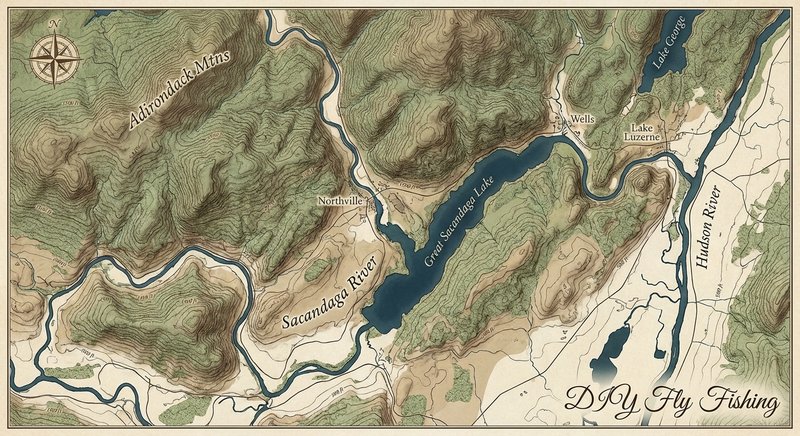
Sacandaga River
Fly fishing in New York · Beginner · Best seasons: Spring, Summer, Fall
Target Species
Brown Trout, Brook Trout
About This Water
Southern Adirondack stream with wild trout. Good public access throughout.
Fishing Recommendations
The Sacandaga River is one of the Adirondacks’ most storied and diverse fisheries. To understand it, an angler must realize it is essentially two different rivers: the West Branch (a classic, freestone mountain stream) and the Main Stem/Tailwater (the section below the Conklingville Dam flowing into the Hudson).
For the purpose of this guide, we will focus primarily on the West Branch and the upper reaches, as these offer the premier experience for Brown and Brook trout.
🎣 Location Overview
The Sacandaga River, particularly the West Branch, is the quintessential Adirondack trout stream. Characterized by "pocket water," large boulders, and tea-colored (tannic) flows, it offers a rugged beauty that draws anglers seeking a true wilderness experience.
What makes it special is the diversity of the water. You’ll find everything from turbulent plunges and deep pools to long, flat glides. Unlike the more famous Delaware River system to the south, the Sacandaga is tighter, more technical, and rewards those who can read water and wade carefully among slippery "river snot" rocks.
🐟 Target Species & Behavior
- Brown Trout: The "kings" of the Sacandaga. You’ll find both wild and stocked browns. They are notorious for hugging the undercut banks and sitting in the "cushion" right in front of large boulders. In the lower tailwater section, these fish can reach trophy sizes (20"+) by feeding on abundant baitfish.
- Brook Trout: The native jewels of the Adirondacks. In the Sacandaga, they are typically found in the upper reaches of the West Branch and the smaller tributaries. They are opportunistic but shy; they favor the highly oxygenated "white water" at the heads of pools during the warmer months.
- Feeding Behavior: These fish are keyed into the river's heavy stonefly and caddis populations. Because the water is tannic (darker), fish often rely on vibration and silhouette, making bushy dry flies and articulated streamers very effective.
📅 Best Times to Fish
- Spring (Late April – June): This is the prime window. The Hendrickson hatch in May is legendary here. Water levels can be high from snowmelt, so heavy nymphs and streamers are necessary early on.
- Summer (July – August): The West Branch is a freestone stream, meaning it is rain-dependent. In hot, dry years, water temperatures can climb. Pro Tip: Carry a thermometer; if the water hits 68°F, stop fishing to protect the trout. Target the early morning (sunrise to 10:00 AM) or the "magic hour" at dusk.
- Fall (September – October): My personal favorite time. The Brown trout become aggressive and territorial as they prepare for the spawn. The Isonychia (Slate Drake) hatches occur, and the surrounding foliage makes this one of the most beautiful fishing spots in America.
🪰 Recommended Flies & Techniques
Top Fly Patterns
- Dry Flies:
- Ausable Wulff: (Sizes 10–14) Created by local legend Fran Betters; its high buoyancy is perfect for the Sacandaga's rough water.
- Elk Hair Caddis: (Sizes 12–18) Tan or Olive.
- Standard Hendrickson/Red Quill: (Sizes 12–14) For May.
- Isonychia Parachute: (Sizes 10–12) For late summer/fall.
- Nymphs:
- Pat’s Rubber Legs: (Sizes 6–10) In coffee/black; mimics the river's massive stoneflies.
- Pheasant Tail: (Sizes 14–18) A universal staple.
- Prince Nymph: (Sizes 12–16) The flash helps in the tannic water.
- Streamers:
- Woolly Bugger: (Sizes 6–10) Black or Olive with a gold bead.
- Muddler Minnow: Excellent for mimicking sculpins in pocket water.
Effective Techniques
- High-Sticking / Tight-Line Nymphing: Because the river is full of conflicting currents and boulders, traditional indicator nymphing can be difficult. Using a tight-line approach allows you to get deep into the pockets without your line getting caught in the "wash."
- The "Skating" Caddis: On summer evenings, don't just let your dry fly drift. Give it a slight twitch or skate it across the surface to trigger explosive strikes from active Brookies.
💡 Pro Tips & Local Knowledge
- Focus on the Confluence: The area where the West Branch meets the Main Stem near Route 10 and Route 8 is high-quality water with plenty of access.
- The "Bubble Line": Sacandaga trout are notorious for sitting right in the foam lines. If there is bubbles/foam on the surface, there is a trout underneath it. Don't bypass the "skinny" water at the edges.
- Wading Safety: The rocks here are notoriously "greased." Studded felt boots and a wading staff are not optional—they are requirements for safety.
- Stealth Matters: Despite the rough water, the fish are wild and wary. Approach pools from downstream and keep a low profile.
⚠️ Important Information
- Access: Much of the West Branch runs along Route 10 and Route 8. Look for the "P" parking signs or DEC public fishing rights (PFR) signs. Respect private property where noted.
- Regulations: New York revamped its trout regulations recently. Most of the Sacandaga follows the "Statewide" rules (5 fish limit, any size), but check the NYS DEC website for specific "Catch and Release Only" or "Artificial Lures Only" sections that are occasionally implemented.
- The Tailwater Warning: If you fish the section below the Conklingville Dam (the Hadley/Lake Luzerne area), be extremely mindful of the water levels. This is a regulated release for power; the water can rise several feet in minutes. Check the Hudson River-Black River Regulating District website for release schedules.
- Permits: A valid New York State Fishing License is required for everyone 16 and older.
Guide’s Final Word: The Sacandaga isn't a river that gives up its secrets easily. You have to work for your fish, but landing a wild, buttery Brown or a neon-spotted Brookie in the heart of the Adirondacks is a reward well worth the effort. Tight lines!
Bug Hatches & Matching Flies
| Hatch | Type | Peak months | Time of day | Hook sizes | Matching flies |
|---|---|---|---|---|---|
| Blue-Winged Olive Baetis | mayfly | April, May, September, October | Mid-day/Afternoon | #18-22 | RS2 #20-22, Parachute BWO #18-20, Pheasant Tail #18-22 |
| Hendrickson Ephemerella subvaria | mayfly | May | Afternoon | #12-14 | Hendrickson Spinner #12-14, Red Quill #14, Hendrickson Emerger #12-14 |
| Grannom Caddis Brachycentrus | caddis | April, May | Morning/Afternoon | #14-16 | Elk Hair Caddis (Olive) #14-16, Deep Sparkle Pupa #14-16, Peacock Caddis #16 |
| Sulphur Ephemerella invaria/dorothea | mayfly | June, July | Evening | #14-18 | Sulphur Parachute #16-18, CDC Sulphur Emerger #14-18, Rusty Spinner #14-18 |
| Isonychia (Slate Drake) Isonychia bicolor | mayfly | June, September | Late Afternoon/Evening | #10-12 | Iso Nymph #10-12, Parachute Isonychia #10-12, Prince Nymph #10-14 |
| Golden Stonefly Acronuria | stonefly | June, July | Evening/Night | #8-12 | Golden Stone Nymph #8-12, Stimulator (Yellow) #8-12, Pat's Rubber Legs #8-12 |
| Light Cahill Stenonema | mayfly | June, July | Evening | #12-14 | Light Cahill #12-14, Cream Usual #12-14, Hare's Ear Nymph #12-14 |
| Trico Tricorythodes | mayfly | July, August, September | Morning | #22-26 | Trico Spinner #22-24, Trico Dun #24, Zebra Midge #20-22 |
| Ants/Beetles Formicidae/Coleoptera | terrestrial | July, August | All Day | #12-18 | Cinnamon Ant #16-18, Black Foam Beetle #14-16, Chernobyl Ant #10-12 |