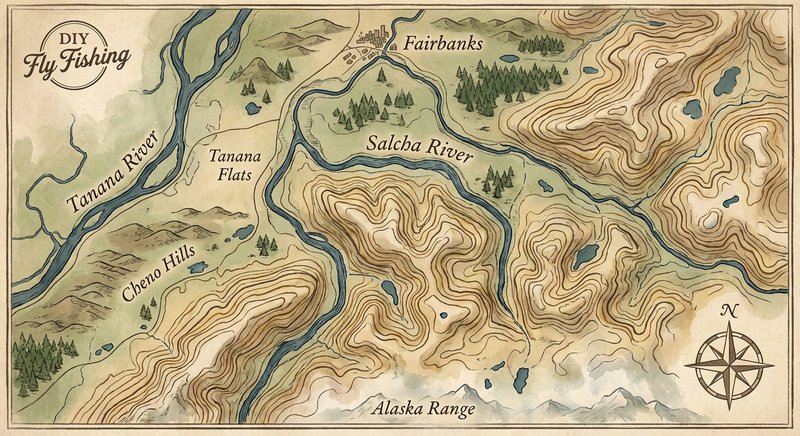
Salcha River
Fly fishing in Alaska · Intermediate · Best seasons: Summer
Target Species
King Salmon, Arctic Grayling, Northern Pike
About This Water
Interior Alaska river with king salmon and grayling. Clear water tributary of the Tanana.
Fishing Recommendations
The Salcha River, located about 40 miles southeast of Fairbanks, is one of the premier "road-system" rivers in Interior Alaska. Unlike the glacial, silty waters of the nearby Tanana, the Salcha is a clear-water runoff stream that originates in the Tanana Hills. It is a favorite among local anglers because it offers a rare trifecta: massive King Salmon, eager Arctic Grayling, and aggressive Northern Pike, all within a beautiful boreal forest setting.
🎣 Location Overview
The Salcha is a classic Interior Alaska river—winding, tea-colored but clear, with a bottom composed primarily of gravel and cobble. It is characterized by long, slow glides punctuated by deep outer-bend pools and shallow riffles.
What makes it special is its accessibility and clarity. While many rivers in the Interior require a bush plane to reach, the Salcha is accessible via the Richardson Highway. For the fly angler, the clarity is paramount; it allows for sight-fishing for Grayling and helps Salmon track your swinging fly in the current. It feels wild, yet you’re never more than a few miles from the trailhead.
🐟 Target Species & Behavior
King (Chinook) Salmon
The Salcha hosts one of the largest King Salmon runs in the Yukon River drainage. These fish are massive, often exceeding 30 pounds.
- Behavior: They don't feed once they enter the river, but they are highly territorial. They hold in the "guts" of deep pools and in the transition zones (tailouts) where the water begins to accelerate before a riffle.
- Feeding: Aggression-based strikes. They respond to large, colorful profiles that invade their space.
Arctic Grayling
The "Sailfish of the North" are the crown jewel of the Salcha for light-tackle enthusiasts.
- Behavior: They are opportunistic feeders. You’ll find them in the seams where fast water meets slow water, directly behind submerged boulders, and in the "bubble line" downstream of riffles.
- Feeding: They have a penchant for surface film activity. They eat mosquitoes, caddis, and terrestrial insects like ants and beetles.
Northern Pike
Found primarily in the slower sloughs and the lower reaches near the confluence with the Tanana River.
- Behavior: Ambush predators. They sit motionless near weed lines, submerged logs, or in backwater eddies.
- Feeding: Anything that moves. They focus on juvenile salmon, whitefish, and even small waterfowl.
📅 Best Times to Fish
- Optimal Season: Mid-June through August.
- King Salmon Window: Late June to mid-July is the peak. By early August, they are spawning and should be left alone to ensure future runs.
- Grayling Window: Early June through September. They become most active once the water warms slightly in July.
- Best Time of Day: In the land of the Midnight Sun, "time of day" is flexible. However, for Kings, the low-light hours (10 PM to 2 AM) can actually be very productive as fish move into shallower tailouts to travel. For Grayling, the afternoon "heat" (60–70°F) triggers the best insect hatches.
🪰 Recommended Flies & Techniques
For King Salmon (Heavy Gear: 9-10wt rods)
- Fly Patterns: Pink, Orange, or Chartreuse Intruders; Comet patterns; Bunny Leeches; Lead-eyed Squidroes.
- Technique: The Swing. Cast quartering downstream with a heavy sink tip (T-11 or T-14). Let the fly swing through the deep holes. Keep the fly deep; if you aren't occasionally touching the gravel, you aren't deep enough.
For Arctic Grayling (Light Gear: 3-5wt rods)
- Dry Flies: Elk Hair Caddis (size 12-16), Royal Coachman, Black Gnats, and Parachute Adams.
- Nymphs: Gold Ribbed Hare’s Ear, Pheasant Tail, and Copper Johns.
- Technique: Dead drift dry flies through the seams. Grayling have small mouths, so don't over-size your flies. If they are rising but missing your fly, move to a slightly smaller size.
For Northern Pike (Stout Gear: 8-9wt rods)
- Fly Patterns: Large streamers in "Firetiger" colors (Green/Yellow/Orange), Dahlberg Divers, and Bunny Prowlers.
- Technique: Use a wire leader (essential!). Strip the fly with a "strip-strip-pause" rhythm near structure. The pause is often when the strike occurs.
💡 Pro Tips & Local Knowledge
- The "Salcha Skitter": Grayling in the Salcha often react better to a fly that is slightly skated or twitched on the surface rather than a perfect dead drift. It mimics a struggling insect and triggers their predatory instinct.
- Boat Access: While there is walk-in access at the Richardson Highway bridge, the best fishing is 5–10 miles upstream. If you don't have a jet boat, consider a packraft or canoe (though rowing against the current is tough).
- The "Bubble Line": Experienced Salcha guides look for the line of foam on the surface. Grayling stack up directly under this foam because it acts as a conveyor belt for food.
- Water Levels: The Salcha is "flashy." If it rains hard in the hills, the river can rise and turn murky within hours. Always check the USGS water gauges before driving out from Fairbanks.
⚠️ Important Information
- Access: The primary access point is the Salcha River State Recreation Site at Mile 323 of the Richardson Highway. There is a boat launch and some public bank access.
- Regulations: Crucial. King Salmon populations in the Yukon drainage have been struggling. Check the Alaska Department of Fish & Game (ADF&G) "Emergency Orders" before you go. The river is frequently closed to King Salmon fishing (even catch-and-release) to protect spawning escapement.
- Permits: You need a valid Alaska Sport Fishing License. If you are targeting Kings (and the season is open), you must also have a King Salmon Stamp.
- Bear Safety: This is grizzly and black bear country. Always carry bear spray, make noise, and never leave your catch or food unattended on the bank.
- Private Property: Much of the riverbank above the bridge is lined with private cabins. Be respectful and stay below the ordinary high-water mark.
Bug Hatches & Matching Flies
| Hatch | Type | Peak months | Time of day | Hook sizes | Matching flies |
|---|---|---|---|---|---|
| Midges Chironomidae | midge | May, September | All Day | #18-24 | Zebra Midge #18-22, Griffith's Gnat #20-22, Smoke Jumper #20 |
| Giant Black Stonefly Pteronarcys californica | stonefly | June | Morning/Evening | #4-8 | Pats Rubber Legs #6-8, Kaufmann's Stone #4-8, Chubby Chernobyl #6-10 |
| Blue-Winged Olive Baetis spp. | mayfly | May, August, September | Afternoon | #16-20 | RS2 #18-20, Parachute Adams #16-20, Pheasant Tail #16-18 |
| Yellow Sally Isoperla spp. | stonefly | June, July | Afternoon/Evening | #12-16 | Yellow Sally Foam Dry #14-16, Little Yellow Sloan #14-16 |
| Grannom Caddis Brachycentrus occidentalis | caddis | June | All Day | #12-16 | Elk Hair Caddis #14-16, Holy Grail #14-16, Peacock Caddis #12-14 |
| Gray Drake Siphlonurus occidentalis | mayfly | July | Evening | #10-14 | Gray Drake Spinner #12, Hare's Ear Nymph #10-12 |
| Spotted Sedge Hydropsyche spp. | caddis | July, August | Evening | #14-18 | LaFontaine's Deep Sparkle Pupa #16, Godzilla Caddis #14-16 |
| Pale Morning Dun Cinygmula spp. | mayfly | July | Afternoon | #14-18 | PMD Sparkle Dun #16, Mercer's Poxyback PMD #16 |
| Flying Ants Formicidae | terrestrial | August | Afternoon | #12-16 | Black Foam Ant #14-16, Cinnamon Ant #16 |