Salmon River
Fly fishing in Idaho · Intermediate · Best seasons: Summer, Fall
Target Species
Steelhead, Chinook Salmon, Rainbow Trout
About This Water
The River of No Return offers steelhead, salmon, and trout fishing in remote wilderness. Multi-day float trips available.
Fishing Recommendations
The Salmon River, known as the "River of No Return," is one of the most iconic free-flowing rivers in the lower 48. Carving through the second deepest canyon in North America, it offers a rugged, high-desert wilderness experience that is unparalleled. For the fly angler, it represents the ultimate test of skill and endurance, offering some of the longest inland migrations of anadromous fish in the world.
🎣 Location Overview
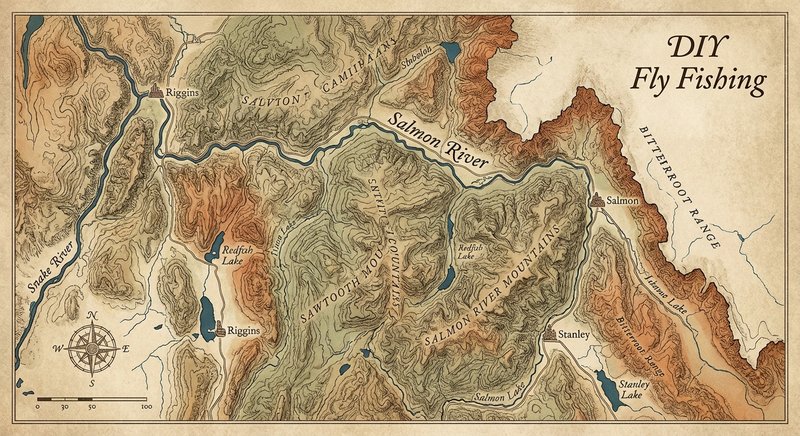
The Salmon River is unique because it remains undammed for most of its length, allowing for a more natural flow and temperature cycle. It is a massive drainage, but for fly fishing, we primarily focus on the Upper Salmon (near Stanley) and the Main Salmon (near Salmon and North Fork).
The water is characterized by classic "freestone" features: large boulder gardens, deep pools, long tail-outs, and swift riffles. What makes it special is the sheer scale—you aren't just fishing a river; you are fishing a geological masterpiece. Anglers love it for the solitude, the dramatic scenery of the Sawtooth Mountains, and the opportunity to catch a fish that has traveled over 800 miles from the Pacific Ocean.
🐟 Target Species & Behavior
Steelhead (B-Run and A-Run)
- Behavior: These are "summer-run" fish that enter the river in late summer and fall. They are aggressive but can be moody depending on water temperature.
- Holding: They prefer "walking speed" water—about 3 to 4 feet deep with a broken surface. Look for the "tail-outs" of large pools and the seams where fast and slow water meet.
Chinook Salmon
- Behavior: Massive, powerful fish. During the summer run, they are focused on reaching spawning gravel. They don't "feed" in the traditional sense once they hit fresh water, but they will strike out of territorial aggression.
- Holding: Deep, dark holes and the "buckets" behind large mid-river boulders.
Rainbow (and Westslope Cutthroat) Trout
- Behavior: The resident trout are opportunistic. In the summer, they are looking up for terrestrials and aquatic hatches.
- Holding: Look for "frothy" water, current breaks, and the edges of the main current.
📅 Best Times to Fish
Summer (July – August)
- Focus: Chinook Salmon and Resident Trout.
- Conditions: The water is clearing from snowmelt. This is the prime window for dry-fly fishing for Cutthroat and Rainbows in the Stanley area. Chinook are present in the deeper holes.
- Time of Day: Early morning and late evening are critical for salmon. Trout are active throughout the day, peaking during afternoon hatches.
Fall (September – November)
- Focus: Steelhead and "Troop" Trout.
- Conditions: This is the "Golden Season." As water temperatures drop into the 40s and 50s, Steelhead become very active.
- Time of Day: Mid-day becomes better as the sun warms the water slightly, increasing the fish's metabolic rate.
🪰 Recommended Flies & Techniques
For Steelhead
- Technique: Swinging flies with a Spey rod is the traditional "purist" method. Nymphing under an indicator is often more productive in cold water.
- Flies:
- Swinging: Green Butt Skunk, Blue Charm, Hobo Spey (Purple/Black).
- Nymphing: Lifter Brights, Egg patterns (Pink/Orange), and large Rubber Leg Stoneflies.
For Chinook Salmon
- Technique: High-stick nymphing or "twerking" streamers in deep holes. You need heavy sink tips to get down to their eye level.
- Flies: Comets (Orange/Pink), Sparkle Shrimp, and heavy-weighted Intruders.
For Rainbow & Cutthroat Trout
- Technique: Dry-dropper rigs are the bread and butter of the Salmon River in summer.
- Flies:
- Dries: Chubby Chernobyl (Orange/Royal), Stimulators, and Hoppers.
- Nymphs: Pat’s Rubber Legs, Pheasant Tails, and Perdigons.
💡 Pro Tips & Local Knowledge
- The "Walking Speed" Rule: For Steelhead, if the water is moving faster than you can comfortably walk, it’s too fast. If it's slower than a slow stroll, it's too slow. Find that perfect "glide."
- Shadow Management: The canyon walls are high. Once the sun hits the water, Steelhead often move deeper or into more turbulent water for cover. Fish the "shadow lines" as the sun moves across the canyon.
- The Stanley "Town Stretch": For easy-access trophy trout fishing, the stretch right through the town of Stanley offers surprisingly good dry fly action in July.
- Cover Water: Don't marry a hole. If you’ve made 20 good casts into a run with no interest, move 50 yards downstream. These fish are travelers; you need to find the one that's "resting."
⚠️ Important Information
Access
- Highway 93 & 75: Much of the upper and main river follows these highways, providing excellent public access. Look for BLM (Bureau of Land Management) signs and developed river access points.
- The Wilderness: Downstream of North Fork, the river enters the "Roadless Area." Access here is by multi-day float trip only.
Regulations & Permits
- Steelhead/Salmon Permits: You must have a valid Idaho fishing license plus the specific permit (tag) for Salmon or Steelhead.
- Barbless Hooks: Required for all Salmon and Steelhead fishing. Even if you are trout fishing in certain stretches, it's best practice to pinch your barbs.
- Season Closures: Check the Idaho Fish and Game (IDFG) website religiously. Seasons for Salmon and Steelhead are set based on dam counts and can change with 24-hour notice.
Safety
- Wading: The Salmon River is powerful. The rocks are slippery (felt soles or studs are highly recommended). Always wear a wading belt.
- Wildlife: This is bear and mountain lion country. Carry bear spray if you are hiking into remote stretches.
Bug Hatches & Matching Flies
| Hatch | Type | Peak months | Time of day | Hook sizes | Matching flies |
|---|---|---|---|---|---|
| Salmonfly Pteronarcys californica | stonefly | June, July | All Day | #4-8 | Rogue River Stone #4-6, Pats Rubber Legs #6-8, Chubby Chernobyl (Orange) #6-10 |
| Golden Stonefly Hesperoperla pacifica | stonefly | June, July | Morning/Afternoon | #8-12 | Norm Wood Special #8-10, Golden Stone Nymph #10-12, Clark's Stone #10-12 |
| Pale Morning Dun (PMD) Ephemerella inermis | mayfly | July, August | Late Morning/Afternoon | #14-18 | Sparkle Dun #16-18, Parachute Adams #14-18, Pheasant Tail #14-18 |
| Blue Winged Olive (BWO) Baetis tricaudatus | mayfly | March, April, September, October | Afternoon | #18-22 | RS2 #20-22, BWO Parachute #18-20, WD-40 #18-22 |
| October Caddis Dicosmoecus gilvipes | caddis | September, October | Afternoon/Evening | #8-12 | Orange Stimulator #8-10, Morrish October Caddis #10-12, Peeking Caddis #10-12 |
| Grasshoppers Acrididae | terrestrial | August, September | Mid-day/Afternoon | #8-12 | Morrish Hopper #8-12, Dave's Hopper #10-12, Tan Thunder Thighs #10-14 |
| Spotted Sedge Hydropsyche | caddis | July, August | Evening | #14-16 | Elk Hair Caddis #14-16, Soft Hackle Hare's Ear #14-16, Hydropsyche Larva #14-16 |
| Trico Tricorythodes | mayfly | August, September | Early Morning | #20-24 | Trico Spinner #20-24, Trico Dun #22-24, Zebra Midge #20-22 |