Salmon River
Fly fishing in New York · Intermediate · Best seasons: Fall, Winter, Spring
Target Species
Chinook Salmon, Steelhead, Brown Trout
About This Water
Famous for its fall salmon and steelhead runs. Pacific salmon stocked in Lake Ontario tributaries.
Fishing Recommendations
The Salmon River in Pulaski, New York, is the "Crown Jewel" of Great Lakes tributary fishing. It offers a truly world-class experience that rivals the rivers of Alaska and British Columbia, but with the accessibility of the Northeast. As your guide, I’m here to tell you that this river demands respect—both for its powerful fish and its challenging wading conditions.
🎣 Location Overview
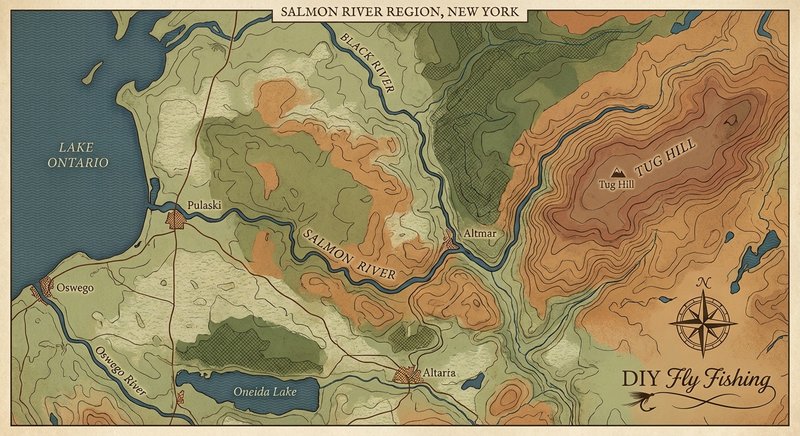
The Salmon River flows roughly 17 miles from the Lighthouse Hill Reservoir in Altmar down to Port Ontario, where it empties into Lake Ontario. It is famous for its massive runs of Lake Ontario Chinook (King) Salmon, Coho Salmon, and legendary Steelhead.
What makes it special is the sheer volume of fish. During peak runs, the river can hold tens of thousands of fish. The water is generally clear, with a bottom composed of flat "shale" rock and round "egg" stones. It features a classic mix of deep pools, fast pocket water, and broad tailouts. However, it is also famous for "combat fishing"—the crowds can be intense, but the reward is the chance to land a 20-lb Steelhead or a 30-lb Salmon on a fly rod.
🐟 Target Species & Behavior
Chinook (King) Salmon
- Behavior: These are "terminal" spawners. They enter the river to spawn and die. Early in the season (September), they are aggressive and will strike out of territorial dominance. As they move onto gravel "redds" (nests), they become more focused on spawning.
- Holding: Deep holes during the day; shallow gravel bars (riffles) during the morning and evening.
Steelhead (Lake-run Rainbow Trout)
- Behavior: Unlike salmon, steelhead enter the river to feed on salmon eggs and eventually spawn in the spring. They are incredibly powerful, known for acrobatic leaps and long runs.
- Holding: They sit behind spawning salmon to eat drifting eggs. In winter, they move to the "slow and deep" guts of pools to conserve energy.
Brown Trout (Lake-run)
- Behavior: These are the "ghosts" of the river. They are wary, often holding in structure or under cut banks. They enter in the fall to spawn and are often found in the lower river sections early in the season.
📅 Best Times to Fish
- September – Mid-October (The Salmon Run): This is peak King Salmon season. The river is crowded, but the action is fast. Expect warm days and cool nights.
- Late October – November (Prime Steelhead/Browns): My personal favorite. The salmon are dying off, and the Steelhead are entering the river in force to gorge on eggs.
- December – February (Winter Steelhead): For the hardy angler. The crowds disappear. You’ll deal with shelf ice and freezing guides, but the fishing can be incredibly rewarding if you find a pod of wintering fish.
- March – April (Spring Run & Dropbacks): Steelhead spawn in the spring. "Dropbacks" (fish heading back to the lake after spawning) are very aggressive and hungry, making for some of the best sport of the year.
🪰 Recommended Flies & Techniques
Techniques
- Indicator Nymphing: The most effective way to catch Steelhead. Use a long (9.5' to 11') 7-8 weight rod. Use a heavy fluorocarbon leader and enough split shot to get the fly to the "zone" (the bottom 6 inches of the water column).
- Swinging (Spey): Using a two-handed rod to swing streamers or wet flies across the current. This is the most "sporting" way to catch a Steelhead.
- Chuck-and-Duck: A traditional Great Lakes method using a heavy running line and lead to "bounce" flies along the bottom in deep, fast water.
Top Fly Patterns
- Egg Patterns (The Gold Standard): Estaz Eggs, Glo-Bugs, and "Sucker Spawn" in Oregon Cheese, Chartreuse, and Pink.
- Nymphs: Stoneflies (size 6-10) in black or brown. Copper Johns and Hare’s Ears are great for Steelhead.
- Streamers: Wooly Buggers (Black/Olive), Egg-Sucking Leeches, and large "Intruder" style flies for swinging.
- Beads: While technically not a "fly," 8mm and 10mm plastic beads in various egg colors are incredibly effective under an indicator.
💡 Pro Tips & Local Knowledge
- The "Pulaski Step": The rocks in the Salmon River are notoriously slippery (slicker than most rivers due to a fine layer of silt/algae). Studded wading boots are mandatory. Do not attempt to wade this river in plain rubber soles.
- The Douglaston Salmon Run (DSR): This is a private, pay-to-play stretch at the mouth of the river. If you want the first crack at fresh fish entering from the lake, it is worth the daily fee.
- Watch the Flow: The river is dam-controlled. Check the Brookfield Renewable flow gauge (online). A flow of 350-500 CFS is ideal for wading; 750+ CFS makes wading difficult and dangerous in many spots.
- Upper River vs. Lower River: If the fish are just starting to run, stay in the lower river (Pulaski/DSR). If it’s late in the season, head to the "Fly Only" zones in Altmar (Upper and Lower Fly Zones), where fish congregate before the hatchery.
⚠️ Important Information
Regulations
NY State has very specific regulations for the Salmon River to prevent snagging.
- Hook Size: There are strict limits on the gap between the hook point and the shank (usually no larger than 1/2 inch).
- Weight: Split shot must be at least 12 inches above the fly in some areas.
- Single Hook: Most of the river is restricted to single-pointed hooks only.
Safety & Ethics
- Wading Belt: Wear one. If you slip in a deep hole, a wading belt can save your life.
- Crowd Etiquette: If someone is fighting a fish, pull your line in. If a pool is full, ask before stepping in.
- License: You need a valid New York State Fishing License. You can buy them online or at any local shop (like Fat Nancy's or Whitakers).
Final Guide Advice: Dress in layers, bring a high-quality raincoat, and keep your hooks sharp. The Salmon River is a test of endurance, but hooking into a fresh-run Steelhead in the middle of a November snowstorm is an experience you will never forget. 🎣
Bug Hatches & Matching Flies
| Hatch | Type | Peak months | Time of day | Hook sizes | Matching flies |
|---|---|---|---|---|---|
| Blue Winged Olive Baetis | mayfly | April, May, September, October | Afternoon | #18-22 | RS2 #18-22, Parachute Adams #18-22, Pheasant Tail Nymph #18-20 |
| Grannom Caddis Brachycentrus | caddis | April, May | Morning/Afternoon | #14-16 | Peacock Herl Caddis #14-16, Deep Sparkle Pupa #14-16, Elk Hair Caddis #14-16 |
| March Brown Maccaffertium vicarium | mayfly | May, June | Afternoon | #10-14 | March Brown Emerger #12-14, Gold Ribbed Hare's Ear #10-14, March Brown Dry #12-14 |
| Sulphur Ephemerella invaria/dorothea | mayfly | June, July | Evening | #14-18 | Sulphur Parachute #16-18, Sulphur CDC Emerger #16-18, Pheasant Tail #16-18 |
| Slate Drake Isonychia bicolor | mayfly | June, September, October | Afternoon/Evening | #10-12 | Isonychia Parachute #10-12, Prince Nymph #10-12, Zug Bug #10-12 |
| Golden Stonefly Acroneuria | stonefly | June, July | Morning/Evening | #8-12 | Pat's Rubber Legs #8-12, Golden Stimulator #8-12, 20 Incher Stone #8-12 |
| Little Black Caddis Chimarra | caddis | April | Afternoon | #18-20 | Zebra Midge #18-20, Black Elk Hair Caddis #18-20, LaFontaine Sparkle Pupa #18-20 |
| Midges Chironomidae | midge | January, February, March, December | Morning/Afternoon | #20-26 | Griffith's Gnat #20-24, Black Zebra Midge #20-24, Blood Worm #18-22 |