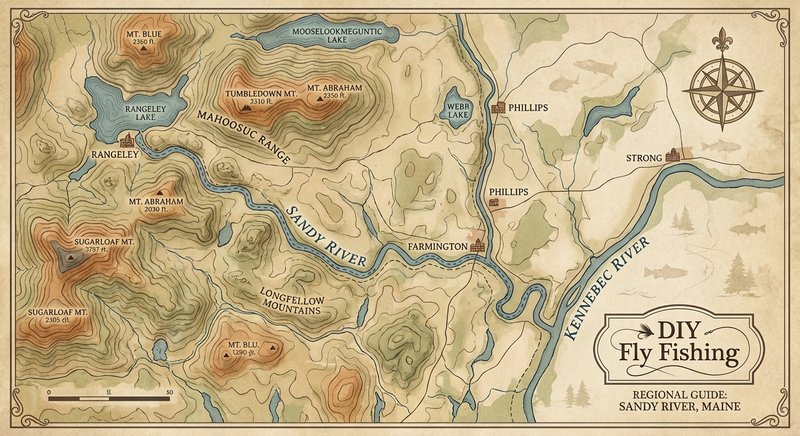
Sandy River
Fly fishing in Maine · Beginner · Best seasons: Spring, Summer, Fall
Target Species
Brook Trout, Brown Trout
About This Water
Western Maine stream with brook and brown trout. Good public access.
Fishing Recommendations
The Sandy River is one of Maine’s most underrated gems. Flowing from the high peaks of the Longfellow Mountains near Rangeley down to the Kennebec River in Norridgewock, it offers a diverse range of water—from tumbling mountain streams to broad, meandering pools. It is a classic "freestone" river, meaning its flow and temperature are dictated by snowmelt and rainfall rather than dam releases.
Here is your guide to mastering the Sandy River.
🎣 Location Overview
The Sandy River is a study in transitions. The Upper Sandy (above Phillips) is a high-gradient mountain stream filled with boulders, plunge pools, and pocket water. As it moves through Strong and Farmington, it widens into classic riffle-and-pool water. The Lower Sandy (below Farmington) slows down, with sandy bottoms and deep holes that hold larger, more elusive fish.
What makes it special is the scenery and the solitude. While the nearby Kennebec and Androscoggin get the headlines, the Sandy offers a quieter experience. It is also a critical nursery for Atlantic Salmon, which adds a sense of wildness to every cast.
🐟 Target Species & Behavior
- Brook Trout: These are the stars of the upper river. Expect bright, wild fish in the 6–10 inch range, with larger "holdovers" in the deeper pools of the middle section. They are opportunistic and aggressive, holding in oxygenated pocket water and at the heads of pools.
- Brown Trout: Found primarily from Strong down to Norridgewock. These fish are more selective and nocturnal. They hold in "deep and dark" spots—under cut banks, beneath overhanging trees, and in the slow, deep troughs of the lower river.
- Behavioral Note: Because the Sandy is a freestone river, fish are very temperature-sensitive. In the heat of summer, they will migrate toward the mouths of cold-water "feeder" brooks.
📅 Best Times to Fish
- Spring (May - June): This is the prime window. Once the spring runoff (freshet) subsides in mid-May, the insect hatches begin. This is your best chance for larger fish feeding on the surface.
- Summer (July - August): Fishing becomes technical. Stick to the upper reaches where the water stays cool, or fish early mornings and late evenings. Focus on "white water" where oxygen levels are higher.
- Fall (September - October): A spectacular time to be on the water. Brook trout take on their vibrant spawning colors and become aggressive. This is also when the larger Browns begin to move and feed heavily before winter.
- The Window: The "Golden Hour" on the Sandy is the last two hours of daylight, especially during the June Caddis hatches.
🪰 Recommended Flies & Techniques
Top Fly Patterns
- Dry Flies:
- Hendrickson (Size 12-14): Essential for late May.
- Elk Hair Caddis (Size 14-18): A staple all season, especially in tan or olive.
- Royal Wulff or Stimulator (Size 10-14): Perfect "attractor" patterns for the turbulent upper sections.
- Nymphs:
- Pheasant Tail (Size 14-18): Mimics almost any mayfly nymph.
- Prince Nymph (Size 12-16): Great for the faster pocket water.
- Pat’s Rubber Legs (Size 8-12): Deadly for larger Browns in the spring.
- Streamers:
- Black or Olive Woolly Bugger: The universal Maine fly.
- Muddler Minnow: Excellent for imitating the sculpins and dace found in the Sandy.
Techniques
- High-Sticking/Euro Nymphing: In the boulder gardens above Phillips, keep as much line off the water as possible to avoid the complex currents.
- The "Dry-Dropper": A Stimulator with a small Pheasant Tail nymph tied 18 inches below it is the most effective way to cover the Sandy's riffles.
- Streamer Stripping: In the lower river, cast toward cut banks and strip streamers aggressively to trigger a reaction strike from territorial Browns.
💡 Pro Tips & Local Knowledge
- Follow the Cold: During July, if the water feels like bathwater, find a map and look for where small mountain brooks enter the main stem. The trout will stack up in these "cold water refugia."
- The Phillips Reach: The stretch through the town of Phillips offers excellent public access and a perfect mix of water types. It’s a great "starting point" for someone new to the river.
- Watch the Sand: In the lower sections, the sandy bottom can be unstable. Wade carefully, as "holes" can shift after big spring floods.
- The "Evening Rise": Don't leave too early. Some of the best dry fly action occurs just as you're losing the ability to see your fly. Use a high-vis sighter or fish by "sound" and "ripple."
⚠️ Important Information
- Atlantic Salmon: The Sandy is a primary spawning tributary for Atlantic Salmon. It is illegal to target them. If you hook one accidentally, keep it in the water and release it immediately. They are distinguished by their black spots and "X" markings.
- Regulations: Maine fishing laws change by section (S-Code). Always check the Maine Department of Inland Fisheries & Wildlife (MDIFW) Open Water Rulebook. Many sections of the Sandy are "Artificial Lures Only" or "Catch and Release."
- Access: Much of the Sandy flows through private land. Maine has a generous "permissive access" tradition, but always respect "Posted" signs and never block farm gates with your vehicle.
- Safety: Be aware of rapid water rises after heavy rains in the mountains. The Sandy can go from a trickle to a torrent in a matter of hours.
Guide’s Final Word: The Sandy River is a "reading water" river. It rewards the angler who can spot a seam, a pocket behind a rock, or a deep undercut bank. Bring your 4-weight or 5-weight rod, a box of classic dries, and a sense of adventure.
Bug Hatches & Matching Flies
| Hatch | Type | Peak months | Time of day | Hook sizes | Matching flies |
|---|---|---|---|---|---|
| Hendrickson Ephemerella subvaria | mayfly | May | Afternoon | #12-14 | Red Quill #12-14, Hendrickson Emerger #14, Pheasant Tail Nymph #12-14 |
| Blue Winged Olive Baetis spp. | mayfly | May, September, October | Mid-day/Overcast | #18-22 | BWO Sparkle Dun #18-20, RS2 #20-22, WD-40 #18-22 |
| Grannom Caddis Brachycentrus | caddis | May | Morning/Afternoon | #14-16 | Elk Hair Caddis (Olive/Grey) #14-16, LaFontaine's Deep Sparkle Pupa #14-16, Holy Grail #16 |
| Sulphur Ephemerella invaria/dorothea | mayfly | June, July | Evening | #14-18 | Sulphur Parachute #16-18, Sulphur Snowshoe Emerger #16, Gold Ribbed Hare's Ear #14-16 |
| March Brown Maccaffertium vicarium | mayfly | June | Afternoon | #10-12 | March Brown Dry #10-12, March Brown Spun Dun #12, Hare's Ear Nymph #10-12 |
| Golden Stonefly Acronuria | stonefly | June, July | Evening/Night | #6-10 | Golden Stimulator #8-10, Pat's Rubber Leg #6-10, Kaufmann's Stone #8 |
| Light Cahill Stenacron canadense | mayfly | July, August | Evening | #12-14 | Light Cahill #12-14, Cream Usual #14 |
| Cinnamon Caddis Hydropsyche | caddis | June, July, August | Evening | #14-18 | Tan Elk Hair Caddis #16, Tan Soft Hackle #14-16, Peeping Caddis #14 |
| Black Ants Formicidae | terrestrial | August, September | All day | #14-18 | Black Foam Ant #14-18, Chernobyl Ant #10-12 |