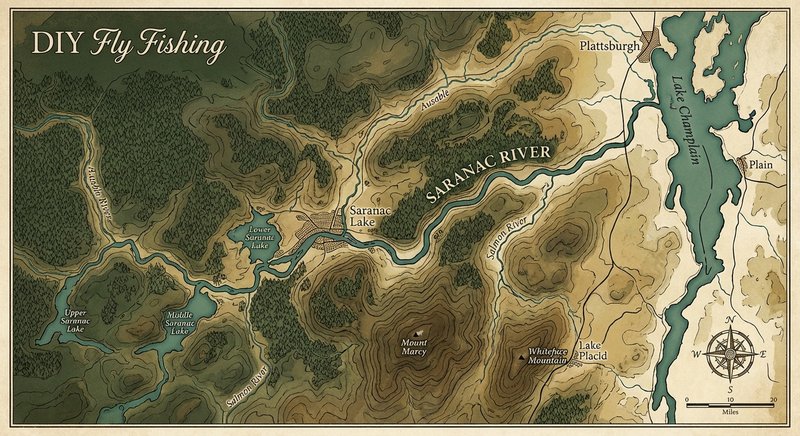
Saranac River
Fly fishing in New York · Intermediate · Best seasons: Spring, Summer, Fall
Target Species
Brown Trout, Brook Trout, Landlocked Salmon
About This Water
Adirondack river system with excellent brown trout. Multiple branches with diverse fishing.
Fishing Recommendations
The Saranac River is one of the crown jewels of the Adirondack Mountains. Stretching from the high peaks region down to the shores of Lake Champlain in Plattsburgh, it offers a diverse range of water types—from intimate mountain brook trout streams to powerful, wide runs frequented by trophy-sized landlocked salmon.
Here is your comprehensive guide to fly fishing the Saranac River.
🎣 Location Overview
The Saranac River is unique because it effectively functions as three different rivers in one.
- The Upper Saranac: Above the village of Saranac Lake, the river is smaller, colder, and characterized by classic Adirondack "pocket water" and beautiful bends.
- The Middle Saranac: This section includes a series of "flowages" (reservoirs like Franklin Falls and Union Falls). While these are better known for Pike and Bass, the tailwaters below these dams hold excellent trout populations.
- The Lower Saranac (Cadyville to Plattsburgh): This is the most famous stretch for fly anglers. It features large boulders, heavy rapids, and deep pools. It is a world-class destination for Landlocked Atlantic Salmon that migrate from Lake Champlain.
What makes the Saranac special is its resilience and variety. Whether you want to hike into the wilderness for native brookies or wade into big water for a 5-pound salmon, the Saranac provides.
🐟 Target Species & Behavior
Landlocked Atlantic Salmon
These are the river's celebrities. Unlike Pacific salmon, they do not die after spawning and remain extremely aggressive. They hold in fast "bubbly" water, at the heads of pools, and behind large mid-river boulders. They are famous for acrobatic leaps once hooked.
Brown Trout
The lower and middle sections hold wild and stocked browns. They are "cover-oriented," tucked under overhanging banks or deep in the shadows of boulders during the day. In the evening, they move into the riffles to feed on emerging insects.
Brook Trout
Found primarily in the upper reaches and cold-water tributaries. These fish are opportunistic but wary. They thrive in the high-oxygen water of the mountain sections and prefer bright, flashy attractor patterns.
📅 Best Times to Fish
Spring (April – June)
- The Draw: The Spring Salmon Run. As the ice melts, salmon follow smelt (their primary food source) into the lower river.
- Conditions: Water is high and cold. Use sinking tips and weighted streamers.
- Hatches: Hendrickson (May) is the first major dry fly event.
Summer (July – August)
- The Draw: Dry fly fishing for resident trout.
- Conditions: Water temperatures can rise; focus on the early morning (sunrise to 10 AM) and the "witching hour" at dusk.
- Tip: If the lower river gets too warm (above 68°F), head to the Upper Saranac or higher elevation tributaries where the water stays cool.
Fall (September – November)
- The Draw: The Main Salmon Run and spawning Browns. This is the prime time for trophy fish.
- Conditions: Crisp air and stunning foliage. The salmon become very aggressive as they prepare to spawn in October.
🪰 Recommended Flies & Techniques
For Landlocked Salmon
- Streamers: Grey Ghost, Black Ghost, Mickey Finn, and the "Magog Smelt." (Sizes 4–8).
- Technique: "The Wet Fly Swing." Cast 45 degrees downstream, let the fly swing across the current, and give it small twitches.
- Nymphs: Large stoneflies and egg patterns (orange/pink) during the fall run.
For Brown & Brook Trout
- Dry Flies: Elk Hair Caddis (tan/olive), Adams, and Light Cahills. For summer, use Terrestrials (Ants, Beetles, and Hopper patterns).
- Nymphs: Pheasant Tail, Hare's Ear, and Prince Nymphs (Sizes 12–18). Euro-nymphing is incredibly effective in the Saranac’s boulder-heavy pocket water.
- Streamers: Woolly Buggers (Olive or Black) and Sparkle Minnows.
💡 Pro Tips & Local Knowledge
- The Cadyville "Gorge": This section offers some of the best pocket water for trout. It requires some hiking and nimble wading, but the pressure is lower.
- Watch the "Bubble Line": Salmon and trout on the Saranac love to sit right under the foam lines. If you see a line of bubbles on the surface, your fly should be directly under it.
- Wading Safety: The Saranac is a powerful river with slippery, "bowling ball" rocks. A wading staff and studded boots are not optional here—they are essential for safety.
- The Smelt Factor: In the spring, if you aren't seeing rises, fish a smelt-imitation streamer. The salmon are there for one reason: protein. Match the silver/blue/white flash of the smelt.
⚠️ Important Information
Access
- Lower River: Excellent access in Plattsburgh near the Imperial Dam and various municipal parks.
- Cadyville: High Falls Park provides access to some rugged and beautiful water.
- Picketts Corners: A popular spot for trout anglers in the middle section.
Regulations
- Licenses: A New York State freshwater fishing license is required.
- Special Rules: The Saranac has specific "Catch and Release Only" sections and "Artificial Lures Only" sections (notably from the Kent Falls dam to the Cadyville dam). Always check the NYS DEC Adirondack Region regulations before your trip.
- Dam Alerts: The river is dam-controlled. Rapid water level rises can occur. If you notice the water getting muddy or rising suddenly, exit the river immediately.
Ethics
The Adirondack ecosystem is fragile. Practice Leave No Trace, and during the summer, carry a thermometer. If the water hits 70°F, stop fishing for trout to prevent post-release mortality.
Bug Hatches & Matching Flies
| Hatch | Type | Peak months | Time of day | Hook sizes | Matching flies |
|---|---|---|---|---|---|
| Hendrickson Ephemerella subvaria | mayfly | April, May | Afternoon | #12-14 | Red Quill #12-14, Hendrickson Emerger #12-14, Pheasant Tail #12-14 |
| Blue-Winged Olive Baetis | mayfly | April, May, September, October | Afternoon | #18-22 | RS2 #18-22, BWO Sparkle Dun #18-22, JujuBaetis #18-22 |
| Grannom Caddis Brachycentrus | caddis | May | Morning/Evening | #14-16 | Peacock Caddis #14-16, Deep Sparkle Pupa #14-16, Elk Hair Caddis (Olive) #14-16 |
| March Brown Maccaffertium vicarium | mayfly | May, June | Afternoon | #10-12 | March Brown American #10-12, Hare's Ear Nymph #10-12, March Brown Wet Fly #10-12 |
| Green Drake Ephemera guttulata | mayfly | June | Evening | #8-10 | Coffin Fly #8-10, Green Drake Cripple #8-10, Grey Fox #10-12 |
| Light Cahill Stenonema ithaca | mayfly | June, July | Evening | #12-14 | Light Cahill #12-14, Cream Usual #14, Gold Ribbed Hare's Ear #14 |
| Slate Drake Isonychia bicolor | mayfly | June, August, September | Afternoon/Evening | #10-12 | Iso Parachute #10-12, Prince Nymph #10-12, Zug Bug #10-14 |
| Golden Stonefly Acroneuria | stonefly | June, July | Night/Morning | #6-10 | Pat's Rubber Legs #6-10, Stimulator (Yellow) #8-12, Golden Stone Nymph #8-10 |
| Trico Tricorythodes | mayfly | July, August, September | Morning | #22-26 | Trico Spinner #22-26, Trico Parachute #22-24 |
| Ants and Beetles Formicidae / Coleoptera | terrestrial | July, August, September | Midday | #12-18 | Black Foam Ant #14-18, Crowe Beetle #12-16, Cinnamon Ant #16-18 |