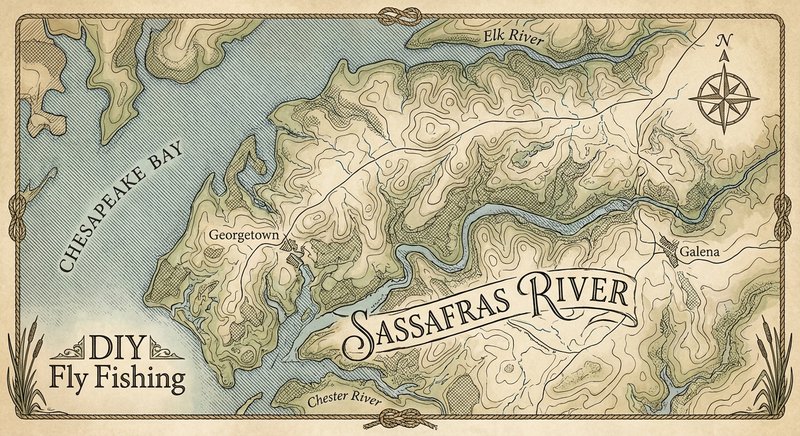
Sassafras River
Fly fishing in Maryland · Beginner · Best seasons: Spring, Summer, Fall
Target Species
Largemouth Bass, White Perch, Catfish
About This Water
Kent County tidal river with bass and perch. Upper Bay fishing.
Fishing Recommendations
Welcome to the Sassafras River, one of the most scenic and productive tributaries on the upper Chesapeake Bay. As a guide, I often recommend the Sassafras to fly anglers who want a break from the crowded trout streams or the open bay. This is "Sweetwater" fishing at its finest—a blend of tidal influence, lily pad fields, and expansive marshes.
Here is your comprehensive guide to fly fishing the Sassafras River.
🎣 Location Overview
The Sassafras River is located on the Northern Eastern Shore of Maryland, flowing into the Chesapeake Bay near Betterton. Unlike the rocky rivers of Western Maryland, the Sassafras is a coastal plain tidal river.
What makes it special is its clarity compared to other Bay tributaries; the sandy bottom in many sections keeps the water relatively clear, which is crucial for sight-casting with a fly rod. It is a wide, slow-moving river characterized by expansive spatterdock (lily pad) fields, submerged aquatic vegetation (SAV), and numerous creeks like Turner’s Creek and Lloyd Creek. Anglers love it because it offers a "low-country" feel with a diverse mix of freshwater and brackish species.
🐟 Target Species & Behavior
Largemouth Bass
The Sassafras is a premier bass destination. These fish are "tide-dependent."
- Behavior: During high tide, they push deep into the lily pads and shoreline brush to hunt frogs and dragonflies. During low tide, they pull back to the "edges" of the grass lines or drop-offs.
- Feeding: Their diet consists of mummichogs (minnows), bluegill, crayfish, and leopard frogs.
White Perch
Often overlooked by fly anglers, these are pound-for-pound some of the hardest-fighting fish on a 3-weight or 4-weight rod.
- Behavior: They school up in massive numbers. In the spring, they run upriver to spawn. In summer, they hold around shaded dock pilings, fallen timber, and rocky shorelines.
- Feeding: They focus on grass shrimp, small minnows, and insect larvae.
Catfish (Channel & Blue)
Yes, you can catch these on a fly! The Sassafras has a healthy population of Channel cats and an increasing number of invasive Blue cats.
- Behavior: They cruise the bottom of channel edges but will move into the shallows of the marshes during low light (dawn/dusk).
- Feeding: They are opportunistic. While they prefer scent, they will aggressively strike large, dark streamers stripped slowly along the bottom.
📅 Best Times to Fish
Optimal Seasons
- Spring (April - June): The prime window. White Perch run in April. Largemouth Bass become highly aggressive in the "pre-spawn" and "spawn" phases (late April through May) in the shallower creeks.
- Summer (July - August): Best for topwater action. Focus on the early morning or late evening to avoid the midday heat and heavy boat traffic.
- Fall (September - November): The "Second Spring." As temperatures drop, bass feed heavily for winter. The White Perch school up deep near the mouth of the river.
The "Tide Factor"
In the Sassafras, the tide is more important than the time of day.
- Best Window: The last two hours of a falling tide and the first hour of a rising tide. This movement "flushes" baitfish out of the grass and forces the predatory fish to the edges where your fly can reach them.
🪰 Recommended Flies & Techniques
For Largemouth Bass
- Patterns:
- Topwater: Frog-pattern Poppers (size 1/0), BoogleBugs, and Hollow Fleye Deer Hair bugs.
- Subsurface: Gamechangers (white/chartreuse), Clouser Minnows, and Woolly Buggers (black or olive).
- Technique: Use a 7-weight or 8-weight rod with a Weight Forward Floating line. Cast directly into the pockets of lily pads. Give the fly a long pause—bass here often strike on the "sit."
For White Perch
- Patterns:
- Size 6 or 8 Bead-head Woolly Buggers (pink, white, or chartreuse).
- Grass Shrimp imitations.
- Technique: Use a 3-weight or 4-weight rod. "Dredge" the fly around dock pilings or fallen trees using a slow, rhythmic strip.
For Catfish
- Patterns:
- Large, weighted streamers (Black or Purple).
- Bunny Leeches.
- Technique: Use a sinking tip line. You must get the fly to the bottom. Move it slowly, making sure it "puffs" the silt or sand on the riverbed.
💡 Pro Tips & Local Knowledge
- Focus on Turner’s Creek: This is a legendary spot on the Sassafras. It has a public boat ramp and a pier. The area around the pier and the marshes across from it are goldmines for White Perch and Bass.
- The "Docks" Strategy: The Sassafras has many private docks. In the heat of summer, the biggest bass hide in the shadows of these docks. Skip your fly as far back under the structure as possible.
- Color Palette: Because the water can have a "tannin" (tea-colored) tint, gold, orange, and black flies often outperform white or silver ones.
- The Spatterdock Edge: Don't just cast anywhere in the lily pads. Look for "points" in the weed line or small gaps where water flows through. These are ambush points.
⚠️ Important Information
Access
- Public Ramps: Turner’s Creek Park (Kennedyville) and the Georgetown area (under the US-301 bridge) are the primary access points for boaters and kayakers.
- Kayaking: The Sassafras is perfect for kayak fly fishing. Launching at Turner’s Creek allows you to reach prime marsh habitat without a long paddle.
Regulations & Permits
- License: You will need a Maryland Tidal Sport Fishing License. If you fish far enough upstream where it becomes non-tidal, you technically need a non-tidal license, but for most of the Sassafras, the Tidal license is the standard.
- Invasive Species: If you catch a Blue Catfish, the Maryland DNR encourages you to keep it and harvest it, as they are invasive and detrimental to the local ecosystem.
Safety
- Boat Traffic: During summer weekends, the main channel of the Sassafras can get very busy with large yachts and powerboats. Stay in the creeks and shallows to avoid heavy wakes.
- Sun/Bugs: The Eastern Shore mosquitoes and "no-see-ums" can be brutal at dusk. Bring high-quality repellent.
Bug Hatches & Matching Flies
| Hatch | Type | Peak months | Time of day | Hook sizes | Matching flies |
|---|---|---|---|---|---|
| Giant Mayfly (Hex) Hexagenia limbata | mayfly | June, July | Dusk/Night | #6-10 | Hexagenia Spinner #6-8, Burrowing Mayfly Nymph #8-10 |
| Chironomids (Midges) Chironomidae | midge | March, April, October, November | Morning/Evening | #18-24 | Zebra Midge #18-22, Griffith's Gnat #20-24 |
| White Mayfly Ephoron leukon | mayfly | August | Evening/Night | #12-14 | White Wulff #12-14, Ephoron Nymph #14 |
| Damselfly Enallagma spp. | terrestrial | May, June, July | All Day | #10-14 | Marabou Damselfly Nymph #10-12, Adult Damselfly #12-14 |
| Trico Tricorythodes | mayfly | July, August, September | Early Morning | #20-26 | Trico Spinner #22-24, Sunken Trico #22-24 |
| Blue-Winged Olive Baetis | mayfly | April, May, September, October | Afternoon | #18-22 | BWO Sparkle Dun #18-20, Pheasant Tail #18-22 |
| Spotted Sedge Hydropsyche | caddis | May, June | Evening | #14-16 | Elk Hair Caddis (Tan) #14-16, Hydropsyche Larva #14-16 |
| Terrestrial Beetles Coleoptera | terrestrial | June, July, August | All Day | #12-16 | Foam Beetle #12-16, Japanese Beetle #14 |
| Crickets & Grasshoppers Orthoptera | terrestrial | August, September | Afternoon | #8-12 | Dave's Hopper #10-12, Black Foam Cricket #12 |