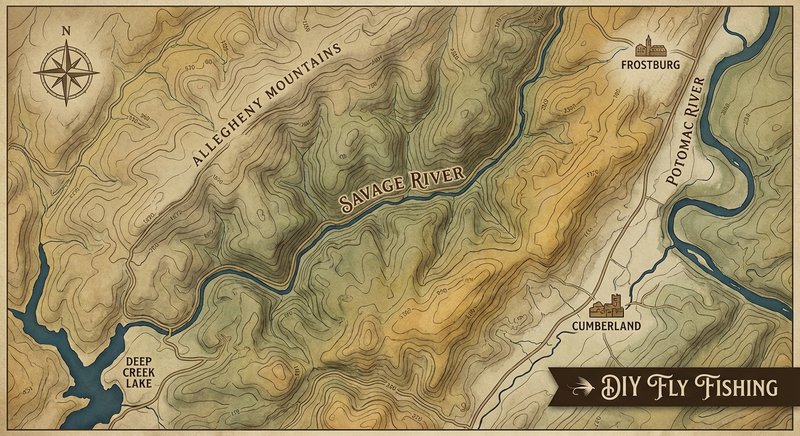
Savage River
Fly fishing in Maryland · Intermediate · Best seasons: Spring, Summer, Fall, Winter
Target Species
Brown Trout, Rainbow Trout
About This Water
Western Maryland tailwater with excellent brown trout. Trophy trout management area.
Fishing Recommendations
As your guide for the Savage River in Western Maryland, let me start by saying: prepare for a challenge. This isn't just "fishing"; this is tactical trout hunting. The Savage is widely considered the crown jewel of Maryland fly fishing and one of the most technical wild trout tailwaters in the Eastern United States.
🎣 Location Overview
The Savage River, specifically the tailwater section below the Savage River Reservoir dam, is a high-gradient, boulder-choked mountain stream. Unlike the slow, meandering limestone creeks of Pennsylvania, the Savage is characterized by "pocket water."
What makes it special is its consistency. Because it is a bottom-release dam, the water remains cold (under 60°F) even in the heat of July. The river holds a dense population of wild, stream-born Brown and Rainbow trout that are notoriously selective and sophisticated. It feels more like a wild torrent in the Rockies than a Mid-Atlantic stream.
🐟 Target Species & Behavior
- Wild Brown Trout: These are the kings of the Savage. They are dark, buttery, and incredibly spooky. They live in the "pockets"—the soft water behind boulders, the "pillows" in front of rocks, and the tight seams along the banks.
- Wild Rainbow Trout: Usually found in the faster, more oxygenated water at the heads of pools or in the heavy riffles. They are smaller on average than the browns but are incredibly acrobatic.
Behavior: These fish are masters of energy conservation. They won't move three feet to eat a fly; your drift must be surgical. Because the water is so clear, they have exceptional vision—if you can see them, they have likely already seen you.
📅 Best Times to Fish
The Savage is a true year-round fishery, but each season demands a different approach.
- Spring (April - June): Prime Time. This is the window for major hatches. The water levels are usually higher, meaning the fish are less spooky and more willing to look up for dry flies.
- Summer (July - August): While other rivers are too hot to fish, the Savage is perfect. Focus on early mornings and late evenings. Terrestrials (ants/beetles) become vital.
- Fall (September - November): The Brown Trout spawn occurs in late autumn. The fish become aggressive, and the foliage in Garrett County is world-class. Note: Avoid fishing over active spawning beds (redds).
- Winter (December - March): Only for the dedicated. Midges and small nymphs are the name of the game. Look for the warmest part of the day (12 PM - 3 PM).
🪰 Recommended Flies & Techniques
Top Fly Patterns
- Dry Flies:
- Sulphurs (Size 14-18): The legendary late spring hatch.
- Blue Winged Olives (Size 18-22): Essential on cloudy/rainy days.
- Little Green Stoneflies: Very common in early summer.
- Ants and Beetles: Critical in mid-to-late summer.
- Nymphs:
- Pheasant Tail (Size 16-20): A year-round staple.
- Zebra Midge (Size 18-22): Red or Black.
- Pats Rubber Legs: Essential for high-water "weight" and movement.
- Streamers:
- Black or Olive Woolly Buggers: Fish these tight to the banks during high-flow events.
Effective Techniques
- Tactical Nymphing: European Nymphing (Tight-line) is arguably the most effective way to fish the Savage. The complex currents make getting a drag-free drift with a traditional indicator very difficult.
- The "Short Drift": Don't try to cast 50 feet. Most fish are caught within 15–20 feet of the angler. Focus on high-sticking your rod to keep line off the conflicting currents.
- Dry-Dropper: In the summer, a high-visibility foam beetle with a small nymph 18 inches below is deadly in the pocket water.
💡 Pro Tips & Local Knowledge
- Stealth is Mandatory: Wear drab colors (greens/browns) to blend into the forest. Move slowly. On the Savage, your wading boots often cause more "spook" than your fly line.
- Watch the Flow: Always check the USGS gauge for "Savage River near Barton, MD."
- Ideal flow: 50–100 cfs.
- Challenging but fishable: 100–150 cfs.
- Dangerous: Anything over 250 cfs is difficult to wade and potentially hazardous.
- The "Trophy Trout Area": The most popular stretch is from the dam down to the Allegany County line. This is the strictly regulated Wild Trout Management Area.
- Light Tippet: You will often need to drop down to 6X or 7X fluorocarbon to get bites on nymphs, especially in the slower pools.
⚠️ Important Information
- Regulations: The upper section is a Trophy Trout Management Area. This means Catch and Release Only and Lure/Fly Only (no bait). Always check the current Maryland DNR Freshwater Fishing Guide for specific boundary markers.
- Permits: You need a Maryland Non-Tidal Angler's License and a Trout Stamp.
- Safety: The rocks in the Savage are incredibly slippery. Studded wading boots and a wading staff are highly recommended. The riverbed is a "jumble" of rocks, and a fall here can be serious.
- Cell Service: Expect zero cell service in the gorge. Download your maps for offline use before you head down Savage River Road.
Guide’s Final Word: The Savage River doesn't give up its secrets easily. You might go a whole day with only two bites, but those two fish will likely be the most beautiful wild trout you've ever held. Take your time, watch the water, and enjoy the rugged beauty of Western Maryland.
Bug Hatches & Matching Flies
| Hatch | Type | Peak months | Time of day | Hook sizes | Matching flies |
|---|---|---|---|---|---|
| Blue-Winged Olive Baetis tricaudatus | mayfly | April, May, September, October | Mid-day/Overcast | #18-22 | RS2 #20-22, Parachute BWO #18-22, WD-40 #20-22 |
| Sulphur Ephemerella invaria/dorothea | mayfly | June, July | Late Afternoon/Evening | #14-18 | Pheasant Tail #14-18, Sulphur Snowshoe Emerger #16-18, Sulphur Parachute #14-18 |
| Green Drake Ephemera guttulata | mayfly | May, June | Evening | #8-12 | Green Drake Cripple #10-12, Coffin Fly #10-12, Hare's Ear Nymph #8-12 |
| Blue Quill Paraleptophlebia adoptiva | mayfly | April, May | Mid-day | #16-18 | Blue Quill Dry #16-18, Quill Gordon Nymph #16-18 |
| Tan Caddis Hydropsyche | caddis | May, June, July | Late Afternoon/Evening | #14-18 | Elk Hair Caddis (Tan) #14-18, LaFontaine's Deep Sparkle Pupa #14-16, Iris Caddis #16-18 |
| Little Black Stonefly Taeniopteryx | stonefly | February, March, April | Mid-day | #14-18 | Early Black Stone Nymph #14-16, CDC Stonefly #16-18 |
| Light Cahill Stenacron interpunctatum | mayfly | June, July | Evening/Dusk | #12-16 | Light Cahill Dry #12-16, Gold Ribbed Hare's Ear #14-16 |
| Zebra Midge Chironomidae | midge | January, February, March, December | All Day | #18-24 | Zebra Midge #18-24, Griffith's Gnat #20-24, Top Secret Midge #20-22 |