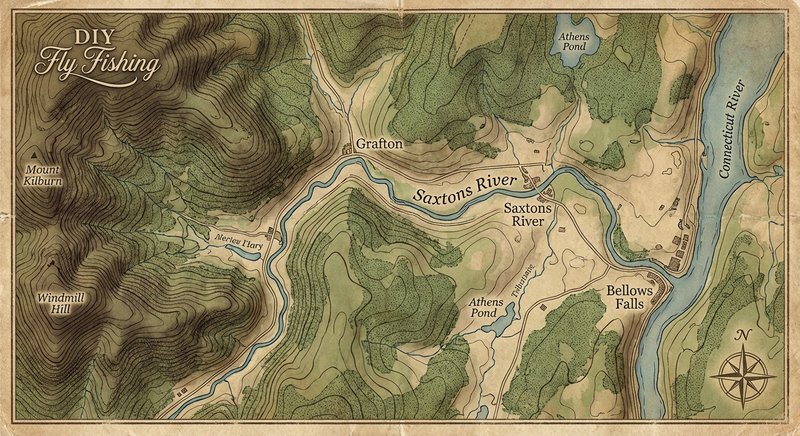
Saxtons River
Fly fishing in Vermont · Beginner · Best seasons: Spring, Summer, Fall
Target Species
Brown Trout, Brook Trout
About This Water
Southern Vermont stream with good wild brown trout. Scenic fishing through covered bridge country.
Fishing Recommendations
The Saxtons River is one of Vermont’s hidden gems. While it often plays second fiddle to the nearby West River or the Battenkill, the Saxtons offers a classic New England freestone experience. It’s a river of two characters: a tumbling, cold-water mountain stream in its upper reaches and a classic pool-and-riffle river as it winds toward the Connecticut River.
Here is your comprehensive guide to fly fishing the Saxtons River.
🎣 Location Overview
The Saxtons River flows roughly 23 miles through Windham County in southeastern Vermont. Originating in the hills of Windham and Grafton, it drops through steep gradients before leveling out near the village of Saxtons River and eventually joining the Connecticut River at Bellows Falls.
What makes this river special is its diversity of water. You’ll find high-gradient pocket water, deep ledge pools, and long, glassy runs. It is a "flashy" river, meaning it rises and falls quickly with rainfall, which keeps the gravel clean and the oxygen levels high. Anglers love it because it feels intimate; even in the lower sections, you are rarely more than a short cast away from a beautiful trout.
🐟 Target Species & Behavior
The Saxtons River is managed by Vermont Fish & Wildlife as a cold-water fishery, featuring both wild and stocked populations.
- Brook Trout: Found primarily in the headwaters above the town of Grafton and in the small mountain tributaries. These are often wild, vibrant fish. They are opportunistic feeders, hiding behind boulders and in "plunge pools."
- Brown Trout: Predominant in the middle and lower stretches (from Grafton down to Bellows Falls). The Browns here are wary. They tend to hold in deep undercut banks, under overhanging hemlock branches, or at the very tail-out of deep pools during the evening rise.
- Rainbow Trout: While not your primary target, the state stocks catchable-sized Rainbows in the accessible sections near Route 121, providing great action in the spring.
📅 Best Times to Fish
Spring (Late April – June)
The "Golden Era" of the Saxtons. Once the snowmelt (mud season) subsides and the water hits 50°F, the fishing explodes.
- Prime Window: Mid-May to late June.
- Conditions: High but clear water. This is when the major hatches occur.
Summer (July – August)
The Saxtons is a freestone river and can get low and warm.
- Strategy: Focus on the early morning (6 AM – 10 AM) or the last hour of light.
- Location: Head upstream to the cooler, shaded canopy of the Grafton area. Note: If water temps exceed 68°F, please stop fishing to protect the trout from thermal stress.
Fall (September – October)
A favorite for locals. As the leaves turn, the Brown trout become aggressive and territorial ahead of the autumn spawn.
- Strategy: Use larger streamers and terrestrial patterns.
- Conditions: Crisp mornings and low, clear water require a stealthy approach.
🪰 Recommended Flies & Techniques
Dry Flies
- Elk Hair Caddis (Sizes 12-16): The staple fly for the Saxtons. Tan and Olive are best.
- Royal Wulff (Sizes 12-14): Great for the fast-moving pocket water in the upper reaches.
- Hendrickson (Size 14): Essential for late May.
- Terrestrials (Summer): Foam Ants and Beetle patterns are lethal when fished tight to the banks under overhanging brush.
Nymphs
- Pheasant Tail (Sizes 14-18): Best for mimicking the various mayflies.
- Pat’s Rubber Legs (Sizes 8-12): A "stonefly" imitation that works wonders in the heavier spring flows.
- Hare’s Ear (Sizes 14-16): A great generalist nymph for the slower pools.
Streamers
- Woolly Bugger (Black or Olive): The go-to for high water or targeting big Browns in the fall.
- Black Ghost: A classic New England streamer that mimics the small dace and minnows found in the river.
Techniques
- High-Sticking/Euro Nymphing: In the rocky sections, keeping your line off the water is key to avoiding "drag" caused by the conflicting currents.
- Stealth: The water is often crystal clear. Wear earthy tones and avoid "lining" the fish (casting your fly line directly over their heads).
💡 Pro Tips & Local Knowledge
- The Route 121 Corridor: Route 121 follows the river for much of its length. While many people fish right next to the pull-offs, a 10-minute walk upstream or downstream will often lead you to "unpressured" fish.
- The "Gorge" Area: Near the village of Saxtons River, there are several deep ledge pools. These hold the largest Brown trout in the river, but they require a "fine and far off" approach with long leaders (9-12 feet).
- Look for Cold Water Influx: In the heat of summer, look for where small, unnamed mountain "trickles" enter the main river. The water will be several degrees cooler, and trout will stack up there.
- The "After-Work" Rise: In June, the Saxtons has a fantastic evening caddis hatch. Be on the water at 7:30 PM with a size 16 Tan Caddis.
⚠️ Important Information
- Access: Much of the river runs through private land. Vermont law generally allows fishing on unposted land, but always look for "Posted" signs and respect the landowners. If you see a house near the river, it’s always polite to ask.
- Regulations: The Saxtons River is generally under "General Fishing Regulations," but check the current Vermont Fish & Wildlife Law Digest for the most up-to-date info on creel limits and tackle restrictions.
- Wading Safety: The rocks in the Saxtons can be incredibly slippery (covered in "didymo" or rock snot at times). Felt-soled boots or studs are highly recommended.
- Catch & Release: While some sections allow harvesting, we highly recommend Catch & Release for all wild Brook and Brown trout to preserve the health of this fragile freestone system.
Guide’s Final Word: The Saxtons isn't a river where you go to catch 20-inch monsters every day. It's a river where you go to enjoy the quintessential Vermont fly fishing experience: technical water, beautiful scenery, and the chance to hook into a wild, buttery Brown trout in a pool all to yourself.
Bug Hatches & Matching Flies
| Hatch | Type | Peak months | Time of day | Hook sizes | Matching flies |
|---|---|---|---|---|---|
| Hendrickson Ephemerella subvaria | mayfly | April, May | Afternoon | #12-14 | Red Quill #12-14, Hendrickson Emerger #12-14, Pheasant Tail #12-14 |
| Blue-Winged Olive Baetis spp. | mayfly | April, May, September, October | Late Morning/Afternoon | #18-22 | BWO Sparkle Dun #18-22, RS2 #20-22, JujuBaetis #18-20 |
| Sulphur Ephemerella invaria/dorothea | mayfly | May, June | Evening | #14-18 | Sulphur Parachute #14-18, Sulphur Cripple #16, Pheasant Tail #16-18 |
| Grannom Caddis Brachycentrus | caddis | April, May | All Day | #14-16 | Elk Hair Caddis (Olive) #14-16, Deep Sparkle Pupa #14-16, Holy Grail #14-16 |
| March Brown Maccaffertium vicarium | mayfly | May, June | Afternoon | #10-12 | March Brown American #10-12, Hare's Ear #10-12, March Brown Wet Fly #12 |
| Slate Drake Isonychia bicolor | mayfly | June, July, August, September | Afternoon/Evening | #10-14 | Iso Parachute #12-14, Zug Bug #10-12, Prince Nymph #10-14 |
| Light Cahill Stenacron interpunctatum | mayfly | June, July | Evening | #12-14 | Light Cahill #12-14, Gold Ribbed Hare's Ear #14 |
| Ants and Beetles Hymenoptera / Coleoptera | terrestrial | July, August, September | All Day | #12-18 | Black Foam Ant #14-18, Cinnamon Ant #16-18, Fat Albert #12 |
| Trico Tricorythodes | mayfly | July, August, September | Early Morning | #22-26 | Trico Spinner #22-24, Griffith's Gnat #20-22 |
| Spotted Sedge Hydropsyche | caddis | May, June, July, August | Evening | #14-18 | Elk Hair Caddis (Tan) #14-18, LaFontaine's Sparkle Pupa #14-16, Frenchie #14-18 |