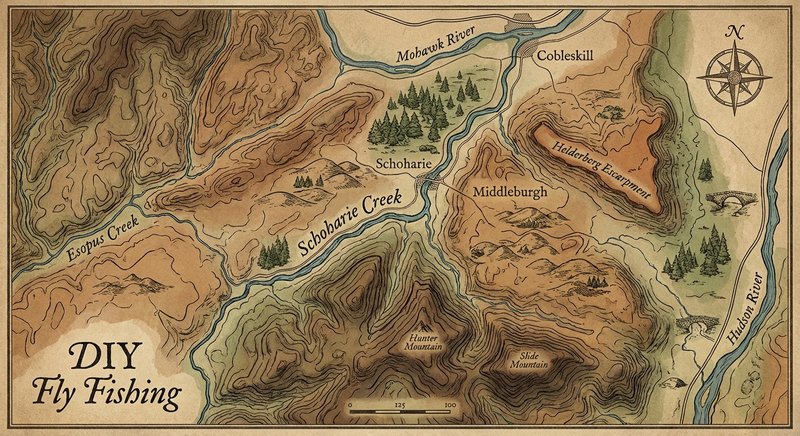
Schoharie Creek
Fly fishing in New York · Intermediate · Best seasons: Spring, Summer, Fall
Target Species
Brown Trout, Rainbow Trout
About This Water
Catskill region stream with wild brown and rainbow trout. Historic fly fishing water.
Fishing Recommendations
Welcome to the Schoharie Creek, a cornerstone of Catskill fly fishing history. While its neighbors—the Beaverkill and the Willowemoc—often steal the spotlight, the "Schoharie" offers a rugged, freestone experience that captures the true essence of New York fly fishing.
As your guide, here is everything you need to know to find success on these historic waters.
🎣 Location Overview
The Schoharie Creek is a classic mountain freestone river that begins in the high peaks of the Catskills near Tannersville and flows north to the Mohawk River. For the trout angler, the Upper Schoharie (above the Gilboa Reservoir) is the primary focus.
What makes the Schoharie special is its freestone character. Unlike the bottom-release tailwaters of the Delaware system, the Schoharie is at the mercy of the weather. It is a river of "pocket water"—full of boulders, riffles, and deep, ledge-lined pools. It feels more intimate and wilder than the wider rivers to the south, offering a mix of technical dry fly pools and aggressive pocket water.
🐟 Target Species & Behavior
- Brown Trout: The king of the Schoharie. You’ll find a mix of wild, buttery browns and well-conditioned stocked fish. In this river, they are notorious for tucked-away lies—tight against the rocky ledges or in the "cushion" just in front of a large boulder.
- Rainbow Trout: Found primarily in the swifter riffles and oxygenated "white water" sections. They are generally more aggressive than the browns and will often move further to chase a fly.
Behavior: Because this is a freestone stream, these fish are highly opportunistic but temperature-sensitive. They move into the fast, bubbly water (riffles) as soon as the weather warms to find oxygen, and they retreat to deep ledge holes during the heat of mid-summer or the cold of late fall.
📅 Best Times to Fish
Spring (April – June)
- Prime Window: Mid-May to mid-June is the "Golden Era."
- Conditions: April can be high and cold (snowmelt). Once the water hits 50°F, the hatches begin.
- Hatches: Quill Gordons, Hendricksons, and the famous March Browns.
Summer (July – August)
- Prime Window: Early morning (6 AM – 10 AM) and "the evening rise" (7 PM – Dark).
- Conditions: Warning: As a freestone river, the Schoharie can get dangerously warm (over 70°F) in July. Always carry a thermometer. If the water is over 68°F, stop fishing to protect the trout.
Fall (September – October)
- Prime Window: Mid-day as the sun warms the water.
- Conditions: Cooling water brings a second wind. Brown trout become aggressive and colorful as they prepare for the spawn.
- Hatches: Blue Winged Olives (BWO) and Isonychia.
🪰 Recommended Flies & Techniques
Dry Flies (The Catskill Tradition)
- Hendrickson (Dark & Light): Essential for late April/May.
- Adams (Parachute): The best generalist fly for the pocket water.
- Elk Hair Caddis: Sizes 12–16. Fish this with a "skitter" to trigger strikes.
- Isonychia: Size 10-12. Large, dark dries that work wonders in the riffles in late summer/fall.
Nymphing
- Pheasant Tail & Hare’s Ear: Sizes 14–18. These should be your bread and butter.
- Prince Nymph: Great for the faster, deeper runs.
- Stonefly Creepers: Large, weighted black or golden stoneflies work well in the spring.
Streamers
- Wooly Bugger (Black or Olive): Best used after a rain when the water has a "tea" stain.
- Muddler Minnow: Excellent for mimicking the sculpins that hide in the Schoharie’s rocks.
Presentation Tip
The Schoharie is famous for "micro-drifts." Because of the many boulders, there are dozens of competing currents. Use a Reach Cast and keep as much fly line off the water as possible to avoid drag.
💡 Pro Tips & Local Knowledge
- Focus on Lexington & Prattsville: The stretch between the towns of Lexington and Prattsville offers some of the most consistent water. Look for the "Ledge Pools"—deep troughs carved into the bedrock.
- The "Pocket Water" Secret: Most anglers bypass the bubbly, shallow-looking water between the big pools. Some of the biggest rainbows live in pockets no larger than a hula-hoop.
- Watch the Gauge: The Schoharie is "flashy." It rises and muddies quickly after a storm. Check the USGS gauge at Prattsville; if it’s spiking sharply, the river may be unfishable.
- Stealth Matters: The water is often crystal clear. Wear earthy tones (olive/tan) and avoid "lining" the fish (casting your fly line directly over their heads).
⚠️ Important Information
Access
New York State has done a great job securing Public Fishing Rights (PFR). Look for the yellow and blue "Public Fishing Stream" signs along NY-23A and NY-42. Large parking areas exist near the bridges in Lexington and Hunter.
Regulations
- The Schoharie has various regulations depending on the specific reach. Generally, much of it follows the standard New York statewide trout regs, but always check the NYSDEC Freshwater Fishing Guide for the specific year, as "Catch and Release only" sections can be designated.
- A valid New York State Fishing License is required for anyone 16 or older.
Safety
- Wading: The rocks in the Schoharie are notoriously slippery and "rolly." Studded wading boots and a wading staff are highly recommended.
- Cell Service: Spotty at best in the Notch. Let someone know where you are parking before you head out.
Tight lines, and enjoy one of the most beautiful "hidden gems" of the Catskill Mountains!
Bug Hatches & Matching Flies
| Hatch | Type | Peak months | Time of day | Hook sizes | Matching flies |
|---|---|---|---|---|---|
| Quill Gordon Epeorus pleuralis | mayfly | April, May | Midday | #12-14 | Quill Gordon Dry #12-14, Gordon Quill Nymph #12-14 |
| Hendrickson Ephemerella subvaria | mayfly | April, May | Afternoon | #12-14 | Red Quill #12-14, Hendrickson Emerger #12-14, Pheasant Tail Nymph #12-16 |
| Grannom Caddis Brachycentrus | caddis | April, May | Morning/Afternoon | #14-16 | Grannom Pupa #14-16, Elk Hair Caddis (Olive) #14-16 |
| March Brown Maccaffertium vicarium | mayfly | May, June | Afternoon | #10-12 | March Brown American #10-12, Hare's Ear Nymph #10-12 |
| Sulphurs Ephemerella dorothea | mayfly | May, June, July | Evening | #16-20 | Sulphur Parachute #16-20, Sulphur Emerger #16-18 |
| Slate Drake Isonychia bicolor | mayfly | June, September | Afternoon/Evening | #10-14 | Isonychia Parachute #12-14, Zug Bug #10-14 |
| Light Cahill Stenacron interpunctatum | mayfly | June, July | Evening | #14-16 | Light Cahill #14-16, Cream Variant #14-16 |
| Blue-Winged Olive Baetis | mayfly | March, April, September, October | Midday | #18-22 | BWO Sparkle Dun #18-22, RS2 #20-22 |
| Trico Tricorythodes | mayfly | July, August, September | Morning | #22-26 | Trico Spinner #22-26, Black Zebra Midge #22-24 |
| Tan Caddis Hydropsyche | caddis | June, July, August | Evening | #14-18 | Elk Hair Caddis (Tan) #14-18, Hydropsyche Larva #14-16 |