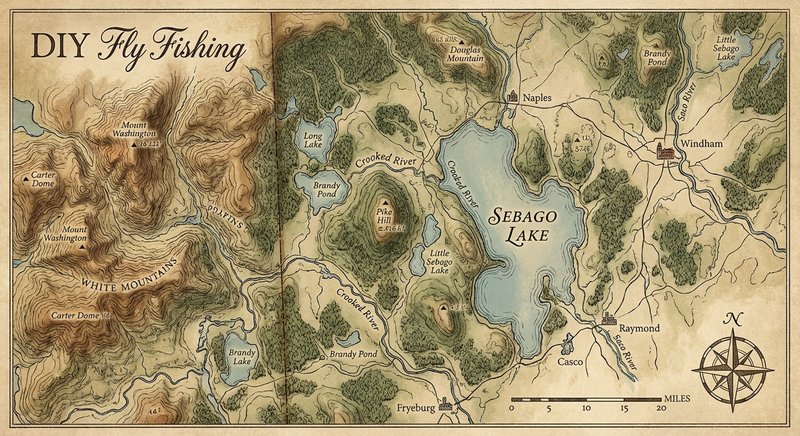
Sebago Lake
Fly fishing in Maine · Intermediate · Best seasons: Spring, Fall
Target Species
Landlocked Salmon, Lake Trout, Smallmouth Bass
About This Water
Southern Maine lake and birthplace of landlocked salmon fishing. Trophy potential.
Fishing Recommendations
Welcome to Sebago Lake, the second-largest lake in Maine and the spiritual home of the original strain of Landlocked Atlantic Salmon (Salmo salar sebago). As a guide, I consider Sebago one of the most rewarding yet challenging fisheries in the Northeast. Its crystal-clear, deep glacial waters hold legendary fish, but success requires an understanding of the specific Maine "smelt-based" ecosystem.
🎣 Location Overview
Sebago Lake covers roughly 45,000 acres with depths reaching over 300 feet. It is the primary water source for Portland, meaning the water quality is exceptional. What makes Sebago special for the fly angler is the early spring window. Shortly after "ice-out," the water column is uniform in temperature, bringing deep-dwelling predators right to the surface and the shorelines.
Anglers love Sebago because it offers a "big water" experience where you can catch trophy-sized salmon and lake trout on a fly rod—a rarity in many other parts of the country. The scenery is classic Maine: pine-lined shores, granite boulders, and the distant White Mountains.
🐟 Target Species & Behavior
Landlocked Salmon
The crown jewel of Sebago. Unlike their sea-run cousins, these fish spend their lives in the lake.
- Behavior: They are highly migratory within the lake, following schools of Rainbow Smelt. They are known for spectacular, acrobatic leaps when hooked.
- Feeding: 90% of their diet is smelt. They look for "transition zones" where deep water meets shallow shoals.
Lake Trout (Togue)
In Maine, we call them "Togue." Sebago holds a massive population of wild lake trout.
- Behavior: Usually deep-dwellers, but in the spring (water temps 42–52°F), they cruise the rocky shallows in 5–15 feet of water.
- Feeding: They are opportunistic but prefer smelt and smaller yellow perch.
Smallmouth Bass
Sebago is one of the premier smallmouth destinations in New England.
- Behavior: They hold in the rocky "ledge" areas and around the numerous islands.
- Feeding: They focus on crawfish and smelt. They are aggressive and grow large here due to the high oxygen levels and forage base.
📅 Best Times to Fish
- Spring (Ice-out to Late May): This is the Prime Window for fly fishing. As the ice melts (usually mid-April), salmon and trout follow the smelt to the shorelines and river mouths (Songo and Crooked Rivers).
- Fall (September to October): As water temperatures drop, salmon begin staging near the mouths of their spawning tributaries. Bass fishing also peaks as they feed heavily before winter.
- Best Time of Day: Low light is your best friend. Start at "civil twilight." On Sebago, a "smelt chop"—a light breeze that ruffles the surface—is better than a dead calm, as it masks your leader and disorients the baitfish.
🪰 Recommended Flies & Techniques
Top Fly Patterns
You must match the Rainbow Smelt.
- Classic Maine Streamers (Tandem Hook): Gray Ghost, Black Ghost, Supervisor, and Nine-Three. These are traditional long-wing flies designed to mimic the undulating motion of a smelt.
- Modern Synthetics: EP Smelt, Game Changers (white/gray), and Sculpin Helmet patterns.
- For Bass: Clouser Minnows (chartreuse/white), BoogleBugs (poppers), and Crawfish patterns in olive or rusty orange.
Effective Techniques
- The "Sebago Strip": When fishing streamers, use a fast, erratic retrieve. Landlocked salmon love to chase; if you think you’re stripping too fast, go faster.
- Sinking Lines: Use a Type 3 or Type 5 sinking tip line to get the fly down 4–8 feet while drifting over points.
- River Mouth Drifting: In the fall, focus on the "seams" where the river current meets the lake stillwater using a floating line and a long leader (12ft).
💡 Pro Tips & Local Knowledge
- Focus on "The Shoals": Areas like Frye Island and Lower Bay have dramatic drop-offs. Position your boat in the deep water and cast into the shallows, stripping your fly back over the ledge.
- The Wind is Your Friend: If the wind is blowing into a rocky point, the smelt will be pushed there, and the salmon will follow. Don't be afraid of a little "Maine chop."
- The Crooked River: If the lake is too rough, the Crooked River is the primary spawning tributary. In the fall, it offers world-class wade fishing for landlocked salmon, but it is strictly catch-and-release and fly-fishing only in many stretches.
- Color Palette: On sunny days, use silver and blue. On overcast days, switch to black or dark purple streamers to create a stronger silhouette.
⚠️ Important Information
Access
- Sebago Lake State Park: Located in Casco and Naples. Excellent boat launches and some of the best wade-fishing access near the Songo River mouth.
- Public Ramps: Standish (Station Rd) and Sebago Lake Station are popular southern entry points.
Regulations & Permits
- License: A valid Maine Fishing License is required (available online via Maine DIFW).
- Special Rules: Sebago has specific length and bag limits for salmon and togue. Always check the current "Lawbook" (Open Water Regulations) as they change annually to manage fish populations.
- Lead Ban: Maine law prohibits the use of small lead sinkers and unpainted lead jigs to protect loons.
Safety Considerations
- The "Sebago Chop": This lake can turn dangerous in minutes. Because of its size and orientation, North or Northwest winds can create 3-4 foot swells. If you are in a small boat or kayak, keep a close eye on the horizon.
- Cold Water: In the spring, the water is 40°F. If you fall in, hypothermia is an immediate threat. Always wear your PFD.
Tight lines, and remember: Keep the salmon in the water for photos. These are a precious resource!
Bug Hatches & Matching Flies
| Hatch | Type | Peak months | Time of day | Hook sizes | Matching flies |
|---|---|---|---|---|---|
| Hexagenia Hexagenia limbata | mayfly | June, July | Dusk/Night | #6-10 | Hexagenia Paradun #6-8, Hex Wiggle Nymph #8-10, Stillborn Hex #8 |
| Hendrickson Ephemerella subvariabilis | mayfly | May | Afternoon | #12-14 | Red Quill #12-14, Hendrickson Nymph #12-14, Snowshoe Rabbit Foot Emerger #14 |
| Midges Chironomidae | midge | April, May, September, October | Morning/Evening | #18-24 | Griffith's Gnat #18-22, Zebra Midge #18-24, Top Secret Midge #20-22 |
| Brown Drake Ephemera simulans | mayfly | June | Evening | #10-12 | Brown Drake Spinner #10-12, Harrop's Brown Drake #12 |
| Flying Ants Formicidae | terrestrial | August, September | Afternoon | #14-18 | Black Fur Ant #14-18, Cinnamon Flying Ant #16, Transparant Wing Ant #14-16 |
| Grannom Caddis Brachycentrus | caddis | May | Morning/Afternoon | #14-16 | Elk Hair Caddis (Olive) #14-16, LaFontaine's Deep Pupa #14-16 |
| Blue Winged Olive Baetis | mayfly | May, September, October | Afternoon | #18-22 | RS2 #20-22, BWO Sparkle Dun #18-20, Pheasant Tail Nymph #18-20 |
| Spotted Sedge Hydropsyche | caddis | June, July, August | Evening | #14-18 | Tan Elk Hair Caddis #14-18, Iris Ventralis #16 |