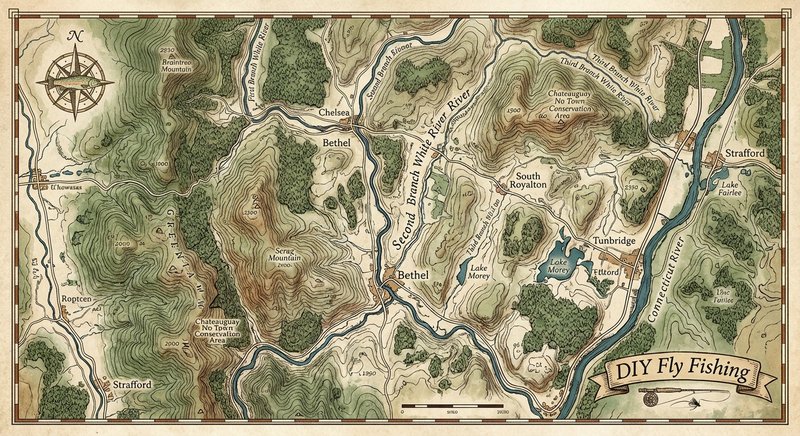
Second Branch White River
Fly fishing in Vermont · Beginner · Best seasons: Spring, Summer, Fall
Target Species
Rainbow Trout, Brown Trout
About This Water
Flows through Randolph area with good rainbow and brown trout. Easy access along Route 14.
Fishing Recommendations
The Second Branch of the White River is one of Vermont’s quintessential freestone gems. While the main stem of the White River gets much of the glory for its size and "trophy" potential, the Second Branch offers a more intimate, classic "small-to-medium stream" experience. Flowing through the rolling hills and farmland of Orange and Windsor counties, it provides a perfect mix of technical pocket water and relaxing riffle-and-pool fishing.
🎣 Location Overview
The Second Branch originates near Brookfield and flows south along Route 14 through East Randolph and East Bethel before joining the Main Stem in Royalton. It is a classic Appalachian-style freestone stream characterized by clear, cool water, granite boulders, and gravel runs.
What makes the Second Branch special is its diversity of water. In a single mile, you might fish a plunging mountain pool, a long glassy flat, and a series of oxygenated "pocket water" steps. It feels more manageable than the wide-open main stem, making it a favorite for anglers who prefer to wade and "hunt" individual fish rather than blind-casting across massive runs.
🐟 Target Species & Behavior
The Second Branch is primarily a Rainbow and Brown Trout fishery.
- Rainbow Trout: These are often the stars of the faster water. You’ll find them in the "heads" of pools, sitting right in the heavy current or in the bubbly "seams" where fast water meets slow water. They are aggressive feeders and will often move several feet to smash a dry fly.
- Brown Trout: The "residents" of the deeper, darker water. Look for Browns near undercut banks, under overhanging branches, or at the very bottom of deep holes during the day. They are more nocturnal and cautious; a cloudy day or low-light evening is your best chance at a larger Brown.
- Wild vs. Stocked: While the state stocks portions of the river, the Second Branch has a decent population of wild "holdover" fish that are noticeably more vibrant and skittish.
📅 Best Times to Fish
Spring (Late April – June)
- The Window: This is "Peak Season." Once the snowmelt (mud season) recedes and water temps hit 50°F, the fish become highly active.
- Conditions: High but clear water is ideal. Look for the Hendrickson hatch in May—it is the legendary event of the region.
Summer (July – August)
- The Window: Early morning (6:00 AM – 10:00 AM) and "the evening rise" (7:30 PM until dark).
- Conditions: Low water and heat are the challenges. Pro Tip: Bring a thermometer. If the water exceeds 68°F, stop fishing to protect the trout. Focus on the oxygenated "white water" where the fish are seeking breath.
Fall (September – October)
- The Window: Mid-day fishing is excellent as the water cools.
- Conditions: This is the time for big Brown Trout. As they prepare to spawn, they become aggressive and territorial. The foliage provides a world-class backdrop.
🪰 Recommended Flies & Techniques
Dry Flies
- Mayflies: Hendrickson (#12-14) in May; Light Cahill (#14-16) in June; Blue Winged Olive (#18-22) on rainy autumn days.
- Caddis: Elk Hair Caddis (Tan or Olive, #14-18) is a year-round staple here.
- Terrestrials: In July and August, a Black Foam Beetle or a Para-Hopper dropped near the banks can be deadly.
Nymphs (The "Numbers" Game)
- Pheasant Tail: (#14-18) Mimics almost everything.
- Prince Nymph: (#12-16) The "attractor" that Rainbows love in the riffles.
- Pat’s Rubber Legs: (#8-12) Great for high water in the spring to mimic stoneflies.
Streamers (For the Big Browns)
- Woolly Bugger: Black or Olive (#6-10).
- Muddler Minnow: Excellent for mimicking sculpins or even grasshoppers when greased up.
Technique: The "Dry-Dropper"
The Second Branch is perfect for a "Dry-Dropper" rig. Use a high-floating Elk Hair Caddis as your "indicator" and hang a small Pheasant Tail nymph 18–24 inches below it. This allows you to cover the surface and the mid-column simultaneously in the shallow pocket water.
💡 Pro Tips & Local Knowledge
- The Route 14 Strategy: Much of the river parallels Route 14. While the "bridge holes" are popular, the best fishing is often found by walking 200 yards upstream or downstream from the easy access points.
- Stealth is Vital: Because the water is often crystal clear, these fish see you before you see them. Wear natural colors (greens/tans), keep a low profile, and try to avoid "lining" the fish (casting your fly line directly over their heads).
- Watch the Tributaries: After a heavy rain, the Second Branch can get muddy. Look for the spots where small, clear "feeder brooks" enter the river; trout will often congregate in these "clean water plumes" to feed.
- East Bethel Section: Some of the best pocket water is located between East Bethel and North Royalton. It’s rocky, athletic wading, but the fish are usually less pressured.
⚠️ Important Information
- Access: Much of the land surrounding the Second Branch is private. Vermont has generous "unposted" access laws, but always look for "No Trespassing" signs. If a farmhouse is nearby, it’s always best to ask permission—you’ll often get a "yes" and maybe some local tips.
- Regulations: The Second Branch generally falls under General Trout Streams rules (2 fish limit, no size minimum), but always check the Vermont Fish & Wildlife Law Digest before heading out, as special designations can change.
- Wading Safety: The rocks can be "greasy" with algae. Felt-soled boots or studs are highly recommended.
- Catch & Release: While the law may allow keeping fish, most local guides advocate for Catch and Release, especially for wild trout, to maintain the health of this fragile ecosystem.
Guide’s Final Word: The Second Branch isn't about chasing 25-inch monsters; it's about the art of the cast in a beautiful Vermont valley. Bring a 4-weight or 5-weight rod, take your time, and enjoy the rhythm of the river.
Bug Hatches & Matching Flies
| Hatch | Type | Peak months | Time of day | Hook sizes | Matching flies |
|---|---|---|---|---|---|
| Hendrickson Ephemerella subvariabilis | mayfly | April, May | Afternoon | #12-14 | Red Quill #12-14, Hendrickson Emerger #12-14, Pheasant Tail #12-16 |
| Sulphur Ephemerella invaria/rotunda | mayfly | May, June | Evening | #14-18 | Sulphur Parachute #14-18, CDC Sulphur Emerger #16-18, Sulphur Spinner #14-18 |
| Spotted Sedge Hydropsyche | caddis | May, June, July | Evening | #14-18 | Elk Hair Caddis (Tan) #14-16, LaFontaine Sparkle Pupa #14-18, Holy Grail #14-16 |
| Blue Winged Olive Baetis | mayfly | April, September, October | Mid-day/Afternoon | #18-22 | BWO Sparkle Dun #18-22, RS2 #20-22, WD-40 #18-22 |
| Slate Drake Isonychia bicolor | mayfly | June, August, September | Afternoon/Evening | #10-12 | Isonychia Parachute #10-12, Zug Bug #10-12, Prince Nymph #10-14 |
| Light Cahill Stenonema ithaca | mayfly | June, July | Evening | #12-14 | Light Cahill #12-14, Cream Usual #12-16, Gold Ribbed Hare's Ear #12-14 |
| Golden Stonefly Acronuria | stonefly | June, July | Morning/Evening | #8-12 | Stimulator (Yellow) #8-12, Pat's Rubber Legs #8-12, Golden Stone Nymph #10-12 |
| Black Ant Formicidae | terrestrial | July, August, September | All Day | #14-20 | Cinnamon Ant #16-18, Black Foam Ant #14-20, Flying Ant #16-18 |
| Green Drake Ephemera guttulata | mayfly | June | Evening | #8-10 | Green Drake Hairwing #8-10, Coffin Fly (Spinner) #8-10, Green Drake Nymph #8-10 |