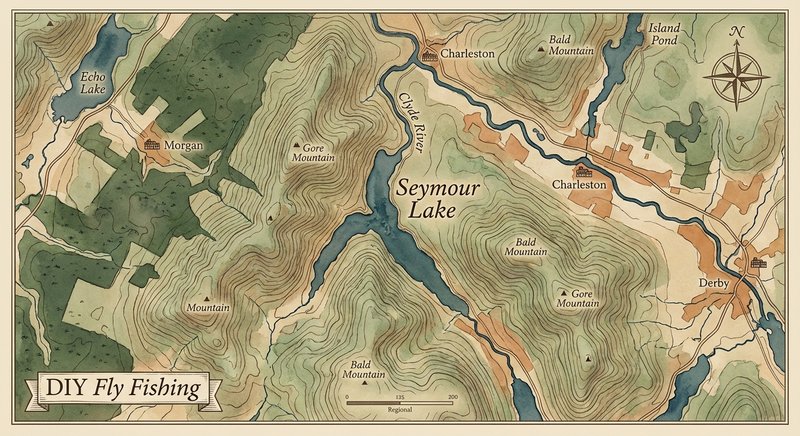
Seymour Lake
Fly fishing in Vermont · Intermediate · Best seasons: Spring, Fall, Winter
Target Species
Landlocked Salmon, Lake Trout, Smelt
About This Water
Northeast Kingdom lake with landlocked salmon and lake trout. Remote location with excellent coldwater fishing.
Fishing Recommendations
Welcome to the "Northeast Kingdom" of Vermont. As your guide, I can tell you that Seymour Lake in Morgan is often considered the crown jewel of Vermont’s cold-water fisheries. Known for its exceptional water clarity and depth (reaching nearly 170 feet), it offers a premier experience for anglers seeking high-quality Landlocked Salmon and some of the largest Lake Trout in New England.
Here is your comprehensive guide to fly fishing Seymour Lake.
🎣 Location Overview
Seymour Lake is a glacial lake spanning roughly 1,770 acres. What makes it special is its ultra-oligotrophic nature—meaning it is deep, cold, and incredibly nutrient-poor but oxygen-rich. This creates a "gin-clear" environment where visibility can exceed 25 feet.
Anglers love Seymour because, unlike many other Vermont lakes, it maintains a robust natural reproduction of Lake Trout and receives consistent stockings of Landlocked Salmon. The shoreline is a mix of rocky ledges, sandy flats, and steep drop-offs, providing diverse habitats. It feels remote, pristine, and offers a true "wild" New England experience.
🐟 Target Species & Behavior
Landlocked Salmon
These are the "silver bullets" of the lake. They are incredibly acrobatic and gear-shy due to the water clarity.
- Behavior: They follow the Rainbow Smelt (their primary forage). In spring, they are found in the top 10–15 feet of water near stream inlets. As the water warms, they retreat to the thermocline (usually 30–50 feet down).
- Feeding: Aggressively pursue smelt schools. Look for "surface busts" in the early morning.
Lake Trout (Togue)
Seymour is famous for "Lakers." While many people troll for them, they are highly accessible to fly anglers during specific windows.
- Behavior: They crave cold water (50°F or less). In the spring and late fall, they move into the shallows (5–20 feet) to cruise rocky reefs.
- Feeding: Bottom-oriented but will suspend to gorge on smelt. They are opportunistic and will hit large, meaty streamers.
Smelt
While not a primary fly target for sport, understanding them is key. They are the engine of the lake. Their spawning run into the tributaries in early spring triggers the best fishing of the year.
📅 Best Times to Fish
Spring (Ice-out to Late June)
- The Window: Immediately after the ice breaks (usually late April/early May).
- Why: This is the "Prime Time." Salmon and Lake Trout are in the top column of water. You can catch them on floating or intermediate lines.
- Time of Day: Dawn and dusk are critical. On "Bluebird" sunny days, the fish go deep quickly.
Fall (September - October)
- The Window: As water temperatures drop back below 55°F.
- Why: Salmon begin to stage near the inlets for their spawning runs. Lake Trout move onto shallow rocky shoals to spawn.
- Conditions: Overcast, drizzly "salmon weather" is best.
Winter (January - March)
- The Window: Hard water season.
- Fly Fishing Note: While traditional fly casting is impossible, "ice-fly" jigging (using bucktail jigs or weighted streamers on short rods) is a local secret for Lake Trout.
🪰 Recommended Flies & Techniques
Top Fly Patterns
- Streamers (The Bread & Butter):
- Gray Ghost / Black Ghost: Classic New England smelt imitations.
- Magog Smelt: A local Vermont favorite.
- Mickey Finn: Effective in murky spring runoff.
- Game Changers (White/Pearl): For high-action movement to trigger big Lake Trout.
- Nymphs (For Spring Inlets):
- Size 12-14 Pheasant Tails: When salmon are staging, they often snack on small invertebrates.
Techniques
- The "Slow Troll" Fly Casting: If you have a boat or kayak, strip-trolling streamers 50–70 feet behind the boat using an Intermediate or Type 3 sinking line is the most effective way to cover water.
- The "Rip and Pause": When casting toward shore or structure, use aggressive 2-foot strips followed by a dead pause. Salmon often strike on the pause when the fly "flutters" like a wounded smelt.
- Structure Fishing: Focus on the drop-offs. If the depth goes from 10 feet to 40 feet abruptly, that's your "Strike Zone."
💡 Pro Tips & Local Knowledge
- Go Long on the Leader: Because the water is so clear, use 10–12 foot leaders. Transition to Fluorocarbon (6lb or 8lb) for the final 4 feet; it is nearly invisible underwater.
- Focus on the Northwest End: The area near the state boat launch and the northern "fingers" of the lake tend to hold baitfish early in the season.
- Wind is Your Friend: A "Seymour Chop" (light waves) breaks up the surface tension, making the fish less spooky and more likely to rise for a streamer.
- The Smelt Run: If you can time your trip with the smelt run in the brooks (usually late April), fish the mouths of those streams. The predators will be waiting there like a conveyor belt of food.
⚠️ Important Information
- Access: There is a well-maintained Vermont Fish & Wildlife Public Boat Launch on the northern end (Route 111). Shore access is limited due to private camps, so a kayak, canoe, or motorboat is highly recommended.
- Regulations:
- Seymour has specific length and bag limits for Salmon and Lake Trout. Always check the current Vermont Fishing Guide (online or at local shops).
- Note that certain tributaries are closed to fishing during the spawning runs to protect the population.
- Safety: The lake is big and can get rough quickly when the North wind blows. If you are in a small craft, stay close to the shoreline.
- Clean, Drain, Dry: Vermont is strict about invasive species (like Eurasian Watermilfoil). Ensure your gear and boat are thoroughly cleaned before entering the water.
Guide's Final Word: Bring a heavy 6-weight or 7-weight rod to handle the wind and the fighting power of a 20-inch Landlocked Salmon. Tight lines!
Bug Hatches & Matching Flies
| Hatch | Type | Peak months | Time of day | Hook sizes | Matching flies |
|---|---|---|---|---|---|
| Hexagenia (The Hex) Hexagenia limbata | mayfly | June, July | Dusk and Night | #4-8 | Hexagenia Spinner #6-8, Burrowing Mayfly Nymph #4-8, Wiggle Hex Emerger #6 |
| Midges Chironomidae | midge | May, June, September | All Day | #18-24 | Zebra Midge #18-22, Griffith's Gnat #20-22, Ice Cream Cone #14-18 |
| Grannom Caddis Brachycentrus | caddis | May | Late Morning/Afternoon | #12-16 | Elk Hair Caddis (Olive) #14-16, Pupa-X #14, Peacock Caddis #16 |
| Eastern Green Drake Ephemera guttulata | mayfly | June | Evening | #8-12 | Green Drake Paradox #10-12, Green Drake Cripple #10-12, Hare's Ear Nymph #10-12 |
| Flying Ants Formicidae | terrestrial | August, September | Afternoon | #14-20 | Black Foam Ant #16-18, Cinnamon Flying Ant #14-16, Fur Ant #18-20 |
| Slate Drake Isonychia bicolor | mayfly | July, August, September | Afternoon/Evening | #10-14 | Iso Parachute #12-14, Zug Bug #10-12, Prince Nymph #12-14 |
| Cinnamon Sedge Hydropsyche | caddis | July, August | Evening/Night | #14-18 | Cinnamon Caddis #16, LaFontaine's Deep Sparkle Pupa #14-16, Balloon Caddis #14 |
| Blue Winged Olive Baetis | mayfly | May, September, October | Afternoon (Cloudy Days) | #18-22 | RS2 #20-22, BWO Sparkle Dun #18-20, Pheasant Tail Nymph #18-20 |