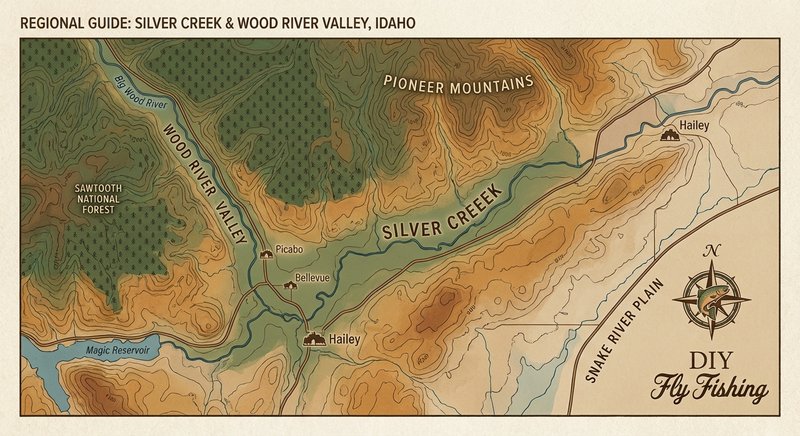
Silver Creek
Fly fishing in Idaho · Advanced · Best seasons: Summer, Fall
Target Species
Rainbow Trout, Brown Trout
About This Water
A legendary spring creek with crystal-clear water and highly selective trout. Technical dry fly fishing at its finest.
Fishing Recommendations
🎣 Silver Creek, Idaho: The PhD of Fly Fishing
Silver Creek is not just a trout stream; it is a legendary spring creek that represents the pinnacle of technical fly fishing. Located in the high desert of south-central Idaho, near Picabo and Sun Valley, this is a slow-moving, crystalline ribbon of water winding through a lush marshland ecosystem.
🎣 Location Overview
Silver Creek is world-renowned for its gin-clear water, consistent temperatures, and prolific insect hatches. Unlike tumbling mountain freestones, Silver Creek is a flat-water spring creek.
- The Challenge: The water is so clear and the surface so smooth that trout can see your 6X tippet from several feet away. It requires extreme stealth, long leaders, and perfect presentations.
- The Allure: Anglers come here for the "match the hatch" experience. It is often called the "PhD of Fly Fishing" because the fish are highly educated and selective.
🐟 Target Species & Behavior
The creek is home to wild Rainbow Trout and Brown Trout.
- Rainbows: Often found in the faster "glides" and near weed beds. They are acrobatic and known for sipping tiny dries with surgical precision.
- Browns: These are the kings of the creek. They tend to hold under undercut banks, near heavy submerged vegetation, or in the deep holes of the "S-turns." Large browns often become active during low-light periods or during the Trico hatch.
- Behavior: These fish are "surface-oriented" but incredibly spooky. They don't move far for a fly; your drift must be dead-on. If they see your shadow or a splashy cast, they will vanish into the weeds instantly.
📅 Best Times to Fish
Optimal Seasons
- Summer (Late June – August): The "Classic" season. This is the time for the legendary Trico and Baetis hatches. Expect heavy crowds but incredible dry fly action.
- Fall (September – October): My personal favorite. The crowds thin out, the scenery turns golden, and the Mahogany Duns and Hecubas (Great Red Quills) bring the largest fish to the surface.
Best Times of Day
- Morning (7 AM – 11 AM): The Trico hatch is the main event. It’s a frenzy of tiny white spinners that can drive an angler mad.
- Evening: The "spinner fall" as the sun hits the horizon can provide some of the best dry fly fishing of the day.
- Mid-Day: In the heat of summer, things can slow down. This is the time for terrestrial patterns (ants/beetles) in the wind.
🪰 Recommended Flies & Techniques
Top Fly Patterns
- Dries:
- Trico Spinners (#22-26): Essential for summer mornings.
- Callibaetis (#14-18): Both duns and spinners.
- PMDs (#16-20): Pale Morning Duns are a staple.
- Terrestrials: Hoppers, Foam Beetles (#14-18), and Cinnamon Ants (#16-20).
- Nymphs:
- Pheasant Tails (#18-22) and Zebra Midges.
- Note: Nymphing is effective but many areas of the Preserve are restricted or simply too weedy for traditional deep nymphing.
- Streamers: Small leeches or wooly buggers in olive/black can work early in the morning or on cloudy days, but use them sparingly.
Effective Techniques
- The "Reach Cast": This is the most important cast here. You must place the fly above the fish with the line upstream so the fish sees the fly before the leader.
- Downstream Presentation: Many pros prefer casting downstream and across, feeding line to the fish to ensure a drag-free drift.
- Sight Fishing: Do not blind cast. Walk slowly, stop often, and use your polarized glasses to spot a "feeding rhythm" before you ever make a cast.
💡 Pro Tips & Local Knowledge
- The "S-Turns": Located in the Nature Conservancy section, these bends hold massive fish. Focus on the "seams" where slow and slightly faster water meet.
- The "Float Tube" Section: Below the Highway 20 bridge, the water deepens. Using a float tube here allows you to access fish that walk-in anglers can't reach.
- Long Leaders: Do not show up with a 9-foot leader. You need 12 to 15-foot leaders tapering down to 6X or 7X fluorocarbon/copolymer.
- The Wind is Your Friend: A slight ripple on the water breaks up the fish's window, making them less spooky. On glassy days, you have to be nearly invisible.
⚠️ Important Information
- The Nature Conservancy (The Preserve): Much of the best water is managed by The Nature Conservancy. You must sign in at the visitor center (it's free, but donations are encouraged).
- Regulations:
- Catch and Release Only on the Preserve.
- Barbless hooks only.
- No felt-soled boots (to prevent the spread of New Zealand Mud Snails).
- Access: The main access points are the TNC Visitor Center, Kilpatrick Bridge, and various Fish & Game access points downstream toward Picabo.
- Wading: The bottom is "muck." It is very easy to get stuck or send a plume of silt downstream that will ruin the fishing for anyone below you. Move slowly and stay on the firmer gravel bars when possible.
Bug Hatches & Matching Flies
| Hatch | Type | Peak months | Time of day | Hook sizes | Matching flies |
|---|---|---|---|---|---|
| Trico Tricorythodes | mayfly | July, August, September | Morning | #20-24 | Trico Spinner #20-24, Sunken Trico Spinner #22, RS2 #20-22 |
| Brown Drake Ephemera simulans | mayfly | June | Evening | #10-12 | Brown Drake Cripple #10-12, Paradrake #10-12, Brown Drake Nymph #10 |
| Pale Morning Dun (PMD) Ephemerella excrucians | mayfly | June, July, August | Morning/Afternoon | #16-18 | Harrop's Last Chance Emerger #16-18, CDC Thorax PMD #16-18, Pheasant Tail #16-18 |
| Blue Winged Olive (BWO) Baetis | mayfly | March, April, September, October | Afternoon | #18-22 | Sparkle Dun #18-22, BWO CDC Emerger #20-22, WD-40 #20-22 |
| Callibaetis Callibaetis | mayfly | July, August | Morning/Afternoon | #14-16 | Callibaetis Spinner #14-16, Hare's Ear Nymph #14-16, Quigley Cripple #14-16 |
| Midges Chironomidae | midge | January, February, March, December | Morning/Afternoon | #20-26 | Zebra Midge #20-24, Griffith's Gnat #20-22, Morgan's Midge #22-24 |
| Terrestrials (Ants and Beetles) Formicidae / Coleoptera | terrestrial | July, August, September | Afternoon | #14-20 | Cinnamon Ant #16-20, Crowe Beetle #14-18, Chernobyl Ant #12-14 |
| Little Western Grasshoppers Melanoplus | terrestrial | August, September | Afternoon | #10-14 | Parachute Hopper #12-14, Dave's Hopper #10-12, Letort Hopper #14 |