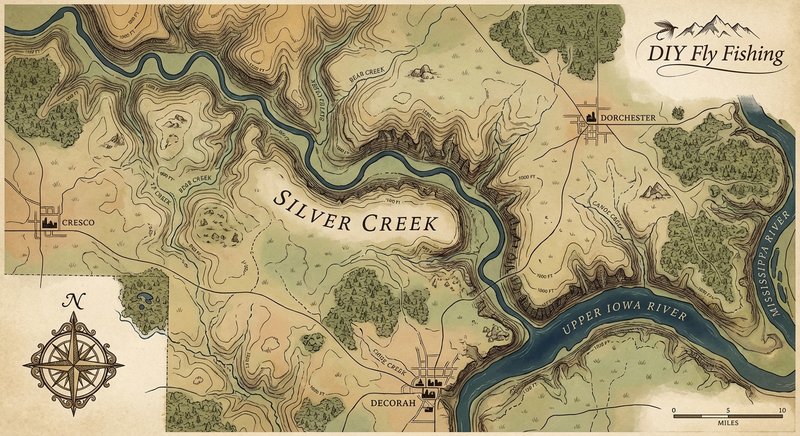
Silver Creek
Fly fishing in Iowa · intermediate · Best seasons: spring, summer, fall
Target Species
Brown Trout
About This Water
Clayton County stream with wild trout population. Spring-fed with consistent flows.
Fishing Recommendations
As an expert guide who has spent years navigating the hidden gems of the Driftless Area, I can tell you that Silver Creek in Allamakee County, Iowa, is one of the most rewarding "technical" streams in the region. Unlike the wider, more famous rivers, Silver Creek is an intimate, spring-fed limestone stream that offers a quintessential Midwest fly fishing experience.
🎣 Location Overview
Silver Creek is a tributary of the Upper Iowa River, located just north of Waukon. It is a classic Driftless spring stream, characterized by cold, nutrient-rich water that flows through a mix of rolling cow pastures, limestone bluffs, and dense riparian corridors.
What makes Silver Creek special is its wild character. While the Iowa DNR manages the stream, it feels less "manicured" than some of the more popular tourist reaches. It features deep undercut banks, tight bends, and excellent overhead cover. It is a stream that demands stealth and precise casting, rewarding the patient angler with some of the most beautiful, buttery-yellow wild Brown Trout in the state.
🐟 Target Species & Behavior
The primary draw here is the Brown Trout.
- Behavior: These fish are notoriously spooky. Because the water is often gin-clear, the trout have evolved high situational awareness. They are "lie-in-wait" predators.
- Where they hold: Look for them tight against the undercut banks, in the shadows of overhanging willow brush, or at the "tail-outs" of deep pools during low light.
- Feeding patterns: In the early season, they are opportunistic subsurface feeders. As the water warms, they become highly attuned to terrestrial insects (grasshoppers and beetles) falling from the meadow grasses.
📅 Best Times to Fish
Spring (Late March – May)
- Conditions: This is the time for the first major hatches. The water is cool, and the fish are hungry after winter.
- Prime Window: Mid-day (11:00 AM – 3:00 PM) when the sun warms the water slightly, triggering insect activity.
Summer (June – August)
- Conditions: Silver Creek stays cold due to spring influence, but the "tall grass" season begins. This is peak Terrestrial Season.
- Prime Window: Early morning or the final "magic hour" before sunset.
Fall (September – October)
- Conditions: The Brown Trout begin to color up for the spawn. They become aggressive and territorial.
- Prime Window: Overcast days are gold. The low light brings big browns out from under the banks to hunt.
🪰 Recommended Flies & Techniques
Dry Flies (The Driftless Staples)
- Caddis: Elkhair Caddis (Size 14-18) in tan or olive.
- Mayflies: Blue Winged Olives (BWO) for those drizzly spring/fall days (Size 18-22). Light Cahills for summer evenings.
- Terrestrials: This is Silver Creek's bread and butter. Hippie Stompers, Foam Beetles, and Dave’s Hoppers (Size 12-14).
Nymphs (The Workhorses)
- Pheasant Tail: (Size 16-20) – Always effective.
- Pink Squirrel: A local Driftless legend. Use it with a gold bead head to trigger strikes in deeper runs.
- Scuds: Since this is a limestone stream, freshwater shrimp (scuds) are a primary food source year-round.
Streamers (For the "Wall Hangers")
- Black or Olive Woolly Buggers: (Size 8-12).
- Muddler Minnows: Work these tight against the cut banks to mimic a fleeing sculpin.
Technique Tip:
The "Crouch and Cast": Because the banks are often higher than the water level, stay low. If you can see the fish, they have already seen you. Use a 7.5 to 9-foot 4-weight rod for delicate presentations.
💡 Pro Tips & Local Knowledge
- Be a Stealth Hunter: Avoid "wading" whenever possible. The crunch of gravel under your boots sends vibrations through the limestone shelf that will shut down a pool instantly. Fish from the bank when you can.
- Focus on the Bends: The "elbows" of Silver Creek often create deep scour holes. These are the apartments for the largest Browns in the creek.
- The "Hopper-Dropper": During July and August, run a high-vis foam hopper with a small Pheasant Tail nymph dropped 18 inches below it. It’s the most efficient way to cover the meadow stretches.
- Check the Gauge: Like many Driftless streams, Silver Creek can get muddy after a heavy rain. If the Upper Iowa is flooding, Silver Creek might be "blown out" as well. Give it 24-48 hours to clear.
⚠️ Important Information
Access
- Much of Silver Creek is accessible via Iowa DNR easements. Look for the green "Angler Access" signs at bridge crossings and fence lines.
- Respect the Land: Many easements are on active cattle pastures. Close every gate you open and do not disturb livestock.
Regulations
- License: You must have a valid Iowa Fishing License and a Trout Fee (Trout Stamp).
- Limits: While some sections allow harvest, most serious fly anglers on Silver Creek practice Catch and Release to protect the wild Brown Trout genetics. Check the latest Iowa DNR Fishing Regulations booklet for specific length limits on the reach you are fishing.
Special Considerations
- Wild Pastures: Be prepared for tall stinging nettles and wild parsnip in the summer—long pants are a must, even when it's hot.
- Cattle: If you encounter cattle, give them a wide berth. They are generally harmless but can be curious.
Silver Creek is a "chess match" of a stream. It won't give up its secrets easily, but when you land a wild, vibrant Brown Trout in the middle of a quiet Iowa meadow, you'll understand why it's a local treasure. Tight lines!
Bug Hatches & Matching Flies
| Hatch | Type | Peak months | Time of day | Hook sizes | Matching flies |
|---|---|---|---|---|---|
| Blue-Winged Olive (BWO) Baetis tricaudatus | mayfly | April, May, September, October | Late Morning/Afternoon | #18-22 | RS2 #18-22, Parachute Adams #18-22, Pheasant Tail #18-20 |
| Midges Chironomidae | midge | February, March, April | Late Morning | #20-24 | Zebra Midge #20-24, Griffith's Gnat #20-22, Morgan's Midge #20-22 |
| Scuds and Sowbugs Gammarus and Asellus | crustacean | Year-round | All Day | #14-18 | Ray Charles #14-18, Pink Scud #14-16, Ray's Sowbug #16-18 |
| Tricos Tricorythodes | mayfly | July, August, September | Early Morning | #20-24 | Trico Spinner #20-24, Trico Dun #22-24, WD-40 #20-22 |
| Sulfurs Ephemerella invaria | mayfly | May, June | Evening | #14-18 | Sulfur Parachute #14-18, Sulfur Emerger #16-18, Gold Ribbed Hare's Ear #14-16 |
| Tan Caddis Hydropsyche | caddis | May, June, July | Late Afternoon/Evening | #14-16 | Elk Hair Caddis #14-16, LaFontaine's Deep Sparkle Pupa #14-16, Caddis Larva (Green) #14-16 |
| Light Cahill Stenacron interpunctatum | mayfly | June, July | Evening | #12-14 | Light Cahill #12-14, Cream Usual #14, Light Cahill Wet Fly #12-14 |
| Terrestrials Formicidae/Orthoptera | terrestrial | July, August, September | Afternoon | #10-18 | Joe's Hopper #10-12, Black Foam Ant #16-18, Cinnamon Ant #16-18 |