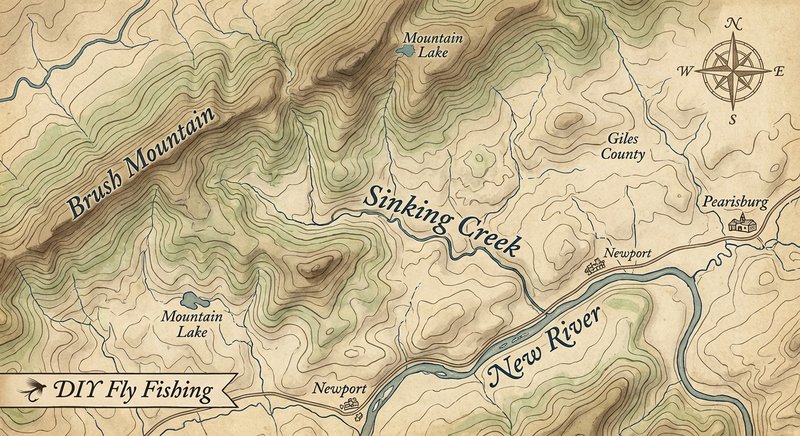
Sinking Creek
Fly fishing in Virginia · Intermediate · Best seasons: Spring, Summer, Fall
Target Species
Brown Trout, Rainbow Trout
About This Water
Craig County stream with wild brown trout. Unique karst geology.
Fishing Recommendations
Sinking Creek is one of Virginia’s hidden gems—a classic limestone spring creek tucked into the rolling karst topography of Giles and Craig Counties. Unlike the freestone mountain streams typical of the Blue Ridge, Sinking Creek offers a technical, fertile environment that reminds many anglers of the famous spring creeks of Pennsylvania.
Here is your comprehensive guide to fly fishing Sinking Creek, Virginia.
🎣 Location Overview
Sinking Creek is a unique "disappearing" stream. Due to the limestone (karst) geology of the region, the creek actually flows underground in several sections before resurfacing. It winds through pastoral farmland and lush meadows, characterized by a low gradient, deep undercut banks, and rich aquatic vegetation.
What makes it special is its alkalinity. The limestone influence keeps the water nutrient-rich and buffered against acidity, leading to a massive biomass of crustaceans and insects. For the angler, this means the fish are well-fed, energetic, and often larger than those found in nearby freestone runs. However, the water is exceptionally clear and often slow-moving, making it a "PhD" water where stealth and presentation are paramount.
🐟 Target Species & Behavior
- Brown Trout: The "kings" of Sinking Creek. There is a healthy population of wild browns in the upper reaches and throughout the private stretches. They are notoriously wary, often tucked deep under overhanging banks or rooted in thick beds of elodea (waterweed).
- Rainbow Trout: Found primarily in the Delayed Harvest (DH) section near Newport. While many are stocked, they quickly acclimate to the creek's bug life. In the cooler months, they can be found in the riffles and at the heads of the deeper pools.
Behavior: These fish are "bank feeders." Because the creek is narrow and the center is often shallow or choked with weeds, trout hold in the shadows of the banks. They are highly sensitive to vibration on the bank; if you can see them, they have likely already seen you.
📅 Best Times to Fish
- Spring (Late March – June): This is the prime window. Water levels are stable, and the major hatches (Hendricksons and Sulphurs) bring fish to the surface.
- Summer (July – August): Fishing becomes technical. The water can get low and clear. Focus on early mornings or late evenings. This is "Terrestrial Season"—the fish look for grasshoppers and ants falling from the meadow grasses.
- Fall (September – November): A fantastic time for Brown Trout as they become aggressive ahead of the spawn. Blue Winged Olives (BWOs) hatch on overcast days.
- Winter: Because it is spring-fed, Sinking Creek stays slightly warmer than freestone streams, making it a viable winter fishery for nymphing on sunny afternoons.
🪰 Recommended Flies & Techniques
Top Fly Patterns
- Nymphs/Crustaceans: This is the most consistent producer.
- Ray Charles or Scud Patterns (Tan, Pink, or Olive) - Sizes 14–18.
- Cressbug Patterns (Grey/Mottled) - Sizes 14–16.
- Pheasant Tail (Flashback or Tactical) - Sizes 16–20.
- Zebra Midge (Black or Red) - Sizes 18–22.
- Dry Flies:
- Sulphur Parachutes (May/June) - Size 16.
- Blue Winged Olives (Overcast days) - Sizes 18–22.
- Dave’s Hopper or Foam Ants (Summer) - Sizes 12–16.
- Streamers:
- Wooly Buggers (Black or Olive) - Sizes 8–10. Focus on the undercut banks.
Techniques & Presentation
- The "Creeper" Approach: Stay low. Avoid wading if possible; fish from the bank, but stay several feet back from the edge to avoid casting a shadow.
- Long Leaders: Use 9-foot to 12-foot leaders tapering down to 6X or 7X fluorocarbon tippet. The clarity of the water demands thin diameters.
- Sight Fishing: Spend more time looking than casting. Use polarized glasses to spot the "white of the mouth" or a subtle tail flick.
- Dry-Dropper: A buoyant dry fly with a small scud dropped 18 inches below is deadly in the meadow stretches.
💡 Pro Tips & Local Knowledge
- The Newport Section: The most popular public access is the Delayed Harvest section in Giles County (near the community of Newport). This stretch is well-maintained and offers classic spring creek bends.
- Fish the "Gaps": Look for gaps in the aquatic vegetation. Trout sit in these "lanes" waiting for nymphs to tumble through. If your nymph catches weed, you're in the right spot, but you need to adjust your depth.
- The "Sinking" Reality: If you find a section that looks bone dry in mid-summer, don't panic. The creek likely went subterranean. Drive a mile or two downstream, and you’ll find it bubbling back up, often colder and fishier than before.
- Respect the Cows: Much of Sinking Creek flows through active cattle pastures. If you are on a section with permission or public access, ensure gates are closed. Cattle often create "muddy" spots; fishing just below where cattle cross can sometimes be productive as they kick up nymphs (a "natural" chum line).
⚠️ Important Information
- Access: Much of Sinking Creek is private property. Always look for "Posted" signs. The primary public access is the State-Managed Delayed Harvest section.
- Regulations:
- Delayed Harvest (DH): Usually runs from October 1 to May 31. During this time, it is strictly Catch and Release, and only artificial lures/flies are permitted.
- Check the Virginia DWR website for current stocking schedules and specific boundary markers.
- Licensing: You need a valid Virginia State Fishing License AND a Trout License.
- Safety: Be mindful of the mud. Spring creek banks can be soft and "boggy." A wading staff is helpful for checking the stability of the bank before stepping.
Guide’s Final Word: Sinking Creek isn't about high fish counts; it's about the quality of the hunt. Slow down, watch the water, and treat every cast like it's your only one. Tight lines!
Bug Hatches & Matching Flies
| Hatch | Type | Peak months | Time of day | Hook sizes | Matching flies |
|---|---|---|---|---|---|
| Blue-Winged Olive Baetis | mayfly | March, April, October, November | Late Morning/Afternoon | #18-22 | RS2 #20-22, Parachute BWO #18-20, WD-40 #20-22 |
| Quill Gordon Epeorus pluralis | mayfly | March, April | Mid-day | #12-14 | Quill Gordon Dry #12-14, Gold Ribbed Hare's Ear #12-14 |
| Grannom Caddis Brachycentrus | caddis | April | Morning/Afternoon | #14-16 | Peacock Caddis #14-16, Green Weenie #14-16, Deep Sparkle Pupa #14-16 |
| Sulphur Ephemerella invaria/dorothea | mayfly | May, June | Evening | #14-18 | Sulphur Parachute #16-18, Pheasant Tail Nymph #14-18, Sulphur Emerger #16-18 |
| Light Cahill Stenonema/Stenacron | mayfly | June, July | Evening | #12-14 | Light Cahill #12-14 |
| Tan Caddis Hydropsyche | caddis | May, June, August | Evening | #14-18 | Elk Hair Caddis (Tan) #14-18, Holy Grail #16-18 |
| Trico Tricorythodes | mayfly | July, August, September | Early Morning | #22-26 | Trico Spinner #22-24, Zebra Midge #22-24 |
| Terrestrials Formicidae/Coleoptera | terrestrial | July, August, September | All Day | #12-18 | Cinnamon Ant #16-18, Black Foam Beetle #14-16, Dave's Hopper #12 |