Sleepers River
Fly fishing in Vermont · Beginner · Best seasons: Summer, Fall
Target Species
Brook Trout
About This Water
Northeast Vermont stream with wild brook trout. Quiet fishing away from the crowds.
Fishing Recommendations
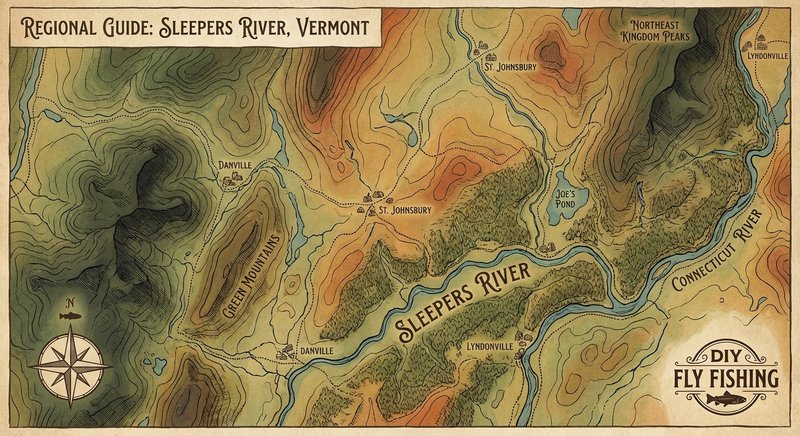
The Sleepers River is a quintessential Vermont freestone stream located in the Northeast Kingdom, near St. Johnsbury. While it may not have the name recognition of the Battenkill or the Lamoille, it is a "guide’s secret"—a high-gradient, cold-water gem that offers some of the most consistent brook trout fishing in the state.
Here is your comprehensive guide to fly fishing the Sleepers River.
🎣 Location Overview
The Sleepers River is a tributary of the Passumpsic River, winding through a mix of forested ravines and pastoral valleys. What makes this river special is its thermal stability. Because it is heavily spring-fed and shaded by dense riparian canopy, it stays significantly cooler than other regional rivers during the heat of July and August.
The water characteristics are classic "pocket water": a series of short runs, plunge pools, and glassy tailouts. It is a small-to-medium-sized stream, making it perfect for the angler who enjoys technical wading and short-range casting. Anglers love it because it offers a true "wild" experience; these aren't stocked fish—they are vibrant, native-born brookies.
🐟 Target Species & Behavior
The primary draw here is the Wild Brook Trout. While you may occasionally find a stray rainbow or brown trout near the confluence with the Passumpsic, the upper and middle reaches belong to the brookies.
- Behavior: These fish are opportunistic but wary. In the summer, they are highly focused on terrestrial insects falling from the overhanging brush. In the fall, they become aggressive and territorial as they prepare for the spawn.
- Where they hold: Look for "the bucket"—the deep, dark center of a plunge pool. Brookies also love to tuck right against the undercut banks or behind large granite boulders. If there is a bubble line, there is a fish under it.
- Feeding: Their diet consists of small stoneflies, caddis larvae, and an abundance of ants, beetles, and grasshoppers.
📅 Best Times to Fish
Summer (Late June – August)
- Conditions: This is the prime window for dry fly action. While other rivers are too warm to fish safely, the Sleepers remains a refuge.
- Time of Day: Morning (8 AM – 11 AM) and late evening (6 PM until dark). The "witching hour" just before dusk often sees a frenzy of activity.
Fall (September – October)
- Conditions: As water temperatures drop, the brook trout don their brilliant spawning colors (deep oranges and reds).
- Time of Day: Mid-day is best. As the sun warms the water slightly, the fish become more active.
- Note: Fishing usually peaks before the mid-October close of the trout season (check current VT Fish & Wildlife regulations for exact dates).
🪰 Recommended Flies & Techniques
Top Fly Patterns
- Dry Flies:
- Royal Wulff (Size 14-16): The high visibility is crucial in the broken pocket water.
- Elk Hair Caddis (Tan or Olive, Size 16).
- Black Ants & Foam Beetles (Size 16-18): Essential for summer afternoons.
- Nymphs:
- Pheasant Tail (Size 16-18): Works year-round.
- Prince Nymph (Size 14-16): The "bling" helps in the darker, deeper pools.
- Streamers:
- Black Nose Dace or small Muddler Minnows (Size 10-12): Excellent for the fall when fish are aggressive.
Techniques & Presentation
- The "Dry-Dropper" Rig: This is the most effective way to fish the Sleepers. Use a buoyant dry fly (like a Stimulator) and hang a small weighted nymph 18-24 inches below it.
- Short Line Casting: You will rarely need to cast more than 20 feet. Focus on stealthy approaches and high-sticking to keep your line off the complex current seams.
- Upstream Approach: Always fish moving upstream. Brook trout face into the current; if you approach from behind, you are less likely to spook them in the clear water.
💡 Pro Tips & Local Knowledge
- The High Gradient Rule: Focus on the sections where the river drops quickly over rocks. These "stair-step" pools oxygenate the water, and brookies will stack up at the very head of the pool right where the whitewater settles.
- Stealth is Everything: The Sleepers is clear. Wear drab clothing (greens/browns) and avoid "crunching" rocks as you wade. If you see the fish, they have likely already seen you.
- The Bridge Effect: Many anglers fish right at the bridge crossings (like along Sleepers River Rd). For better luck, hike at least half a mile away from any road access to find the larger, unpressured fish.
⚠️ Important Information
- Access: Much of the river runs through private land. Vermont has generous access laws, but always look for "Posted" signs. If a landowner is present, asking permission goes a long way. Access is generally found along Sleepers River Road and near the St. Johnsbury Town Forest.
- Regulations: The Sleepers River generally falls under Vermont’s "General Trout Water" regulations.
- Season: Second Saturday in April to October 31st.
- Harvest: While there is a keeper limit, Catch and Release is strongly encouraged for wild brook trout to preserve the fishery.
- Gear Recommendation: A 2-weight or 3-weight rod (7’ to 8’ length) is ideal. A 9-foot 5-weight is overkill and will be difficult to maneuver under the tree canopy. Use 5x or 6x tippet for the best presentation.
Guide’s Final Word: The Sleepers River isn't about trophy sizes; it's about the beauty of the fish and the solitude of the Vermont woods. Bring a camera—the colors of a Sleepers River brook trout in September are something you'll want to remember.
Bug Hatches & Matching Flies
| Hatch | Type | Peak months | Time of day | Hook sizes | Matching flies |
|---|---|---|---|---|---|
| Blue-Winged Olive Baetis spp. | mayfly | April, May, September, October | Midday | #18-22 | RS2 #18-22, Parachute Adams #18-22, Pheasant Tail #18-20 |
| Hendrickson Ephemerella subvaria | mayfly | April, May | Afternoon | #12-14 | Red Quill #12-14, Hendrickson Emerger #12-14, Gold Ribbed Hare's Ear #12-14 |
| Grannom Caddis Brachycentrus | caddis | May | Morning/Afternoon | #14-16 | Elk Hair Caddis (Olive) #14-16, Pupa Larva (Green) #14-16, Holy Grail #14-16 |
| March Brown Maccaffertium vicarium | mayfly | May, June | Afternoon | #10-12 | March Brown American #10-12, Hare's Ear Nymph #10-12 |
| Spotted Sedge Hydropsyche | caddis | June, July, August | Evening | #14-18 | Tan Elk Hair Caddis #14-18, LaFontaine's Deep Sparkle Pupa #14-16 |
| Light Cahill Stenonema/Stenacron | mayfly | June, July | Evening | #14-16 | Light Cahill #14-16, Cream Usual #14-16 |
| Yellow Sally Isoperla spp. | stonefly | June, July | Afternoon/Evening | #14-16 | Yellow Sally Dry #14-16, Little Yellow Sloan #14-16 |
| Terrestrials (Ants & Beetles) Formicidae / Coleoptera | terrestrial | July, August, September | All Day | #12-18 | Black Foam Ant #14-18, Japanese Beetle #12-14 |
| White Miller Nectopsyche | caddis | August | Evening/Night | #14-16 | White Elk Hair Caddis #14-16 |