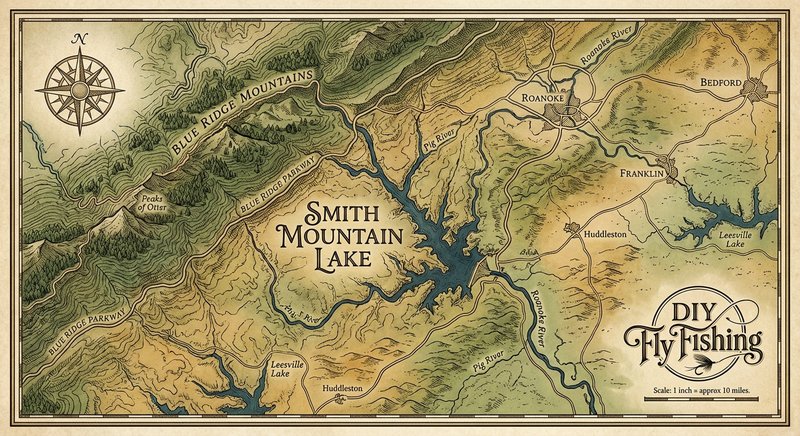
Smith Mountain Lake
Fly fishing in Virginia · Intermediate · Best seasons: Spring, Summer, Fall
Target Species
Striped Bass, Largemouth Bass, Channel Catfish
About This Water
Virginia's second largest lake with excellent striped bass. Also largemouth and catfish.
Fishing Recommendations
Welcome to Smith Mountain Lake (SML), the "Jewel of the Blue Ridge Mountains." As a guide, I can tell you that SML is one of the most diverse and challenging warm-water fly fishing destinations in the Mid-Atlantic. With over 500 miles of shoreline and depths reaching 200 feet, it is a massive playground that requires a tactical approach, especially when chasing Striped Bass on the fly.
🎣 Location Overview
Smith Mountain Lake is a massive reservoir located in Southwest Virginia, formed by the impoundment of the Roanoke and Blackwater Rivers. What makes it special for fly anglers is the water clarity and the vertical structure. Unlike many murky reservoirs, SML offers enough clarity for "sight-casting" to schooling fish in the spring and fall.
The lake is a "pump-back" facility, meaning water is pumped back up into the lake at night to generate power during the day. This creates artificial currents that can trigger feeding binges, a rarity in most standing-water lakes.
🐟 Target Species & Behavior
Striped Bass (The Crown Jewel)
These are landlocked "stripers." They are pelagic, meaning they roam open water following schools of Gizzard and Threadfin Shad.
- Behavior: They are temperature-sensitive. In spring, they move into the shallows and up the river arms. In summer, they retreat to the thermocline (deep, cool water). In fall, they "blitz" baitfish near the surface.
Largemouth Bass
SML is a world-class bass fishery. The lake is heavily developed, meaning there are thousands of boat docks.
- Behavior: Largemouths here are "dock-dwellers." They use the shade of piers and boat lifts as ambush points. They also frequent the "rip-rap" (rocky banks) near bridges.
Channel Catfish
While usually a bait-fishing target, Channel Cats in SML are aggressive predators that will absolutely take a fly.
- Behavior: During the late spring spawn, they move into rocky shallows. They are scent and vibration-oriented. If you bounce a heavy streamer off the bottom near a rocky point, be prepared for a fight that will test your 8-weight rod.
📅 Best Times to Fish
- Spring (April – June): The Prime Window. This is when Stripers move into the "flats" and river arms (Roanoke and Blackwater). The water is warm enough for activity but cool enough for fish to stay shallow.
- Summer (July – August): The Night Game. Daytime boat traffic is heavy and the fish are deep. Fly fishing is best at dawn, dusk, or under "dock lights" at night where stripers and bass hunt bait attracted to the glow.
- Fall (September – November): The Shad Run. As water temperatures drop, shad move to the surface. Look for diving seagulls; they will lead you to the Stripers.
- Time of Day: Early morning (pre-dawn to 9:00 AM) is essential. On SML, the "wind chop" and boat traffic usually kill the topwater bite by mid-morning.
🪰 Recommended Flies & Techniques
For Striped Bass
- Flies:
- Clouser Minnow: (Chartreuse/White or Blue/White) – The "gold standard." Use heavy lead eyes to get down.
- Half and Half: A cross between a Lefty’s Deceiver and a Clouser.
- Crease Flies: For surface "blitzes." They make a splashing sound that mimics wounded shad.
- Technique: Use a 7 to 9-weight rod with a fast-sinking integrated fly line (250–400 grains). You must get the fly down to the 15–25 foot range unless fish are actively busting the surface.
For Largemouth Bass
- Flies:
- Dahlberg Divers: Excellent for "chugging" near dock pilings.
- Game Changers: Multi-jointed flies that mimic the erratic swim of a bluegill.
- Technique: Use a floating line and "skip" your flies under boat docks. Precision is key—if you aren't within 6 inches of the post, you aren't fishing.
For Channel Catfish
- Flies:
- Black or Purple Woolly Buggers: Scented (where legal) or with extra rubber legs for vibration.
- Technique: Use a sink-tip line. Cast to rocky points in May/June and "crawl" the fly along the bottom with very slow strips.
💡 Pro Tips & Local Knowledge
- Follow the Birds: In the fall, look for Ring-billed Gulls. If they are hovering and dipping, Striped Bass have pushed shad to the surface. This is the only time you can reliably catch SML stripers on a floating line.
- The "Bridge Effect": Bridges like Hales Ford or the B-20 bridge create "funnels." Current moves faster here, and Stripers often stack up on the down-current side of the pilings.
- The Pump-Back Current: Check the Appalachian Power (AEP) schedule. When they are generating power at the dam, the moving water "wakes up" the fish in the lower end of the lake.
- Color Palette: SML is clear. Use "natural" colors (white, silver, grey) on sunny days. Save the "Chartreuse" for cloudy days or stained water in the upper river arms.
⚠️ Important Information
- Regulations: A Virginia freshwater fishing license is required. Note that Striped Bass have specific length and creel limits on SML that change seasonally (to protect them during the heat of summer). Check the DWR Virginia website before heading out.
- Safety: SML is a popular recreational lake. During summer weekends, the "wake" from large boats can be dangerous for small fly-fishing skiffs. I recommend fishing the "no-wake" coves or staying out of the main channel after 10:00 AM.
- Access:
- Public Ramps: Smith Mountain Lake State Park (easy access to good water).
- Marinas: Many marinas offer day-use ramp passes for a small fee.
Guide’s Final Word: SML Stripers are "ghosts." You might go four hours without a strike and then have thirty minutes of absolute mayhem. Stay patient, keep your fly deep, and always keep an eye on the horizon for diving birds. Tight lines!
Bug Hatches & Matching Flies
| Hatch | Type | Peak months | Time of day | Hook sizes | Matching flies |
|---|---|---|---|---|---|
| Chironomids (Midges) Chironomidae | midge | March, April, October, November | All Day | #18-24 | Zebra Midge #18-22, Griffith's Gnat #20-24, Smoke Jumper #20-22 |
| Giant Michigan Mayfly (Hex) Hexagenia limbata | mayfly | June, July | Evening/Night | #4-8 | Hexagenia Nymph #6-8, Hex Spinner #4-6, Crippled Hex #6-8 |
| Spotted Sedge Hydropsyche | caddis | May, June, September | Evening | #14-18 | Elk Hair Caddis #14-16, Pupa Sedge #16-18, Holy Grail Caddis #14-16 |
| White Winged Curse Caenis | mayfly | July, August | Early Morning | #22-26 | Caenis Spinner #24-26, Tiny RS2 #22-24 |
| Trico Tricorythodes | mayfly | August, September | Morning | #20-24 | Trico Spinner #22-24, Sunken Trico #20-22 |
| Carpenter Ants Camponotus | terrestrial | May, June | Afternoon | #12-16 | Black Foam Ant #14-16, Fur Ant #12-14 |
| Annual Cicada Neotibicen canicularis | terrestrial | July, August | Afternoon | #4-8 | Project Cicada #6-8, Fat Albert (Black) #6-10 |
| Japanese Beetle Popillia japonica | terrestrial | June, July | All Day | #12-16 | Foam Beetle #12-14, Coffee's Sparkle Beetle #14-16 |