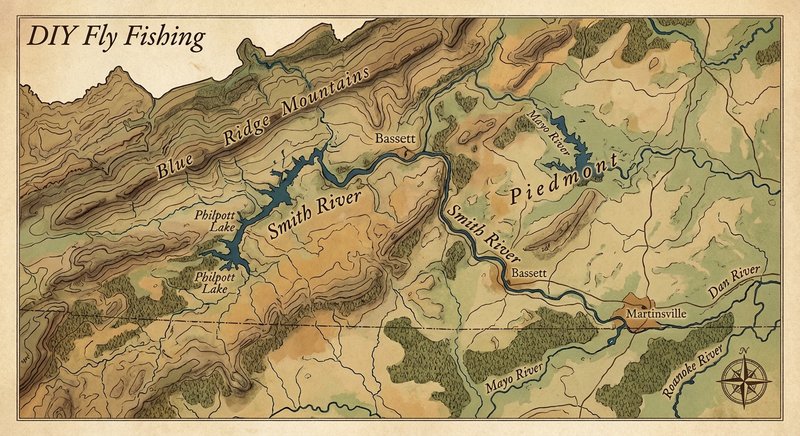
Smith River
Fly fishing in Virginia · Intermediate · Best seasons: Spring, Summer, Fall, Winter
Target Species
Brown Trout, Rainbow Trout
About This Water
Virginia's premier tailwater with trophy brown trout. Year-round fishing below Philpott Dam.
Fishing Recommendations
The Smith River in Henry County, Virginia, is a true "diamond in the rough" of Southern fly fishing. As a tailwater flowing from the bottom of Philpott Dam, it offers a rare opportunity for year-round cold-water trout fishing in a region that usually warms up significantly in the summer.
Known primarily for its wild, wary brown trout, the Smith is a technical river that rewards patience, stealth, and precise presentation.
🎣 Location Overview
The Smith River is a tailwater fishery located near the towns of Bassett and Martinsville. What makes it special is the Philpott Dam. The cold water released from the base of the dam allows trout to thrive for nearly 15 miles downstream, even in the heat of a Virginia July.
The river is characterized by a mix of classic freestone-looking runs, deep slow-moving pools, and thick bank-side vegetation. It is not a massive river; in many spots, you can cast across it easily. However, the water is crystal clear and the banks are often lined with rhododendron and overhanging sycamores, making it a "tight-quarters" tactical game.
🐟 Target Species & Behavior
- Wild Brown Trout: The crown jewel of the Smith. These are not your average "cookie-cutter" stocked fish. They are wild, naturally reproducing, and have a reputation for being some of the most "educated" trout in the Mid-Atlantic. They hold tight to undercut banks, submerged logs, and the shadows of overhanging trees.
- Rainbow Trout: While there is some natural reproduction, many rainbows are found in the "Put-and-Take" sections or drift down from the dam area. They are generally more opportunistic than the browns and will hold in the faster riffles and "heads" of the pools.
Behavior Note: Because it is a tailwater, the fish are keyed into consistent insect life (Midges and Scuds). They are notorious for "sipping" tiny flies in flat water, requiring long leaders and light tippets.
📅 Best Times to Fish
The Smith is a year-round fishery, but your tactics must shift with the seasons:
- Spring (March – May): The Prime Time. This coincides with the famous Grannom Caddis hatch (late March/April). The river comes alive, and the otherwise shy browns will actually rise aggressively.
- Summer (June – August): Excellent fishing due to the cold tailwater release. While other rivers are too warm to fish, the Smith stays in the 50s and 60s. Focus on terrestrial patterns (ants/beetles) along the banks.
- Fall (September – November): A beautiful time to be on the water. The Brown Trout spawn occurs in late fall—please stay off the "redds" (spawning beds) to protect future generations. Streamer fishing is highly effective now as fish become territorial.
- Winter (December – February): Challenging but rewarding. Focus on the warmest part of the day (12 PM – 4 PM). Midges are the primary food source.
🪰 Recommended Flies & Techniques
Top Fly Patterns
- Dry Flies: Elk Hair Caddis (Tan/Olive, #14-18), Parachute Adams (#16-22), Griffith’s Gnat (#18-22), and various Beetle/Ant patterns for summer.
- Nymphs: Zebra Midge (Black or Red, #18-22), Pheasant Tail (#16-20), and Scuds (Olive or Grey, #16-18). The Smith has a massive crustacean population; never fish without a scud pattern.
- Streamers: Woolly Buggers (Black or Olive) and Muddler Minnows. Fish these tight to the banks and wood structure.
Presentation & Techniques
- Nymphing: European-style nymphing or light indicator nymphing is the most consistent producer. Use small weights; the water isn't always deep, but you need to be in the "zone."
- Dry Fly: You must use a long leader (9ft–12ft) tapering down to 6X or 7X fluorocarbon. These fish will spook if they see a thick fly line or a heavy splash.
- The "Caddis Twitch": During the Grannom hatch, giving your dry fly a tiny, rhythmic twitch can trigger a strike from a brown trout that is ignoring a dead-drift.
💡 Pro Tips & Local Knowledge
- The Generation Schedule is Life or Death: Before you even put on your waders, you MUST check the Philpott Dam generation schedule. The water can rise several feet in a matter of minutes. Call the US Army Corps of Engineers at (276) 629-2432 for daily release schedules.
- The Special Regulation Section: Focus your efforts on the 7.7-mile stretch from Philpott Dam down to the Koehler bridge. This area has specific gear and harvest rules that keep the fish population healthy.
- Stealth is Mandatory: Do not "wade-crash" into a pool. The wild browns can feel vibrations through the water. Stay low, wear drab colors (olive/tan), and try to fish from the bank whenever possible before entering the water.
- Look for "Micro-Eddies": The Smith has many tiny pockets of soft water behind rocks or against the bank. Often, a trophy brown will sit in water barely deep enough to cover its back.
⚠️ Important Information
- Regulations: The "Special Regulation Trout Water" section (from the bridge below Philpott Dam to Koehler) requires artificial lures with single hooks only. There is a 16-inch minimum size limit for Brown Trout in this section.
- Access Points:
- Philpott Dam: Great access right at the top.
- Bassett: Several public pull-offs and parks.
- Fieldale: Access near the old textile mills offers great pocket water.
- Wading Safety: The rocks in the Smith are notoriously slippery ("Smith River Grease"). Felt-soled boots or studs are highly recommended, along with a wading staff.
- Permits: You need a valid Virginia Fishing License PLUS a Trout License (if fishing during the designated trout season in certain sections). Check the DWR website for current pricing.
The Smith River isn't an easy river, but for the angler who appreciates wild fish in a beautiful setting, there is nowhere better in the Commonwealth of Virginia. Tight lines!
Bug Hatches & Matching Flies
| Hatch | Type | Peak months | Time of day | Hook sizes | Matching flies |
|---|---|---|---|---|---|
| Sulphurs Ephemerella invaria / dorothea | mayfly | May, June | Late Afternoon/Evening | #14-18 | Comparison Dun #16-18, Sulphur Parachute #14-18, Pheasant Tail #16-18 |
| Blue Winged Olives (BWO) Baetis | mayfly | March, April, October, November | Afternoon | #18-24 | RS2 #20-22, Blue Wing Olive Parachute #18-22, WD-40 #20-24 |
| Midges Chironomidae | midge | January, February, December | Morning/Afternoon | #20-26 | Zebra Midge #20-24, Griffith's Gnat #20-24, Top Secret Midge #22-24 |
| Tan Caddis Hydropsyche | caddis | April, May, June | Morning/Evening | #14-18 | Elk Hair Caddis #14-16, Holy Grail Caddis #14-16, Pupa #16 |
| Trico Tricorythodes | mayfly | July, August, September | Early Morning | #22-26 | Trico Spinner #22-26, Drowned Trico #24 |
| March Brown Maccaffertium vicarium | mayfly | April, May | Afternoon | #10-14 | March Brown Parachute #12-14, Gold Ribbed Hare's Ear #10-14 |
| Light Cahill Stenacron | mayfly | June, July | Evening | #14-16 | Light Cahill #14-16, Cream Usual #14-16 |
| Terrestrials (Ants/Beetles) Formicidae / Coleoptera | terrestrial | July, August, September | Daytime | #12-18 | Black Foam Ant #16-18, Crowe Beetle #14-16 |