Sny Magill Creek
Fly fishing in Iowa · intermediate · Best seasons: spring, summer, fall
Target Species
Brown Trout, Brook Trout
About This Water
Clayton County spring creek with excellent hatches. Wild brown and brook trout.
Fishing Recommendations
Welcome to the heart of the Iowa Driftless Area. As a guide who has spent years navigating these limestone spring creeks, I can tell you that Sny Magill Creek (and its tributary, North Cedar Creek) represents some of the finest coldwater angling in the Midwest.
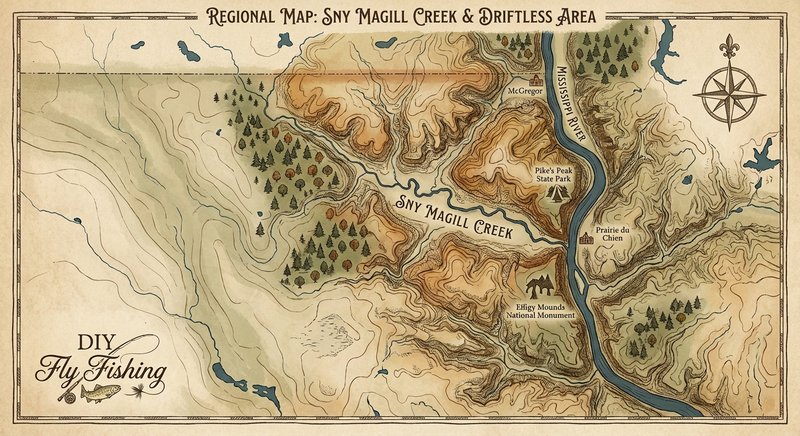
Located in Clayton County, south of McGregor, this system offers a classic Driftless experience: cold, nutrient-rich water, lush valleys, and trout that are as beautiful as they are selective.
🎣 Location Overview
Sny Magill is one of the largest and most popular trout streams in Iowa, but don't let the popularity fool you—it holds plenty of secrets. What makes it special is the Sny Magill-North Cedar Wildlife Management Area, which provides over 7 miles of continuous public access.
The water is classic "spring creek" style: crystal clear under normal conditions, filtered by the limestone bedrock of the Driftless region. It features a diverse mix of habitats, from deep, slow-moving pools and undercut banks to bubbly riffles and runs. Because it is spring-fed, the water temperature remains remarkably stable (around 48-55°F) year-round, making it a biological factory for aquatic insects and crustaceans.
🐟 Target Species & Behavior
- Brown Trout: These are the kings of Sny Magill. While the state stocks catchable rainbows here regularly, the wild and "holdover" Brown Trout are the main draw. They are wary and highly attuned to overhead movement. They hold tight to the undercut banks and submerged logs during the day, moving into the heads of pools to feed during low-light periods.
- Brook Trout: You will find these primarily in the North Cedar Creek arm. Iowa has worked hard to re-establish catchable populations of these native beauties. They are opportunistic but fragile; they prefer the colder, headwater reaches and will often hold in smaller "pockets" of water that bigger Browns overlook.
- Behavior: These fish are "bank feeders." Because the stream is relatively narrow, the trout rely heavily on the cover provided by the tall grasses and carved-out limestone banks.
📅 Best Times to Fish
- Spring (April – June): This is the "Golden Era" for hatches. Once the water hits 50°F consistently, the stream comes alive.
- Summer (July – August): Excellent for terrestrial fishing (grasshoppers/ants). Aim for early morning (5 AM - 9 AM) or the last hour of light to avoid the midday heat and the occasional recreational "creek walkers."
- Fall (September – October): My personal favorite. The Browns become aggressive as they prepare for the spawn. The colors of the Driftless valley are spectacular, and the Blue Winged Olive (BWO) hatches can be prolific on overcast days.
- Prime Conditions: Overcast, drizzly days are your best friend on Sny Magill. The lack of shadows makes the fish much less "spooky" in the clear water.
🪰 Recommended Flies & Techniques
Top Fly Patterns
- Nymphs:
- Pink Squirrel (Size 14-16): An Iowa staple. The flash and the bead move fish in all conditions.
- Scuds/Sowbugs (Gray or Olive, Size 16-18): These are the "bread and butter" of a limestone stream. Fish them deep.
- Pheasant Tail (Size 18-20): Perfect for imitating the small Mayfly nymphs.
- Dry Flies:
- Elk Hair Caddis (Size 16-18): Great for skating across riffles in the evening.
- Hippie Stomper/Foam Beetles (Size 14-16): Essential for summer "hopper-dropper" rigs.
- BWO Sparkle Dun (Size 20-22): For those technical fall hatches.
- Streamers:
- Black or Olive Woolly Bugger (Size 8-10): Swing these near undercut banks during high water.
Presentation Tips
- The Stealth Approach: This is a small stream. If you can see the fish, they have likely already seen you. Stay low, wear drab colors (greens/browns), and move slowly upstream.
- Light Tackle: A 3-weight or 4-weight rod (7'6" to 8'6") is ideal. Use a long leader (9-12 feet) tapering to 5X or 6X fluorocarbon tippet to avoid spooking fish in the clear pools.
💡 Pro Tips & Local Knowledge
- The "North Cedar" Secret: If Sny Magill feels crowded or the water is slightly off-color, hike up into the North Cedar Creek branch. It’s smaller, more technical, and offers a much better chance at catching native Brookies in a secluded setting.
- Mind the Grass: In mid-to-late summer, the bank grass gets very tall. Use this as a blind. Stand back from the bank and "dap" your fly or make short casts over the grass.
- Check the Gauge: Sny Magill can get muddy after a heavy rain due to agricultural runoff upstream. Check local USGS gauges or call a shop in Decorah before making the drive. If it's "chocolate milk," head to the smaller tributary springs which clear faster.
- The "Iowa Twitch": When fishing a terrestrial like a beetle or ant, give it a tiny twitch right as it passes a deep undercut bank. That slight movement often triggers a predatory strike from a large Brown.
⚠️ Important Information
- Access: The main access points are off Sny Magill Road. There are several designated parking lots along the creek. Use the "Iowa Trout Fishing" app (or the DNR website) to view the precise boundaries of the WMA.
- Regulations:
- A valid Iowa Fishing License AND a Trout Fee are required.
- While much of the stream allows for harvest, many serious fly anglers practice Catch and Release to preserve the wild Brown Trout population. Check posted signs at the parking lots for the most current length limits or lure restrictions.
- Safety: Be mindful of wild parsnip in the summer—the sap causes nasty skin burns when exposed to sunlight. Wear long pants even when it’s hot.
- Etiquette: Sny Magill is a "flagship" Iowa stream. If you see another angler, give them a wide berth (at least two full pools of space).
Guide’s Final Word: Sny Magill is a stream that rewards patience and observation. Don't rush to the water. Spend five minutes watching a pool before you cast; you’ll often see the "ghosts" of the Driftless—large Browns—finning just inches from the bank. Tight lines!
Bug Hatches & Matching Flies
| Hatch | Type | Peak months | Time of day | Hook sizes | Matching flies |
|---|---|---|---|---|---|
| Blue-Winged Olive (BWO) Baetis spp. | mayfly | March, April, September, October | Late Morning/Afternoon | #18-22 | RS2 #18-22, Parachute Adams #18-22, Pheasant Tail Nymph #18-20 |
| Midges Chironomidae | midge | January, February, March, December | Mid-day | #20-26 | Zebra Midge #20-24, Griffith's Gnat #20-22, Top Secret Midge #22-24 |
| Grannom Caddis Brachycentrus | caddis | April, May | Afternoon/Evening | #14-16 | Elk Hair Caddis (Dark) #14-16, Deep Sparkle Pupa #14-16, Holy Grail Caddis #14-16 |
| Sulphurs Ephemerella invaria | mayfly | May, June | Evening | #14-18 | Sulphur Parachute #14-18, CDC Sulphur Emerger #16-18, Sulphur Spinner #14-18 |
| Tricos Tricorythodes spp. | mayfly | July, August, September | Early Morning | #20-24 | Trico Spinner #22-24, Sunken Trico Spinner #20-22 |
| Craneflies Tipulidae | terrestrial | August, September | Afternoon | #10-14 | Daddy Long Legs #10-12, Crane Fly Larva #10-14 |
| Terrestrials (Hoppers/Ants/Beetles) Orthoptera/Formicidae | terrestrial | July, August, September | All Day | #10-18 | Dave's Hopper #10-14, Cinnamon Ant #16-18, Black Foam Beetle #14-16 |
| Scuds Gammarus lacusris | terrestrial | March, April, May, June, July, August, September, October, November | All Day | #14-18 | Ray Charles #14-18, Pink Scud #14-16, Orange Scud #16-18 |