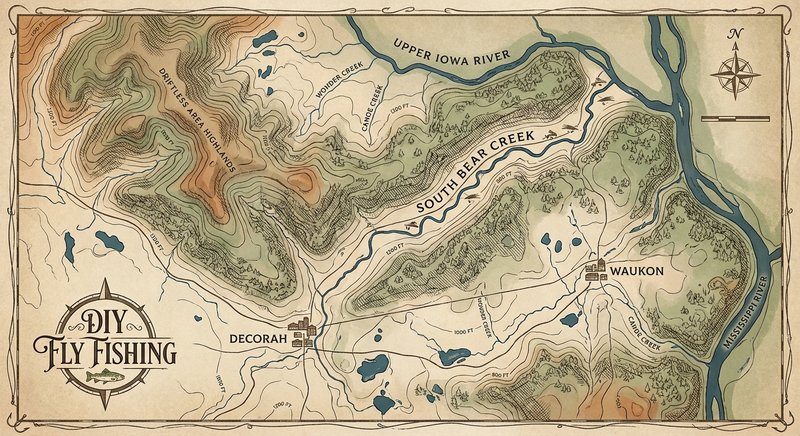
South Bear Creek
Fly fishing in Iowa · intermediate · Best seasons: spring, summer, fall
Target Species
Brown Trout
About This Water
Fayette County tributary with wild trout. Limestone spring creek habitat.
Fishing Recommendations
Welcome to the Driftless Area of Northeast Iowa. As your guide, I’m excited to introduce you to South Bear Creek. Located in Winneshiek County, near the Minnesota border, South Bear is widely considered one of the "crown jewels" of Iowa trout fishing.
Unlike many Midwestern streams that can be silty or sluggish, South Bear is a cold, spring-fed limestone stream that offers a quintessential "English chalk stream" feel mixed with rugged Iowa bluffs.
🎣 Location Overview
South Bear Creek is a classic limestone spring stream. What makes it special is its high water quality and consistent temperatures. Because it is fed by numerous springs, the water stays cool enough for trout to thrive even during the humid Iowa summers.
The stream features a diverse mix of water types: deep limestone pools, bubbly riffles, and long, glassy glides. It flows through a combination of timbered hills and open meadows. Anglers love it because it offers a "technical" challenge—the water is often crystal clear, requiring stealth and precise presentations, yet it holds a high density of fish that reward a skilled hand.
🐟 Target Species & Behavior
The primary draw here is the Brown Trout.
- Behavior: South Bear holds both stocked and wild (naturally reproducing) Brown Trout. These fish are notorious "shadow seekers." They love to tuck under undercut banks, beneath overhanging willow branches, or right against the limestone ledges.
- Feeding: They are opportunistic but can be highly selective during a hatch. They feed heavily on scuds (freshwater shrimp) and sowbugs year-round due to the limestone-rich water. As they grow larger, they become more piscivorous, feeding on sculpins and smaller trout.
- Holdings: Look for the "seams" where fast water meets slow water. In South Bear, the biggest browns are often found in the deep holes at the bends of the creek or buried under the "lunker structures" (man-made wooden cribs installed for habitat).
📅 Best Times to Fish
While you can fish year-round in Iowa, here is the seasonal breakdown:
- Spring (Late March – May): This is arguably the prime window. As the water warms, the bugs get active. You’ll see the first major hatches of Blue Winged Olives (BWOs) and Grannom Caddis.
- Summer (June – August): Focus on early mornings and late evenings. This is Terrestrial Season. When the Iowa wind blows across the hayfields, grasshoppers, ants, and beetles fall into the water, triggering aggressive surface strikes.
- Fall (September – November): The Brown Trout enter their spawning colors and become more aggressive. The scenery is spectacular, and the crowds thin out.
- Time of Day: On clear days, the "magic hour" is just before dusk. However, if you have a drizzly, overcast day, the Brown Trout will lose their inhibions and feed throughout the afternoon.
🪰 Recommended Flies & Techniques
Top Fly Patterns
- Nymphs: Pink Squirrel (an Iowa staple), Gold-Ribbed Hare’s Ear (#16-18), Zebra Midge (#18-22), and Scuds (Grey or Olive, #14-18).
- Dry Flies: Elk Hair Caddis (#14-16), Parachute Adams (#16-20), and Dave’s Hopper or Fat Albert (#8-12) in late summer.
- Streamers: Black or Olive Woolly Buggers (#8-12) and pine squirrel leeches.
Effective Techniques
- European Nymphing: Given the many riffles and pockets, a tight-line nymphing rig is incredibly effective here.
- The "Hopper-Dropper": In summer, hang a weighted nymph (like a Pink Squirrel) 18–24 inches below a buoyant foam hopper.
- Streamer Stripping: On high-water days or early mornings, cast a streamer toward the opposite bank and strip it back aggressively to trigger a territorial strike from a trophy Brown.
💡 Pro Tips & Local Knowledge
- The Stealth Factor: Because the water is often gin-clear, your shadow is your enemy. Avoid "skylining" yourself on the high banks. Wear earthy tones (olive or tan) and stay low.
- Focus on the "Upper" Section: The water near the Highlandville Store and upstream tends to stay cooler and clearer after a rain.
- The Pink Squirrel Secret: If you aren't catching fish, put on a Pink Squirrel nymph. Developed in the Driftless, the flash and the pink dubbing seem to trigger Iowa trout like nothing else.
- Check the Gauges: Before driving out, check the local USGS gauges. If the area has had a massive thunderstorm, the creek can turn "chocolate milk" for 24–48 hours, though it clears faster than many other local streams.
⚠️ Important Information
Access
- Much of South Bear Creek flows through private land with public fishing easements. Respect the "Green Signs" that designate public access.
- Park in designated pull-offs or at the bridge crossings. Do not block field gates for farmers.
- The Highlandville Store is the local landmark and a great place to stop for snacks and local intel.
Regulations & Permits
- License: You need a valid Iowa Fishing License AND a Trout Fee (Trout Stamp).
- Limits: While many anglers practice Catch and Release to preserve the fishery, check the current Iowa DNR regulations for daily bag limits and length restrictions.
- Gear: A 3-weight or 4-weight fly rod (7'6" to 8'6") is the perfect tool for this water. Use 5X or 6X fluorocarbon tippet for nymphs to combat the clear water.
Guide’s Final Note: South Bear is a special place. Please practice Leave No Trace principles. If you see trash, pack it out, and keep this Iowa gem pristine for the next generation of anglers. Tight lines!
Bug Hatches & Matching Flies
| Hatch | Type | Peak months | Time of day | Hook sizes | Matching flies |
|---|---|---|---|---|---|
| Blue-Winged Olive Baetis tricaudatus | mayfly | April, May, September, October | Late Morning/Afternoon | #18-22 | RS2 #18-22, Parachute BWO #18-22, CDC BWO Emerger #20-22 |
| Grannom Caddis Brachycentrus | caddis | April, May | Afternoon/Evening | #14-16 | Peacock Caddis #14-16, Deep Sparkle Pupa #14-16, Elk Hair Caddis (Black) #14-16 |
| Sulphur Ephemerella invaria/dorothea | mayfly | May, June | Late Afternoon/Evening | #14-18 | Sulphur Parachute #14-18, Pheasant Tail #14-18, Sulphur Snowshoe Emerger #16-18 |
| Trico Tricorythodes | mayfly | July, August, September | Early Morning | #20-24 | Trico Spinner #20-24, Zebra Midge #20-22, Griffith's Gnat #20-22 |
| Light Cahill Stenonema/Stenacron | mayfly | June, July | Evening | #12-14 | Light Cahill #12-14, Gold Ribbed Hare's Ear #12-14 |
| Tan Caddis Hydropsyche | caddis | June, July, August | Evening | #14-18 | Elk Hair Caddis (Tan) #14-18, LaFontaine's Emergent Sparkle Pupa #14-16, Frenchie #14-18 |
| Grasshoppers Orthoptera | terrestrial | July, August, September | Late Morning/Afternoon | #8-12 | Dave's Hopper #10-12, Morrish Hopper #8-12 |
| Midges Chironomidae | midge | January, February, March, December | All Day | #18-24 | Zebra Midge #18-22, Morgan's Midge #20-22, Top Secret Midge #20-22 |
| Cranefly Tipulidae | other | August, September | Morning/Evening | #10-14 | Daddy Long Legs #10-12, Crane Fly Larva #10-14 |