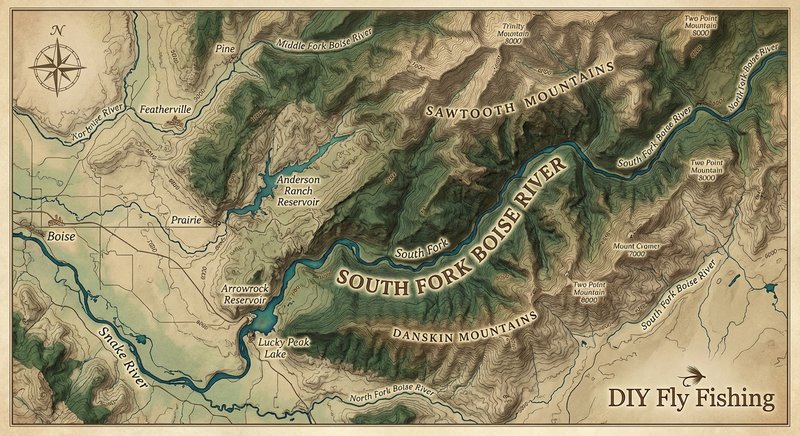
South Fork Boise River
Fly fishing in Idaho · Intermediate · Best seasons: Summer, Fall
Target Species
Rainbow Trout, Bull Trout
About This Water
Above Anderson Ranch Reservoir with wild rainbow and bull trout. Remote mountain fishing.
Fishing Recommendations
The South Fork of the Boise River (SFB), specifically the tailwater stretch below Anderson Ranch Dam, is a crown jewel of Idaho fly fishing. It is a high-desert canyon fishery known for its rugged beauty, powerful wild rainbows, and technical dry fly fishing. As your guide, I’m here to tell you that this river is both rewarding and humbling—it demands respect and precise presentation.
🎣 Location Overview
The South Fork Boise flows through a dramatic, steep-walled volcanic canyon. This is a tailwater fishery, meaning the water temperature remains relatively stable and cold throughout the summer, thanks to the depths of Anderson Ranch Reservoir.
The river is characterized by large, slick pools, fast riffles, and "boulder gardens." What makes it special is the size and strength of the fish. These aren't your average hatchery trout; these are hard-fighting, wild rainbows that utilize the heavy current to their advantage. Because it is managed as a "trophy" fishery, the biomass is incredible, leading to thick-bodied fish that are often referred to as "football-shaped."
🐟 Target Species & Behavior
Wild Rainbow Trout
The primary draw. These fish are known for their aerial acrobatics and brute strength.
- Behavior: They hold in the "seams" between fast and slow water. In the summer, they move into the riffles to feed on nymphs and oxygen-rich water. During hatches, they move to the tailouts of pools or the very edge of the banks to sip dries.
- Feeding: They are opportunistic but can be highly selective during a hatch (especially during the Cicada or Pink Lady seasons).
Bull Trout
The apex predators of the river. These are native, migratory char that can reach massive sizes (24"+).
- Behavior: They are piscivorous (fish-eaters). They hold in the deepest, darkest holes or under heavy undercut banks. They often follow hooked rainbows, so don't be surprised if your 12-inch trout suddenly gets "ambushed" by a 5-pound Bull.
- Note: Bull Trout are a protected species. You cannot target them specifically in some seasons, and they must be released immediately without being removed from the water.
📅 Best Times to Fish
Summer (Late June – August)
This is the peak season, but it is dictated by "flow drops."
- The Window: Fishing usually begins in earnest once flows drop below 1,600 cfs (usually late June or early July).
- The Big Event: The Salmonfly Hatch (late June/early July) is legendary but chaotic. Following that, the Cicada season provides some of the best terrestrial fishing in the West.
- Time of Day: Early morning for nymphing; midday for terrestrials; late evening for Caddis and PMDs.
Fall (September – October)
Many locals prefer the fall over the summer. The crowds thin out, and the scenery turns golden.
- The Window: Flows drop significantly (around 300–600 cfs), making the river much easier to wade.
- The Hatches: This is the time for Pink Ladies (Epeorus) and Blue Winged Olives (BWO).
- Time of Day: 11:00 AM to 4:00 PM is the prime window as the water warms slightly and triggers insect activity.
🪰 Recommended Flies & Techniques
Dry Flies (The SFB Specialty)
- Salmonflies: Rogue River Salmonfly, Foam Sofa Pillow (Size 4-8).
- Terrestrials: Black Foam Cicadas (Size 6-10), Morrish Hopper, Carpenter Ants.
- Mayflies: Pink Lady (Size 14-16), Parachute Adams, Sparkle Duns (Size 16-20 for BWOs).
- Caddis: Elk Hair Caddis, October Caddis (Fall).
Nymphing
When there isn't a hatch, you go deep.
- Patterns: Pat’s Rubber Legs (orange/brown), Zebra Midges (red/black), Pheasant Tails, and San Juan Worms (after a rain).
- Technique: Use a "hopper-dropper" rig in the summer riffles or a dedicated indicator rig with plenty of weight to reach the bottom of the deep canyon slots.
Streamers (For Bull Trout & Big Rainbows)
- Patterns: Sex Dungeon, Sparkle Minnow, or large Sculpin patterns in olive or black.
- Technique: Swing streamers through deep pools or "strip-and-pause" near submerged logs and boulders.
💡 Pro Tips & Local Knowledge
- The "Boise Bounce": This is a local term for the specific nymphing technique required here. Because the bottom is covered in large, slick cobble, you need to use enough split shot to feel the "tick-tick-tick" of the bottom without snagging. If you aren't touching the bottom, you aren't catching fish.
- Side-Channel Stealth: During high flows in early summer, don't overlook the small side channels. Big rainbows will duck into these to escape the heavy main current.
- Mend Like Your Life Depends On It: The SFB has complex currents. A micro-drag on your dry fly will result in a refusal. Feed the fly downstream with a "reach cast" to get longer, drag-free drifts.
- Wading Safety: This river is notoriously difficult to wade. The rocks are "greased bowling balls." Wading boots with studs and a wading staff are non-negotiable.
⚠️ Important Information
- Access: The main access is via the Middle High Bridge down to Danskin Bridge. This is a 10-mile stretch of dirt road (FS Road 113). It is narrow and can be rough—high clearance vehicles are recommended.
- Regulations:
- Barbless hooks only.
- Catch and Release for all trout (Rainbows and Bulls) in the canyon stretch below the dam.
- Always check the current Idaho Fish & Game Seasons and Rules before heading out.
- Flows: Check the Bureau of Reclamation's Hydromet for "South Fork Boise River at Neal Bridge."
- Wading is difficult above 1,200 cfs.
- Ideal wading flows are 300–800 cfs.
- Cell Service: Expect zero cell service in the canyon. Tell someone where you are going and when you expect to be back.
The South Fork is a "masterclass" river. It will challenge your casting, your wading, and your patience, but landing a 20-inch wild rainbow in that red-rock canyon is an experience you'll never forget. Tight lines!
Bug Hatches & Matching Flies
| Hatch | Type | Peak months | Time of day | Hook sizes | Matching flies |
|---|---|---|---|---|---|
| Midge Chironomidae | midge | January, February, March, December | Late Morning/Afternoon | #18-24 | Zebra Midge #18-22, Griffith's Gnat #20-22, Morgan's Midge #20-24 |
| Blue Winged Olive (BWO) Baetis | mayfly | March, April, September, October | Late Morning/Afternoon | #18-22 | RS2 #20-22, Parachute Adams #18-22, Pheasant Tail #18-20 |
| Salmonfly Pteronarcys californica | stonefly | May, June | All Day | #4-8 | Rogue River Stone #4-8, Pat's Rubber Legs #4-8, Fluttering Stone #6-8 |
| Cicada Magicicada | terrestrial | June, July | Midday | #6-10 | Mormon Girl #8-10, Project Cicada #6-10, Black Chubby Chernobyl #8-12 |
| Pale Morning Dun (PMD) Ephemerella | mayfly | June, July | Late Morning/Afternoon | #16-18 | Last Chance Cripple #16-18, Split Case PMD #16-18, Sparkle Dun #16-18 |
| Golden Stonefly Hesperoperla pacifica | stonefly | June, July | All Day | #8-12 | Chubby Chernobyl (Gold) #10-12, Norm Wood Special #8-10, 20-Incher Stone #8-12 |
| Pink Albert Epeorus albertae | mayfly | August, September | Late Afternoon/Evening | #14-16 | Pink Cahill #14-16, Epeorus Emerger #14-16, Cripple Pink Albert #14-16 |
| Spotted Sedge (Caddis) Hydropsyche | caddis | July, August | Evening | #14-18 | Elk Hair Caddis #14-18, LaFontaine's Deep Sparkle Pupa #14-16, X-Caddis #16-18 |