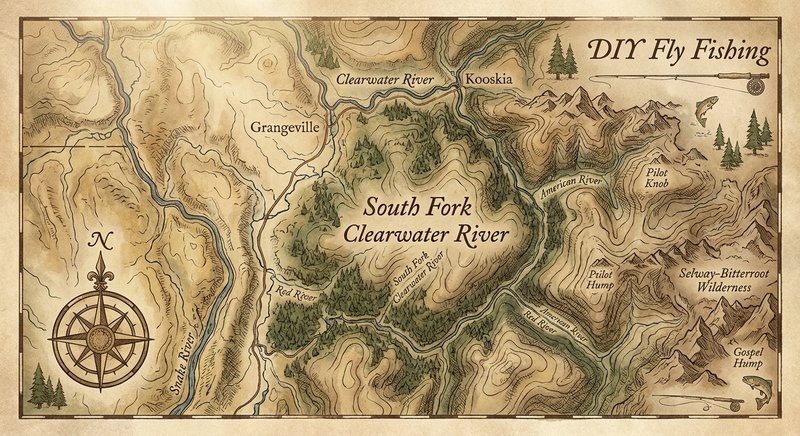
South Fork Clearwater River
Fly fishing in Idaho · Intermediate · Best seasons: Fall, Winter, Spring
Target Species
Steelhead, Rainbow Trout
About This Water
Good steelhead fishing below Harpster. Accessible alternative to remote wilderness rivers.
Fishing Recommendations
The South Fork of the Clearwater River is a gem of North Central Idaho. Unlike its "big brothers"—the Main and Middle Forks—the South Fork is a high-gradient, boulder-strewn river that offers a more intimate and technical "pocket water" experience. It is world-renowned for its legendary B-run Steelhead, fish that spend two or three years in the ocean and often return weighing 12 to 20+ pounds.
Here is your comprehensive guide to fly fishing the South Fork Clearwater.
🎣 Location Overview
The South Fork Clearwater flows through a dramatic, steep-walled canyon along Highway 14, stretching from its confluence with the Main Clearwater at Kooskia up toward the town of Elk City.
What makes it special is its character. It is not a wide, meandering river; it is a series of plunges, deep pools, and "buckets" carved out of granite boulders. While the Main Clearwater is often fished from jet boats, the South Fork is a wade-fisherman’s paradise. It feels wild, rugged, and requires a high level of physical fitness to navigate the steep banks and slick, bowling-ball-sized rocks.
🐟 Target Species & Behavior
B-Run Steelhead
The stars of the show. These fish are larger than average Columbia River steelhead.
- Behavior: Because the river is steep, steelhead here are exceptionally strong. They hold in "tail-outs" of pools, in the soft water behind large boulders, and in "walking speed" water.
- Feeding: They aren't actively feeding, but they are aggressive. They react to the "swing" of a fly or the drift of an egg pattern out of territorial instinct or memory.
Rainbow Trout (Redbands)
The South Fork has a healthy population of wild, native Redband trout.
- Behavior: They are opportunistic feeders. During steelhead season, they congregate behind spawning fish or in slower eddies to feast on drifted eggs and dislodged nymphs.
- Size: Most are in the 8–14 inch range, but they are incredibly feisty for their size.
📅 Best Times to Fish
Fall (October – November)
The fish begin entering the system as water temperatures drop. The water is usually low and clear, making for excellent "swinging" conditions with a Spey rod.
Winter (December – February)
This is "The Grind." The canyon is deep and doesn't get much sun, so it stays cold. However, the fish are settled into their winter holes. If you can handle the ice in your guides, this is the time for solitude and big fish.
Spring (March – Mid-April)
Prime Time. This is when the highest concentration of fish is in the river. The water begins to warm slightly, making fish more active. Note: Once the mountain snowmelt starts (usually late April), the river becomes high, turbid, and dangerous.
- Pro Window: Look for a "dropping and clearing" trend on the USGS gauge (Stites, ID). Ideal flows are typically between 2.5 and 4.0 feet.
🪰 Recommended Flies & Techniques
1. Steelhead: The Swing (Spey Casting)
For those who love the "tug," swinging flies is the soul of the South Fork.
- Patterns:
- Intruders: Purple/Black, Blue/Black, or Pink/Orange.
- Leeches: Prom Dress, Hobo Spay, or Dirty Ho.
- Technique: Use a 7 or 8-weight Spey rod with Skagit heads and T-11 or T-14 sink tips to get the fly down deep into the boulder pockets.
2. Steelhead & Trout: Nymphing (Indicator)
The most effective way to put numbers in the net, especially in cold water.
- Patterns:
- Eggs: Glo-bugs, Trout Beads (10mm or 12mm in Mottled Orange or Roe).
- Nymphs: Size 6-10 Rubber Leg Stoneflies (Pat’s Rubber Legs) in black or brown.
- Technique: High-stick nymphing or indicator rigs. You must use enough weight to get to the bottom quickly in the short, deep pockets.
💡 Pro Tips & Local Knowledge
- The "Golden Mile": The stretch near the Mt. Idaho Grade bridge is famous, but it gets crowded. If you see too many rigs, keep driving upstream. There are dozens of miles of pocket water that hold fish but look "too small"—don't pass them up.
- Short Leashes: Unlike the Main Clearwater, you don't need a 100-foot cast. Many fish are hooked within 20 feet of the bank in the first "bucket."
- The "South Fork Slick": The rocks here are notoriously slippery. Studded wading boots and a wading staff are non-negotiable. Do not attempt to wade this river in rubber-soled boots without studs.
- Follow the Sun: In the winter, fish the sections of the river that get the most sunlight first. A one-degree rise in water temperature can be the "light switch" that turns the bite on.
⚠️ Important Information
- Access: Highway 14 runs parallel to the river for most of its length. There are many pull-outs, but many involve steep scrambles down the embankment.
- Regulations:
- You must have an Idaho Fishing License AND a Steelhead Permit.
- Barbless hooks only for Steelhead.
- Check the Idaho Fish & Game (IDFG) seasons carefully, as they can change based on return numbers.
- Know the difference between "Hatchery" (clipped adipose fin) and "Wild" (intact adipose fin) fish. Wild fish must never be removed from the water.
- Safety: Cell service is non-existent once you deep-dive into the canyon. Let someone know your plan. Bring extra warm layers; once the sun drops behind the canyon walls, the temperature plunges 10-15 degrees instantly.
Bug Hatches & Matching Flies
| Hatch | Type | Peak months | Time of day | Hook sizes | Matching flies |
|---|---|---|---|---|---|
| Salmonfly Pteronarcys californica | stonefly | May, June | All Day | #4-8 | Rogue River Stone #4-8, Pats Rubber Legs #4-8, Chubby Chernobyl (Orange) #6-10 |
| Golden Stonefly Hesperoperla pacifica | stonefly | June, July | Morning/Evening | #8-12 | Norm Wood Special #8-12, Golden Twenty-Incher #8-12 |
| Blue Winged Olive Baetis | mayfly | March, April, September, October | Afternoon | #16-20 | RS2 #18-22, Parachute Adams #16-20, Pheasant Tail #16-20 |
| Pale Morning Dun Ephemerella excrucians | mayfly | June, July, August | Late Morning/Afternoon | #14-18 | Sparkle Dun #14-18, PMD Crack Back #16-18 |
| Mother's Day Caddis Brachycentrus | caddis | May | Afternoon/Evening | #14-16 | Peacock Caddis #14-16, Deep Sparkle Pupa #14-16 |
| Yellow Sally Isoperla | stonefly | July, August | Evening | #12-16 | Little Yellow Stone #14-16, Iron Lotus #14-16 |
| October Caddis Dicosmoecus | caddis | September, October | Afternoon | #8-12 | Stimulator (Orange) #8-12, Morrish October Caddis Pupa #8-10 |
| Midges Chironomidae | midge | February, March, April | Morning/Afternoon | #18-24 | Zebra Midge #18-22, Griffith's Gnat #18-22 |
| Grasshoppers Orthoptera | terrestrial | August, September | Late Morning/Afternoon | #6-12 | Morrish Hopper #8-12, Parachute Hopper #10-14 |