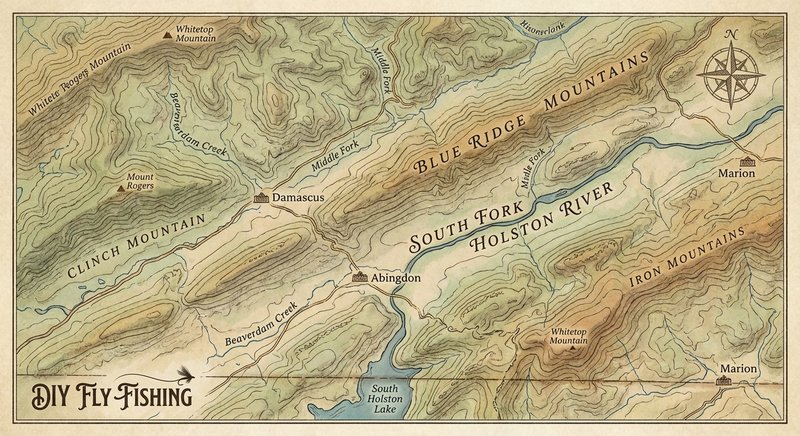
South Fork Holston River
Fly fishing in Virginia · Intermediate · Best seasons: Spring, Summer, Fall
Target Species
Smallmouth Bass, Musky
About This Water
Southwest Virginia river with smallmouth bass. Excellent float fishing.
Fishing Recommendations
The South Fork of the Holston River (SFHR) in Virginia is one of the Commonwealth’s most underrated gems. While its sister tailwater in Tennessee gets the glory for trophy trout, the Virginia section—specifically from the Buller Fish Hatchery downstream toward South Holston Lake—is a premier warm-water destination. It offers a rugged, scenic experience with a high biomass of aquatic life, making it a "factory" for thick-shouldered Smallmouth and elusive, toothy Musky.
🎣 Location Overview
The SFHR in Virginia is a freestone river with significant limestone influence, providing it with high alkalinity and a rich food web. The river flows through Smyth and Washington counties, characterized by a mix of pastoral farmland and dense Appalachian forests.
What makes this water special is its geology. The riverbed is dominated by jagged limestone ledges and "shale shelves" that run perpendicular to the flow. These ledges create deep slots and perfect ambush points. It is a medium-sized river—smaller than the New River but larger than a typical mountain creek—making it accessible for both wading (at lower flows) and small rafts or kayaks (at higher flows).
🐟 Target Species & Behavior
Smallmouth Bass
The "Bronzeback" is the king here. Because of the river's productivity, the Smallmouth are exceptionally healthy.
- Behavior: They are highly structure-oriented. They hold tight against the downstream side of ledges and in the "cushion" in front of large boulders.
- Feeding: Their diet is heavy on Hellgrammites (dobsonfly larvae) and Crayfish. During the summer, they look to the surface for dragonflies and cicadas.
Musky
The "Fish of Ten Thousand Casts" is present in lower densities but grows to impressive sizes (40"+).
- Behavior: They are apex predators that often occupy the "prime real estate"—the deepest woody debris or the dark water at the tail of a long pool.
- Feeding: They target suckers, fallfish, and even smaller bass. They are notorious for following a fly all the way to the angler's feet before peeling away.
📅 Best Times to Fish
Spring (April – May)
- Smallmouth: Pre-spawn movement starts as water hits 50°F. This is when the biggest females are most aggressive.
- Musky: Post-spawn (late spring) is an excellent window as they look to put weight back on.
Summer (June – August)
- Prime Time: This is the season for topwater action. Early mornings and late evenings are best.
- Conditions: Low, clear water requires longer leaders and stealthier approaches.
Fall (September – November)
- Feeding Binge: As water temperatures drop, fish sense winter. This is the best time for streamer fishing.
- Musky: This is the peak season for Musky. They move into shallower "hunting" water as the river cools.
🪰 Recommended Flies & Techniques
For Smallmouth Bass
- Topwater: Boogle Bugs (size 4), Murphey’s Bullfrog, and foam dragonflies. Use a "pop-and-pause" retrieve near overhanging banks.
- Sub-surface: Critter Gitter (Crayfish patterns), Clouser Minnows (Olive/White), and the Gamechanger.
- The "Holston Special": A heavy, black Hellgrammite pattern (size 2-4) fished deep under an indicator or stripped slowly along the bottom ledges.
For Musky
- Streamers: 8 to 12-inch articulated flies. Colors: Firetiger (Chartreuse/Orange), Black/Purple, or Natural White/Tan.
- Equipment: 10-weight rods with intermediate sinking tips and wire bite tippets are mandatory.
Techniques
- The Ledge Hop: Cast streamers upstream of a rock ledge and let them sink into the "slot." Strip the fly across the current.
- The Figure-8: When Musky fishing, always finish every cast by sweeping your rod in a large "8" pattern in the water. These fish frequently strike at the very last second.
💡 Pro Tips & Local Knowledge
- Focus on the "Cuts": The limestone ledges often have small gaps or "cuts" where water funnels through. Smallmouth sit right in these high-velocity chutes waiting for food to be delivered.
- Stealth Wading: The South Fork is clearer than many people expect. If you can see the fish, they can see you. Wear earthy tones and move slowly to avoid sending pressure waves upstream.
- The "Buller" Stretch: The area near the Buller Fish Hatchery is famous. While many go there for the stocked trout in the special regulation area, the Smallmouth fishing just downstream of the dam is world-class.
- Watch the Gauges: This river rises quickly after rain. Check the USGS gauge at Damascus or Chilhowie. Ideal wading flows are generally below 2.5 feet on the Chilhowie gauge.
⚠️ Important Information
- Access:
- Buller Fish Hatchery: Good public access and parking.
- Bridge Crossings: Several VDOT bridge rights-of-way offer access, but be mindful of private property signs. The river is surrounded by private land; stay in the water.
- Regulations:
- Virginia fishing licenses are required (Resident or Non-resident).
- Check specific creel limits for Smallmouth; many locals practice 100% Catch and Release to preserve the trophy quality of this smaller river.
- Safety: The limestone ledges are incredibly slippery and can be sharp. Studded wading boots and a wading staff are highly recommended.
Guide’s Final Word: The South Fork Holston is a "technical" warm-water river. Don't just pound the banks; learn to read the underwater rock formations. If you find the ledges, you’ll find the fish.
Bug Hatches & Matching Flies
| Hatch | Type | Peak months | Time of day | Hook sizes | Matching flies |
|---|---|---|---|---|---|
| Blue-Winged Olive (BWO) Baetis / Pseudocloeon | mayfly | March, April, October, November | Late Morning/Afternoon | #18-22 | Parachute Adams #18-22, RS2 #20-22, Pheasant Tail Nymph #18-20 |
| Quill Gordon Epeorus pleuralis | mayfly | March, April | Mid-day | #12-14 | Quill Gordon Dry #12-14, Gold Ribbed Hare's Ear #12-14 |
| Hendrickson Ephemerella subvaria | mayfly | April, May | Afternoon | #12-14 | Hendrickson Dark #14, Red Quill Dry #12-14, Pheasant Tail #12-14 |
| Sulphur Ephemerella invaria / dorothea | mayfly | May, June | Late Evening | #14-18 | Sulphur Parachute #16-18, CDC Sulphur Emerger #16-18, Split Case Sulphur #14-16 |
| Cinnamon/Tan Caddis Hydropsyche / Cheumatopsyche | caddis | April, May, June, September | Evening/Dusk | #14-18 | Elk Hair Caddis (Tan) #14-16, LaFontaine's Deep Sparkle Pupa #14-16, Holy Grail #16 |
| Yellow Sally Isoperla | stonefly | May, June, July | Late Afternoon/Evening | #14-16 | Yellow Stimulator #14-16, Iron Lotus #16 |
| Light Cahill Stenacron / Stenonema | mayfly | June, July | Evening | #12-14 | Light Cahill Dry #12-14, Gold Ribbed Hare's Ear #12-14 |
| Zebra Midge Chironomidae | midge | January, February, March, December | All Day | #18-24 | Zebra Midge (Black/Silver) #18-22, Griffith's Gnat #20-22 |
| Terrestrials (Ants/Beetles) Formicidae / Coleoptera | terrestrial | July, August, September | All Day | #12-18 | Black Foam Beetle #14-16, Chernobyl Ant #10-14, Cinnamon Flying Ant #16-18 |