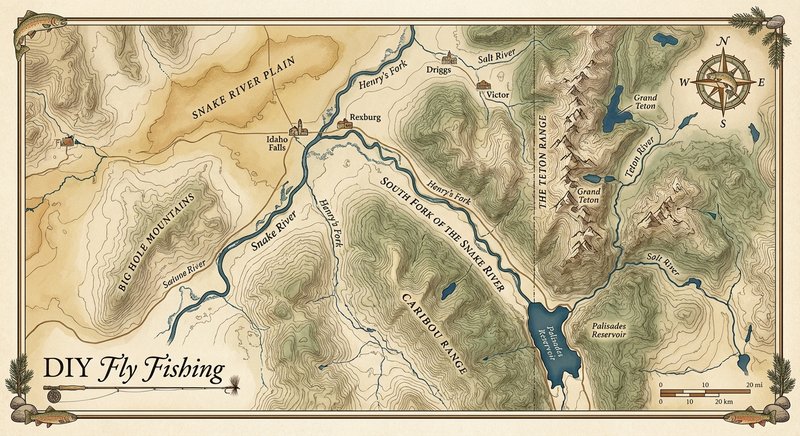
South Fork of the Snake River
Fly fishing in Idaho · Intermediate · Best seasons: Spring, Summer, Fall
Target Species
Cutthroat Trout, Rainbow Trout, Brown Trout
About This Water
One of the best cutthroat fisheries in the lower 48. Float fishing through scenic canyons with prolific hatches.
Fishing Recommendations
🎣 Fly Fishing Guide: The South Fork of the Snake River, Idaho
The South Fork of the Snake River (SFSR) is arguably the crown jewel of Idaho fly fishing. Flowing out of Palisades Reservoir and winding through a stunning 60-mile stretch to its confluence with the Henry’s Fork, it is a high-volume, tailwater-influenced paradise. It is famous for its massive populations of native Yellowstone Cutthroat and its sheer diversity of water—ranging from deep canyon walls and braided riffles to massive foam eddies.
🎣 Location Overview
The South Fork is a powerhouse. It carries a large volume of water, making it primarily a drift boat fishery, though wading is possible during low-water periods in the early spring and late fall.
What makes it special is the braiding. The river splits into dozens of side channels, creating "micro-rivers" within the main stem. This provides endless habitat for trout. The scenery transitions from high-desert canyons to lush cottonwood bottoms, offering one of the most aesthetically pleasing floats in the Rocky Mountains.
🐟 Target Species & Behavior
- Yellowstone Cutthroat Trout: The native star of the show. They are known for their willingness to rise to large dry flies. They often hold in "soft" water, tight to the banks, and in the "foam lines" where the river carries bubbles and bugs.
- Brown Trout: The giants of the river. These are often found in the lower stretches and deep canyon pools. They are more aggressive and piscivorous (fish-eaters), often targeted with large streamers.
- Rainbow Trout: These are present throughout the system. They tend to hold in faster, oxygenated water and riffle corners. Note: There is currently a push to reduce Rainbow numbers to protect pure Cutthroat genetics.
📅 Best Times to Fish
Spring (April – June)
- Conditions: Pre-runoff can be excellent for Blue Winged Olives (BWOs) and Mother’s Day Caddis.
- The Window: Mid-April through May is prime for "midge and nymph" fishing before the reservoir begins its heavy summer release.
Summer (July – August)
- The Prime Time: This is the legendary Salmonfly hatch (late June to early July). Following the Salmonflies, you get Golden Stones, Yellow Sallies, and then the famous terrestrial season (grasshoppers).
- Time of Day: Early morning for streamers; 10:00 AM to 4:00 PM for the big dry fly action.
Fall (September – October)
- Conditions: The water levels drop, making the river more wade-friendly. The cottonwoods turn gold, and the Brown trout become aggressive as they prepare for the spawn.
- The Window: September is the best month for "Hopper-Dropper" rigs and Mahogany Duns.
🪰 Recommended Flies & Techniques
Top Fly Patterns
- Dry Flies: Chubby Chernobyl (Sizes 6-12, Orange, Purple, Gold), Water Walker, Parachute Adams (14-18), Stimulators, and Pink Alberts (Fall).
- Nymphs: Pat’s Rubber Legs (the "South Fork Special"), Zebra Midges (Red/Black), Frenchies, and Perdigons.
- Streamers: Sex Dungeon (White or Olive), Sparkle Minnow, and Gold Bead-Head Wooly Buggers.
Techniques
- The "South Fork Slap": When fishing big foam terrestrials or stoneflies, don't be afraid to let your fly land with a "splat." It gets the attention of hungry Cutthroats.
- Hopper-Dropper: The most effective way to cover water. Hang a weighted nymph 2-3 feet below a buoyant Chubby Chernobyl.
- The Swing: In the Fall, swinging streamers through deep runs can produce trophy-sized Browns.
💡 Pro Tips & Local Knowledge
- Fish the Foam: If you see a swirling eddy of foam, there is a trout under it. Cast into the foam and let it ride. The fish sit there with their mouths open like a conveyor belt.
- Don't Ignore the Side Channels: Many anglers stay in the main current. The most consistent Cutthroat fishing is often in the "willow-lined" side channels where the current is slower.
- The "Purple" Factor: For reasons unknown to science, South Fork fish love purple. A Purple Chubby or a Purple Haze often outfishes natural colors.
- Rowing Matters: Because of the high volume, a "heavy" oar is needed. Keeping the boat 30-40 feet from the bank and matching the speed of the bubbles is key to a natural drift.
⚠️ Important Information
Access Points
The river is divided into three main sections:
- Upper: Palisades Dam to Conant (Classic canyon water).
- Middle: Conant to Byington (The most braided and scenic).
- Lower: Byington to Lorenzo (Warm water, bigger Browns, slower current).
Regulations & Permits
- An Idaho Fishing License is required.
- The South Fork has specific regulations regarding Rainbow Trout. At certain times, there are no limits on Rainbows to encourage their removal and protect the Cutthroat. Always check the current Idaho Fish & Game Seasons/Rules.
Safety
- The South Fork is a powerful river. Life jackets are highly recommended, especially in the Canyon section.
- Watch out for "sweepers" (downed trees) in the narrow side channels; they can trap a boat quickly.
Bug Hatches & Matching Flies
| Hatch | Type | Peak months | Time of day | Hook sizes | Matching flies |
|---|---|---|---|---|---|
| Salmonfly Pteronarcys californica | stonefly | June, July | All day | #4-8 | Chubby Chernobyl (Orange) #6-10, Pat's Rubber Leg (Black/Orange) #4-8, Water Walker #6-8 |
| Golden Stonefly Hesperoperla pacifica | stonefly | June, July | Afternoon/Evening | #8-12 | Fluttering Stone #8-10, Golden Chubby Chernobyl #8-12, Iron Lotus #12-14 |
| Pale Morning Dun (PMD) Ephemerella excrucians | mayfly | July, August | Late Morning/Afternoon | #16-18 | Last Chance Cripple #16-18, Sparkle Dun #16-18, Split Case PMD #16-18 |
| Blue Winged Olive (BWO) Baetis | mayfly | April, May, September, October | Afternoon | #18-22 | BWO Sparkle Dun #18-22, RS2 (Grey or Olive) #20-22, Pheasant Tail #18-22 |
| Yellowstone Stonefly (Mutant) Claassenia sabulosa | stonefly | August, September | Evening/Night | #8-12 | Chernobyl Ant #8-10, Morning Mutant #10-12, Rubber Legged Stone #8-12 |
| Spotted Sedge Hydropsyche | caddis | June, July, August | Evening | #14-18 | Elk Hair Caddis (Tan) #14-16, LaFontaine's Deep Sparkle Pupa #14-18, Iris Caddis #16-18 |
| Trico Tricorythodes | mayfly | August, September | Early Morning | #20-24 | Trico Spinner #20-24, Sunken Trico Spinner #20-22 |
| Grasshopper Acrididae | terrestrial | August, September | Late Morning/Afternoon | #8-12 | Morrish Hopper #8-12, Rainy's Grand Hopper #10-12, Thunder Thighs Hopper #10-12 |
| Mahogany Dun Paraleptophlebia | mayfly | September, October | Afternoon | #16-18 | Mahogany Sparkle Dun #16-18, Mahogany Cripple #16-18 |
| Zebra Midge Chironomidae | midge | March, April, October, November | All day | #18-24 | Zebra Midge (Black/Silver) #18-22, Griffith's Gnat #20-22, Mother's Day Midge #20-24 |